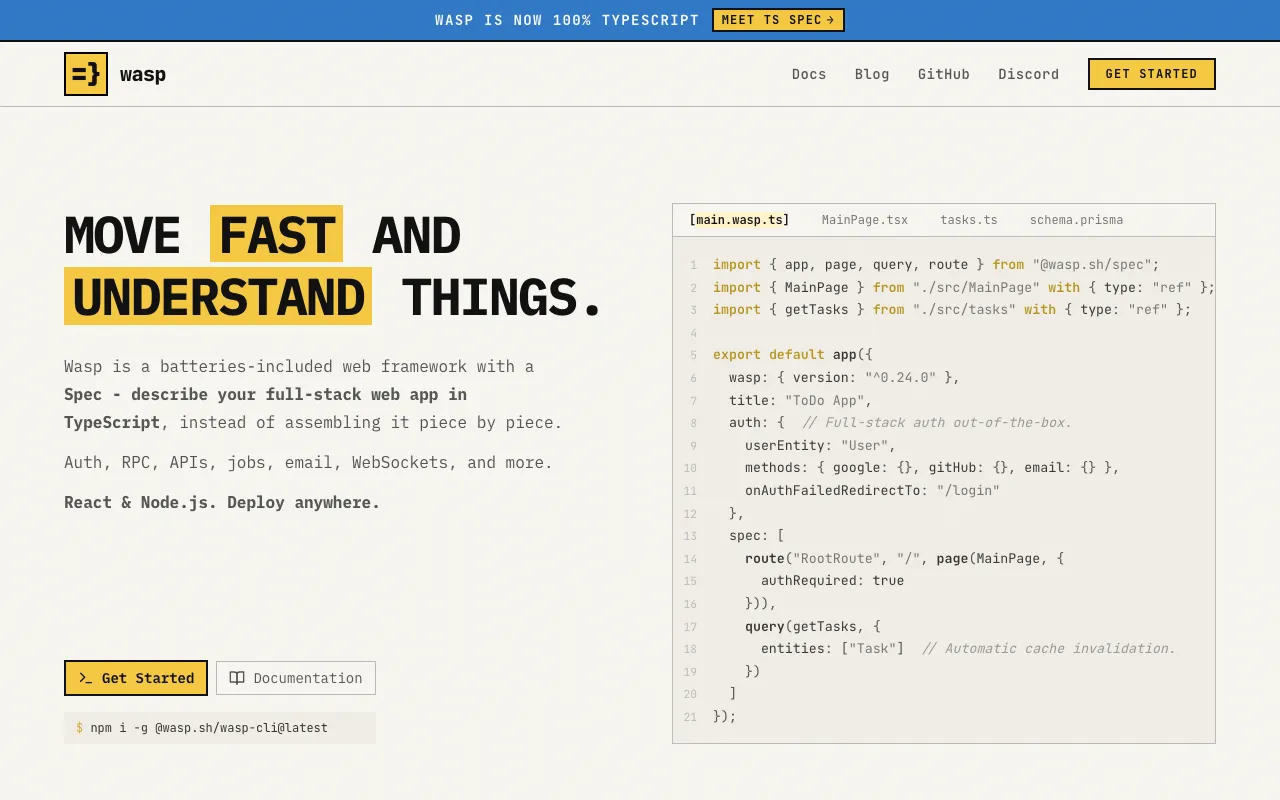
Wasp describes React, Node.js, and Prisma apps in a high-level spec and generates the stack. Built-in auth, RPC, jobs, email, and deploy commands reduce boilerplate.
Overview
Wasp (Web Application Specification) is a framework in the Rails mold for JavaScript and TypeScript stacks. You declare routes, pages, auth, queries, and jobs in a main specification file, then implement custom logic in React and server TypeScript while Prisma models the database.
A compiler expands the spec into front-end, back-end, and deployment assets for React with TanStack Query, Express on Node, and Prisma. Opinionated defaults cover authentication methods, type-safe client-server calls, background jobs, and email sending without wiring each piece by hand.
Projects deploy to infrastructure you choose; generated code lives in a transparent output directory so you are not tied to a single vendor. The CLI supports create, build, and deploy flows, and the project documents agent-oriented plugins for AI-assisted coding tools.
Wasp is in beta with a fixed stack focus today. The team positions the declarative spec as helpful structure for both human developers and coding agents managing full-stack features.
Key features
- TypeScript app specification layer
- React and Node.js code generation
- Prisma database integration
- Built-in authentication flows
- Type-safe RPC operations
- Background jobs and cron
- Email sending integration
- Single-command deployment workflow
Use cases
- Full-stack SaaS prototypes
- Internal admin dashboards
- CRUD web applications
- AI-assisted app scaffolding
- Teams wanting less boilerplate




 Ionic Enterprise


