
TensorFlow
End-to-end machine learning platform and tooling ecosystem
TensorFlow is a machine learning platform with Python and C++ APIs, optional GPU packages, and companion libraries for data, training, deployment, and visualization.
Tokenizer-free multilingual text-to-speech model
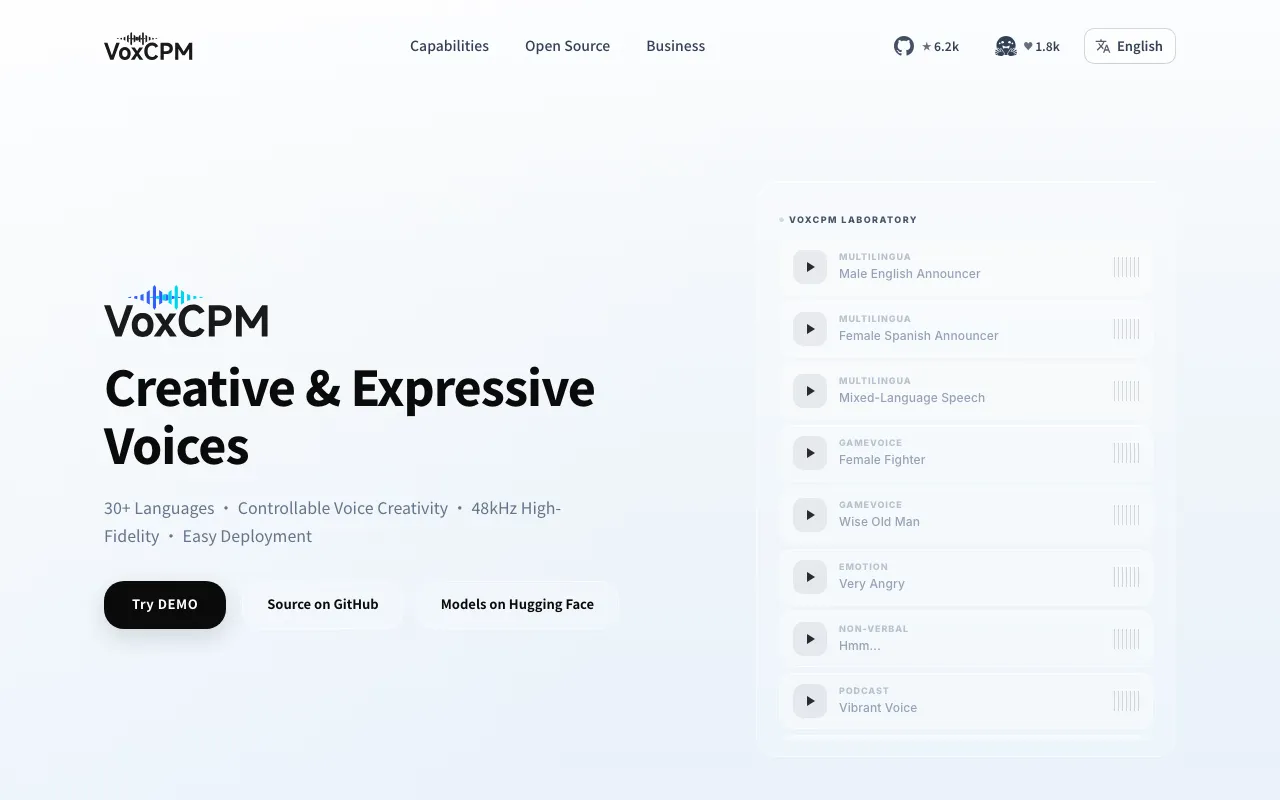
VoxCPM generates speech via an end-to-end diffusion autoregressive design without discrete speech tokens. VoxCPM2 adds voice design, controllable cloning, and 48 kHz output.
VoxCPM is a text-to-speech stack that predicts continuous speech representations directly, aiming for natural prosody without a conventional speech tokenizer. VoxCPM2 extends the line with a larger backbone trained on broad multilingual speech, supporting dozens of languages plus several Chinese dialects.
Users can synthesize from text alone, design a new voice from a natural-language description, clone timbre from a short clip with optional style guidance, or continue from reference audio plus transcript for fine-grained cloning. Output is 48 kHz studio-quality audio from 16 kHz references using an asymmetric audio VAE pipeline with built-in super-resolution.
Interfaces include a Python API, command-line usage, a web demo, FastAPI serving, vLLM-Omni for multi-tenant production, and llama.cpp-omni GGUF weights for on-device CPU, Metal, CUDA, or Vulkan inference. Weights and code are released under Apache-2.0 with commercial use permitted.
Fine-tuning with SFT or LoRA is supported across documented model generations, with published benchmark tables comparing zero-shot quality to other open and closed systems.
End-to-end machine learning platform and tooling ecosystem
TensorFlow is a machine learning platform with Python and C++ APIs, optional GPU packages, and companion libraries for data, training, deployment, and visualization.

Shared model definitions for multimodal ML workloads
Transformers is a Python library that defines pretrained text, vision, audio, and multimodal models once in PyTorch for shared inference and training across the ecosystem.

Open-source RAG engine and agent context platform
RAGFlow ingests heterogeneous documents, builds retrievable knowledge, and supports agent workflows with citations. It can run on your own hardware with Docker or a from-source server stack.

Local LLM context compression library and proxy
Headroom shrinks tool outputs, logs, JSON, and chat history before LLM calls to cut input tokens while preserving retrievable originals. It offers a Python library, proxy, MCP tools, and agent wrappers.

Local desktop workspace to run and fine-tune AI models
Unsloth is a desktop application to chat with, fine-tune, and serve LLMs, diffusion, audio, and embedding models on your own hardware with optional agent integrations.
TensorFlow reference models and modeling utilities collection
The TensorFlow Model Garden hosts implementations of models and modeling solutions for TensorFlow, installable via pip as tf-models-official.