
TensorFlow
End-to-end machine learning platform and tooling ecosystem
TensorFlow is a machine learning platform with Python and C++ APIs, optional GPU packages, and companion libraries for data, training, deployment, and visualization.

Local LLM context compression library and proxy
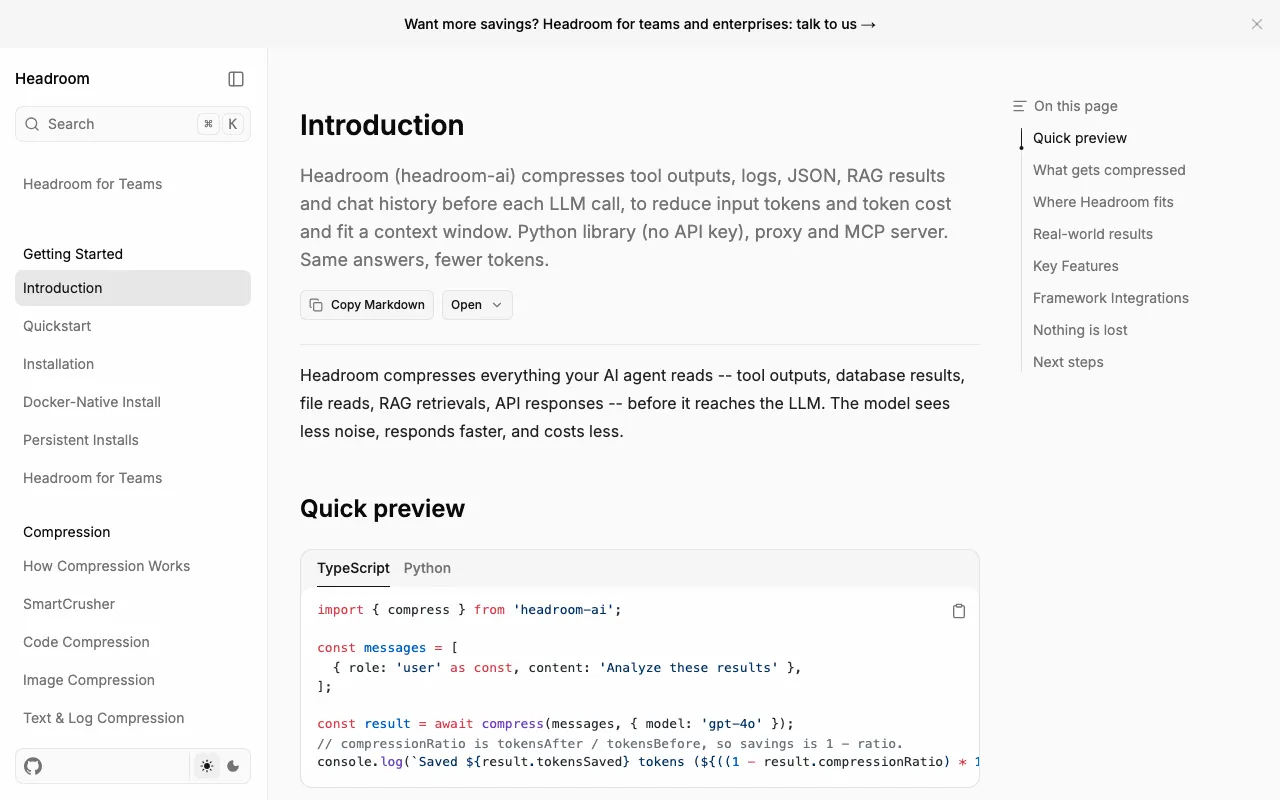
Headroom shrinks tool outputs, logs, JSON, and chat history before LLM calls to cut input tokens while preserving retrievable originals. It offers a Python library, proxy, MCP tools, and agent wrappers.
Headroom intercepts bulky agent payloads—search results, API JSON, build logs, RAG chunks, and file reads—and compresses them on the user’s machine before they reach the model. Documented benchmarks report substantial token reductions on repetitive structured data and moderate savings on realistic agent scenarios, with compression latency measured in sub-millisecond to low-millisecond ranges for large JSON.
A compress function works in-process in Python and TypeScript. A local proxy rewrites traffic for OpenAI-compatible and Anthropic endpoints with no application code changes. The headroom wrap command launches supported coding agents through that proxy; headroom unwrap restores prior configuration. MCP tools expose compress, retrieve, and stats operations, and compress-cache-retrieve storage lets models fetch full originals when needed.
Content routing picks compressors for JSON, code, prose, and logs. Optional features include cross-agent memory, failure learning into project instruction files, cache-aware prefix handling, and output verbosity shaping on supported APIs. Install paths include PyPI, npm for the TypeScript SDK, and persistent proxy deployment commands.
End-to-end machine learning platform and tooling ecosystem
TensorFlow is a machine learning platform with Python and C++ APIs, optional GPU packages, and companion libraries for data, training, deployment, and visualization.

Shared model definitions for multimodal ML workloads
Transformers is a Python library that defines pretrained text, vision, audio, and multimodal models once in PyTorch for shared inference and training across the ecosystem.

Open-source RAG engine and agent context platform
RAGFlow ingests heterogeneous documents, builds retrievable knowledge, and supports agent workflows with citations. It can run on your own hardware with Docker or a from-source server stack.

Local desktop workspace to run and fine-tune AI models
Unsloth is a desktop application to chat with, fine-tune, and serve LLMs, diffusion, audio, and embedding models on your own hardware with optional agent integrations.

TensorFlow reference models and modeling utilities collection
The TensorFlow Model Garden hosts implementations of models and modeling solutions for TensorFlow, installable via pip as tf-models-official.

Unified fine-tuning toolkit for LLMs and multimodal models
LLaMA Factory is a platform to fine-tune large language and vision-language models through CLI or a web board. It bundles many training algorithms, quantization options, and inference backends.