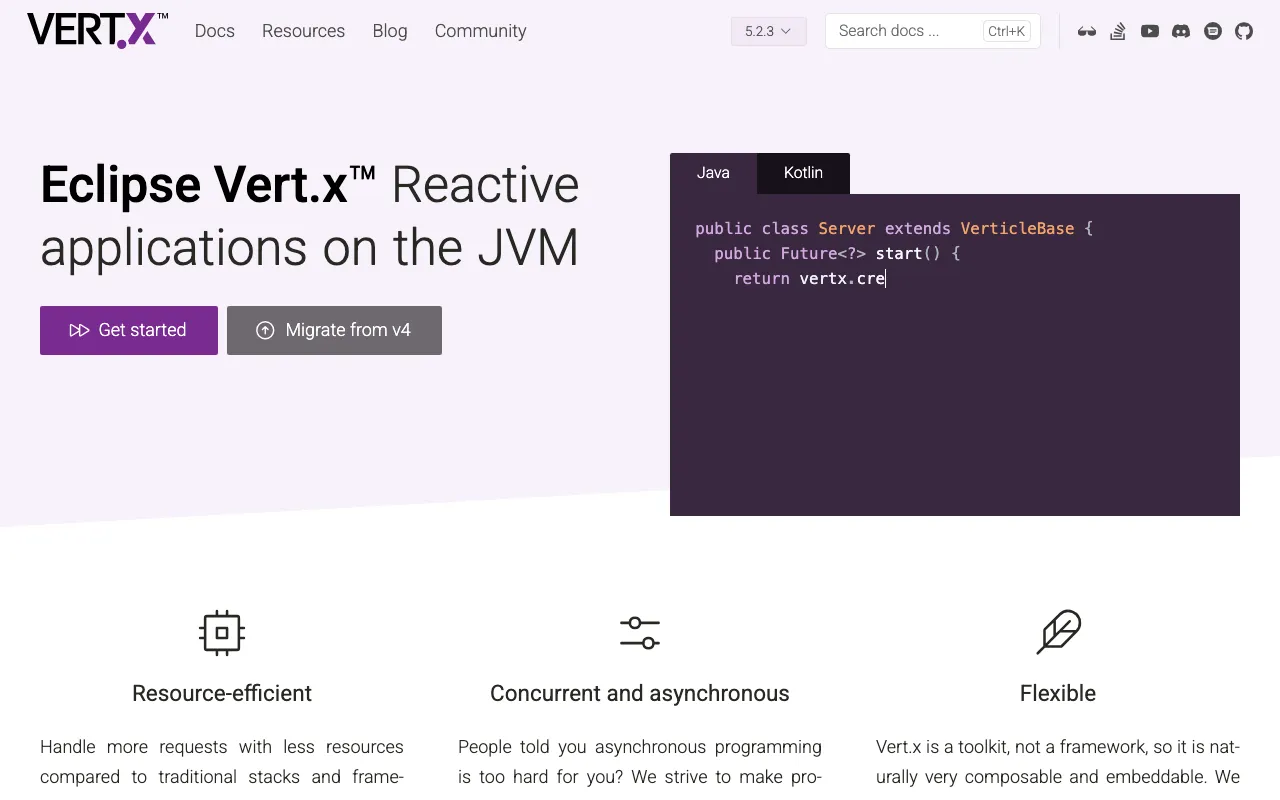
Eclipse Vert.x is a JVM toolkit for building reactive applications with non-blocking I/O. Vert.x core supplies HTTP, TCP, file access, and related low-level features.
Overview
Eclipse Vert.x targets developers who want reactive applications on the JVM. The core module provides foundational capabilities such as HTTP servers, TCP networking, filesystem access, and other building blocks that other Vert.x components and user applications rely on.
Vert.x works as a toolkit rather than a prescriptive application framework, so you can compose modules and clients as needed. Programming models include callbacks, promises, futures, reactive extensions, and Kotlin coroutines. The stack is resource-efficient for constrained environments such as virtual machines and containers.
An ecosystem of modules covers web APIs, databases, messaging, event streams, cloud integration, registries, and security clients. Example starter code shows HTTP servers in Java and Kotlin that listen on a port and return plain-text responses.
Vert.x core supports native transport on BSD and Linux, and domain sockets on Linux. Documentation and learning material include a book on reactive JVM development patterns.
Key features
- Non-blocking HTTP and TCP
- Composable toolkit modules
- Multiple async programming styles
- Kotlin and Java APIs
- File system access
- Reactive client ecosystem
- Native transport on Linux and BSD
- Embeddable architecture
Use cases
- Reactive HTTP microservices
- Event-driven JVM backends
- High-concurrency network services
- Container-friendly server workloads




 Ionic Enterprise


