
TensorFlow
End-to-end machine learning platform and tooling ecosystem
TensorFlow is a machine learning platform with Python and C++ APIs, optional GPU packages, and companion libraries for data, training, deployment, and visualization.
Python GPU language for custom deep-learning kernels
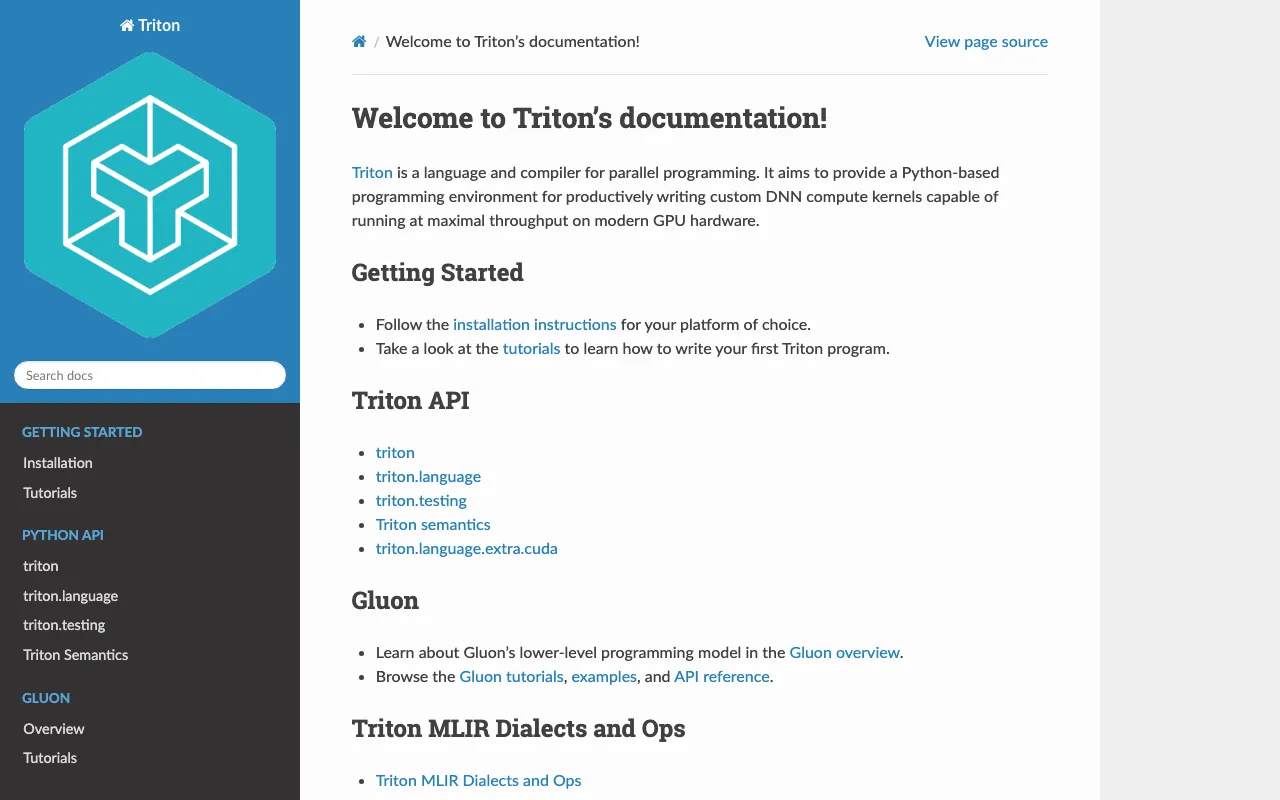
Triton is a language and compiler for writing efficient deep-learning primitives in Python, installable from pip with GPU backends for NVIDIA and AMD.
Triton provides a programming environment to author custom deep neural network compute kernels with higher-level productivity than raw CUDA while remaining flexible compared with some domain-specific alternatives. It includes a compiler pipeline built on MLIR and LLVM targeting modern GPUs.
Stable releases install from pip with prebuilt wheels for supported CPython versions. Documentation covers tutorials, Python APIs, language semantics, and lower-level MLIR dialect references, plus an interpreter mode that can run kernels without a GPU for learning and debugging.
The project supports NVIDIA GPUs above a stated compute capability threshold and AMD GPUs on recent ROCm releases, with CPU support described as under development. Linux is listed among supported platforms for deployment and development containers exist for consistent environments.
Kernels can include patterns such as back-to-back matrix multiplies used in attention-style workloads. Extensive environment variables and knobs expose compiler debugging, autotuning output, caching, and override hooks for advanced development.
End-to-end machine learning platform and tooling ecosystem
TensorFlow is a machine learning platform with Python and C++ APIs, optional GPU packages, and companion libraries for data, training, deployment, and visualization.

Shared model definitions for multimodal ML workloads
Transformers is a Python library that defines pretrained text, vision, audio, and multimodal models once in PyTorch for shared inference and training across the ecosystem.
Open-source RAG engine and agent context platform
RAGFlow ingests heterogeneous documents, builds retrievable knowledge, and supports agent workflows with citations. It can run on your own hardware with Docker or a from-source server stack.

Local LLM context compression library and proxy
Headroom shrinks tool outputs, logs, JSON, and chat history before LLM calls to cut input tokens while preserving retrievable originals. It offers a Python library, proxy, MCP tools, and agent wrappers.

Local desktop workspace to run and fine-tune AI models
Unsloth is a desktop application to chat with, fine-tune, and serve LLMs, diffusion, audio, and embedding models on your own hardware with optional agent integrations.
TensorFlow reference models and modeling utilities collection
The TensorFlow Model Garden hosts implementations of models and modeling solutions for TensorFlow, installable via pip as tf-models-official.