
TensorFlow
End-to-end machine learning platform and tooling ecosystem
TensorFlow is a machine learning platform with Python and C++ APIs, optional GPU packages, and companion libraries for data, training, deployment, and visualization.

Fast NLP tokenization library for research and production
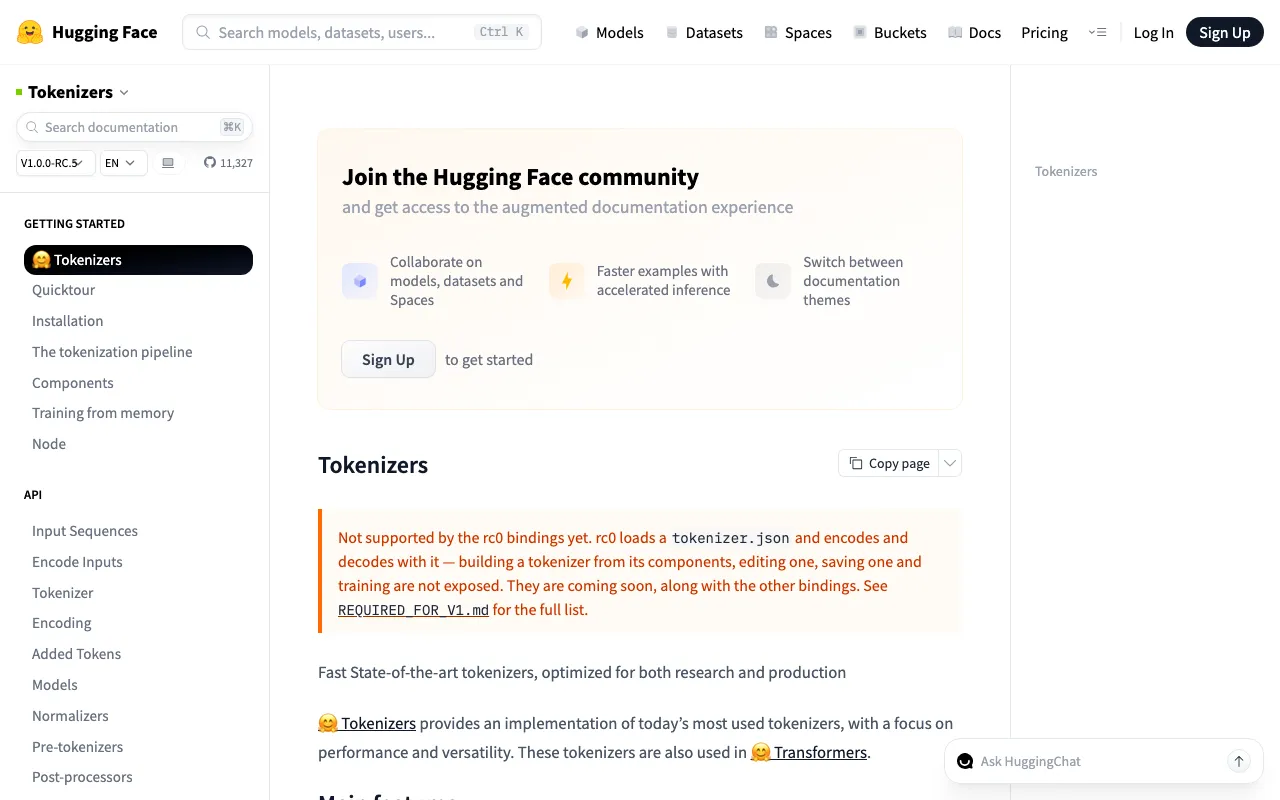
Hugging Face Tokenizers implements common subword tokenizers in Rust with Python and JavaScript bindings for training and high-speed encode and decode.
Tokenizers is a tokenizer engine aimed at natural language processing workflows that need fast, consistent text-to-id conversion for models such as BERT and GPT-style architectures. The Rust core loads a tokenizer.json configuration, compiles it into an inference pipeline, and exposes encode and decode operations with optional training and Hub download features.
The library supports widely used algorithms including BPE, Unigram, WordPiece, and WordLevel, with modular crates for inference, serialization, legacy conversion, and training. Documentation highlights alignment tracking so tokens can be mapped back to source text even after normalization, plus truncation, padding, and special-token handling in the pipeline.
Bindings listed as available include Rust, Python, Node.js, and WebAssembly via tokenizers-wasm on npm, with additional language bindings described as planned. Performance materials claim very fast tokenization on server CPUs and describe hardware-adaptive paths for aarch64 and x86_64 with scalar fallbacks.
The project is used alongside Hugging Face Transformers and is moving toward a v1 release that restores training APIs, batch encoding with zero-copy views, component editing, and saving trained tokenizers to disk.
End-to-end machine learning platform and tooling ecosystem
TensorFlow is a machine learning platform with Python and C++ APIs, optional GPU packages, and companion libraries for data, training, deployment, and visualization.

Shared model definitions for multimodal ML workloads
Transformers is a Python library that defines pretrained text, vision, audio, and multimodal models once in PyTorch for shared inference and training across the ecosystem.

Open-source RAG engine and agent context platform
RAGFlow ingests heterogeneous documents, builds retrievable knowledge, and supports agent workflows with citations. It can run on your own hardware with Docker or a from-source server stack.

Local LLM context compression library and proxy
Headroom shrinks tool outputs, logs, JSON, and chat history before LLM calls to cut input tokens while preserving retrievable originals. It offers a Python library, proxy, MCP tools, and agent wrappers.

Local desktop workspace to run and fine-tune AI models
Unsloth is a desktop application to chat with, fine-tune, and serve LLMs, diffusion, audio, and embedding models on your own hardware with optional agent integrations.

TensorFlow reference models and modeling utilities collection
The TensorFlow Model Garden hosts implementations of models and modeling solutions for TensorFlow, installable via pip as tf-models-official.