qmetrics.net

Titanium SDK

JavaScript cross-platform native mobile app SDK

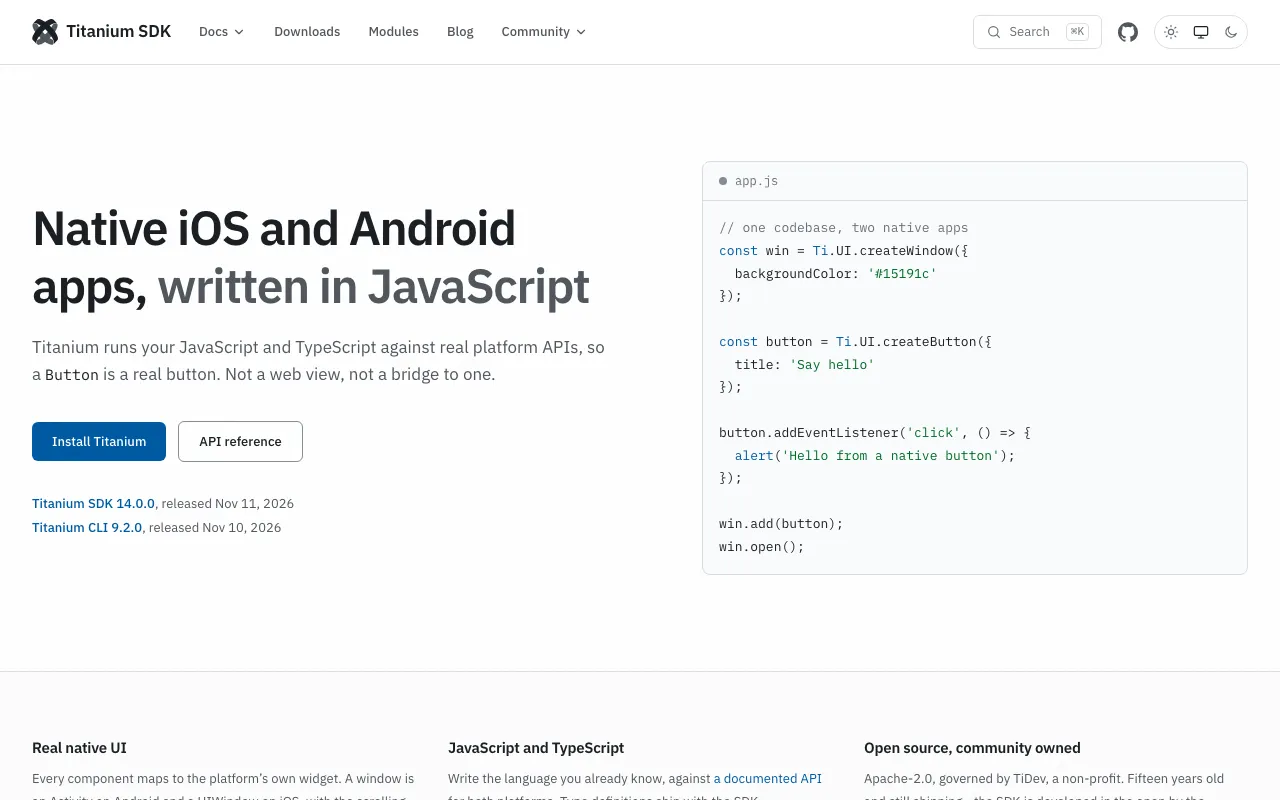
Titanium SDK screenshot

Titanium SDK compiles JavaScript or TypeScript into native iOS and Android apps with platform UI APIs, offline execution, and optional Alloy MVC.

Overview

Titanium SDK lets developers build fully native mobile applications for iOS and Android using JavaScript or TypeScript. Application code is compiled into native executables per platform rather than running inside a hybrid WebView shell. UI components map to real platform widgets on each OS.

The documented API covers native controls, databases, geolocation, camera, calendar, contacts, maps, push notifications, filesystem access, gestures, web views, and many other device capabilities. Apps are compiled to run locally with offline support. Extensions include the Module API, Hyperloop for calling native APIs and third-party libraries directly from JavaScript, and Swift Package Manager dependency declarations for iOS modules.

Alloy is an optional MVC layer on top of the SDK with XML views, JavaScript controllers, and stylesheets compiled down to Titanium calls. Workflow centers on the Titanium CLI and npm-installed tooling to install the SDK, scaffold projects, and build for emulators or devices.

TiDev, a non-profit, governs the open Apache-licensed project with community contributions. Titanium is positioned for teams that want one JavaScript codebase driving two native mobile targets without embedding a web UI for core interactions.

Key features

  • Native iOS and Android targets
  • JavaScript and TypeScript source
  • Platform-native UI components
  • Offline native app binaries
  • Hyperloop native API access
  • Optional Alloy MVC structure
  • In-app SQL and filesystem APIs
  • Community modules ecosystem

Use cases

  • Cross-platform mobile products
  • Field apps with device APIs
  • Apps needing native UI widgets
  • Teams standardizing on JavaScript
  • watchOS-capable mobile stacks

Tags

Similar software

ECC

Open-source agent engineering toolkit for coding harnesses

ECC adds planning, verification, review, memory, skills, and security scanning to coding agents such as Claude Code, Codex, and Cursor. It installs as plugins, packages, and managed adapters across multiple harnesses.

★ 311.7k⟳ 8 days agoMIT
Frameworks & PlatformsDesktop/CLI app

React

JavaScript library for web and native user interfaces

React helps developers build interfaces from reusable components that manage their own state. Views update declaratively when underlying data changes.

★ 253k⟳ 2 days agoMIT
Frameworks & PlatformsDesktop/CLI app

Flutter

Open-source UI framework for multi-platform apps from one codebase

Flutter is an SDK for building user experiences for mobile, web, and desktop from a single codebase. It uses the Dart language and compiles to native machine code or web targets.

★ 181.5k⟳ todayBSD-3-Clause
Open Source Alternative to:Ionic Enterprise

Bootstrap

Responsive HTML, CSS, and JavaScript front-end toolkit

Bootstrap supplies CSS, JavaScript, and Sass-based styles for building responsive, mobile-first sites. It ships prebuilt grid layouts, UI components, and optional JavaScript plugins.

★ 175.1k⟳ 2 days agoMIT

Langflow

Visual low-code builder for AI agents and workflows

Langflow is a visual builder for AI agents and workflows. Flows can be customized in Python and deployed as an API or as an MCP server, with support for major LLMs and vector databases.

★ 157k⟳ todayMIT
Open Source Alternative to:Relevance AIVoiceflow

LangChain

Framework for agents and LLM-powered applications

LangChain helps developers chain interoperable components and integrations to build agents and LLM-powered applications. It offers a standard interface for models, embeddings, vector stores, and related pieces.

★ 150.1k⟳ 2 days agoMIT