qmetrics.net

Tailwind CSS

Utility-first CSS framework for markup-driven UI

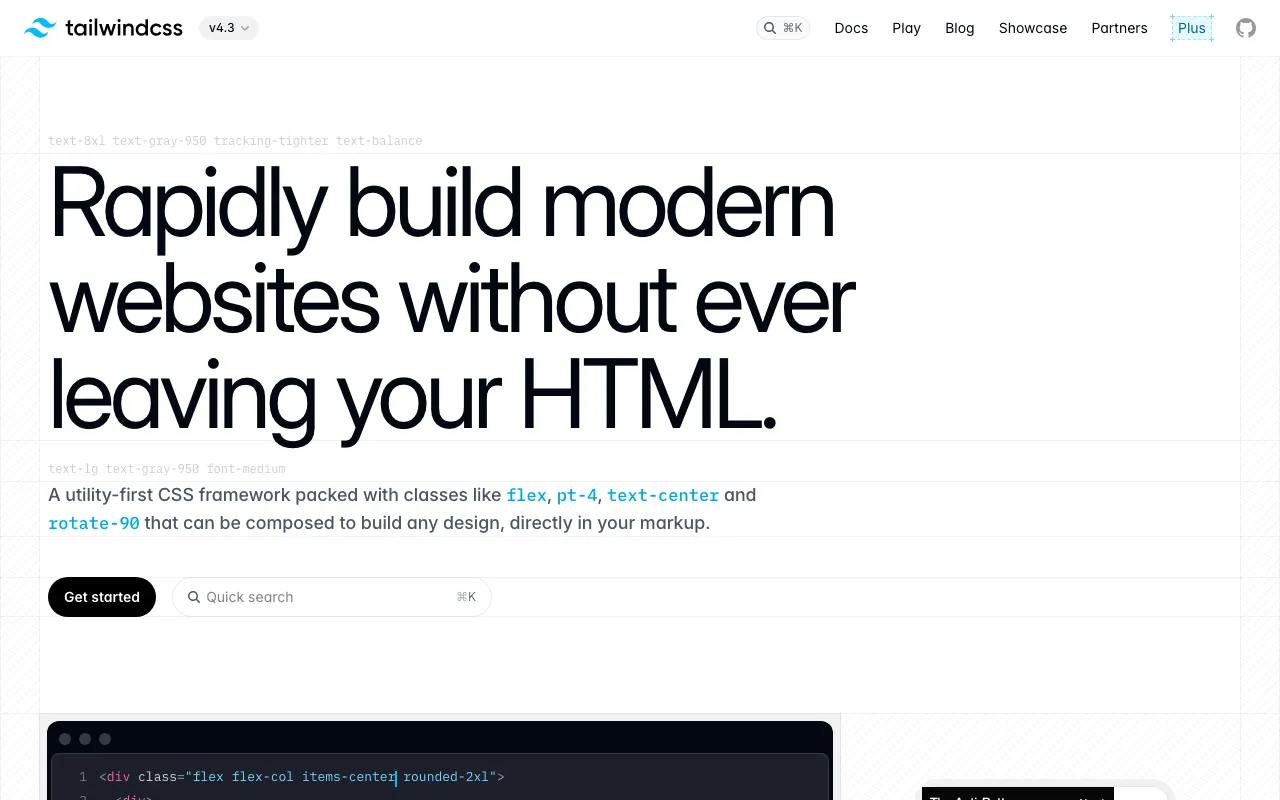
Tailwind CSS screenshot

Tailwind CSS supplies composable utility classes so teams style modern websites directly in HTML. Production builds strip unused rules to keep CSS bundles small.

Overview

Tailwind CSS is a utility-first CSS framework oriented toward rapid interface work in markup. Small class names for layout, spacing, typography, and effects combine in the HTML instead of growing custom stylesheets for every component.

Responsive behavior comes from breakpoint prefixes on utilities. Dark mode uses a parallel prefix on colors. Theme customization leans on CSS variables inside an at-theme block, and wide-gamut color steps ship as named palettes.

Layout and motion features include grid helpers, container queries on tagged parents, transition utilities, gradient classes, and three-dimensional transform utilities. Cascade layers separate theme, base, components, and utilities to reduce specificity clashes. Logical property utilities aim to simplify bidirectional text layouts.

When projects build for production, the toolchain drops unused utilities so the shipped stylesheet stays compact. Documentation, examples, and community discussion live on the project’s public site rather than inside a hosted application users log into.

Key features

  • Composable utility classes in HTML
  • Responsive breakpoint prefixes
  • Dark mode color variants
  • Theme tokens via CSS variables
  • Production purging of unused CSS
  • Grid and container query utilities
  • CSS cascade layers for structure
  • Logical properties for directionality

Use cases

  • Styling marketing and app UIs in HTML
  • Responsive layouts with utility prefixes
  • Theme tuning without large custom CSS files

Tags

Similar software

ECC

Open-source agent engineering toolkit for coding harnesses

ECC adds planning, verification, review, memory, skills, and security scanning to coding agents such as Claude Code, Codex, and Cursor. It installs as plugins, packages, and managed adapters across multiple harnesses.

★ 311.7k⟳ 8 days agoMIT
Frameworks & PlatformsDesktop/CLI app

React

JavaScript library for web and native user interfaces

React helps developers build interfaces from reusable components that manage their own state. Views update declaratively when underlying data changes.

★ 253k⟳ 2 days agoMIT
Frameworks & PlatformsDesktop/CLI app

Flutter

Open-source UI framework for multi-platform apps from one codebase

Flutter is an SDK for building user experiences for mobile, web, and desktop from a single codebase. It uses the Dart language and compiles to native machine code or web targets.

★ 181.5k⟳ todayBSD-3-Clause
Open Source Alternative to:Ionic Enterprise

Bootstrap

Responsive HTML, CSS, and JavaScript front-end toolkit

Bootstrap supplies CSS, JavaScript, and Sass-based styles for building responsive, mobile-first sites. It ships prebuilt grid layouts, UI components, and optional JavaScript plugins.

★ 175.1k⟳ 2 days agoMIT

Langflow

Visual low-code builder for AI agents and workflows

Langflow is a visual builder for AI agents and workflows. Flows can be customized in Python and deployed as an API or as an MCP server, with support for major LLMs and vector databases.

★ 157k⟳ todayMIT
Open Source Alternative to:Relevance AIVoiceflow

LangChain

Framework for agents and LLM-powered applications

LangChain helps developers chain interoperable components and integrations to build agents and LLM-powered applications. It offers a standard interface for models, embeddings, vector stores, and related pieces.

★ 150.1k⟳ 2 days agoMIT






