Core Linux building blocks centered on an init and service manager that runs as PID 1 and starts the rest of the system.
Overview
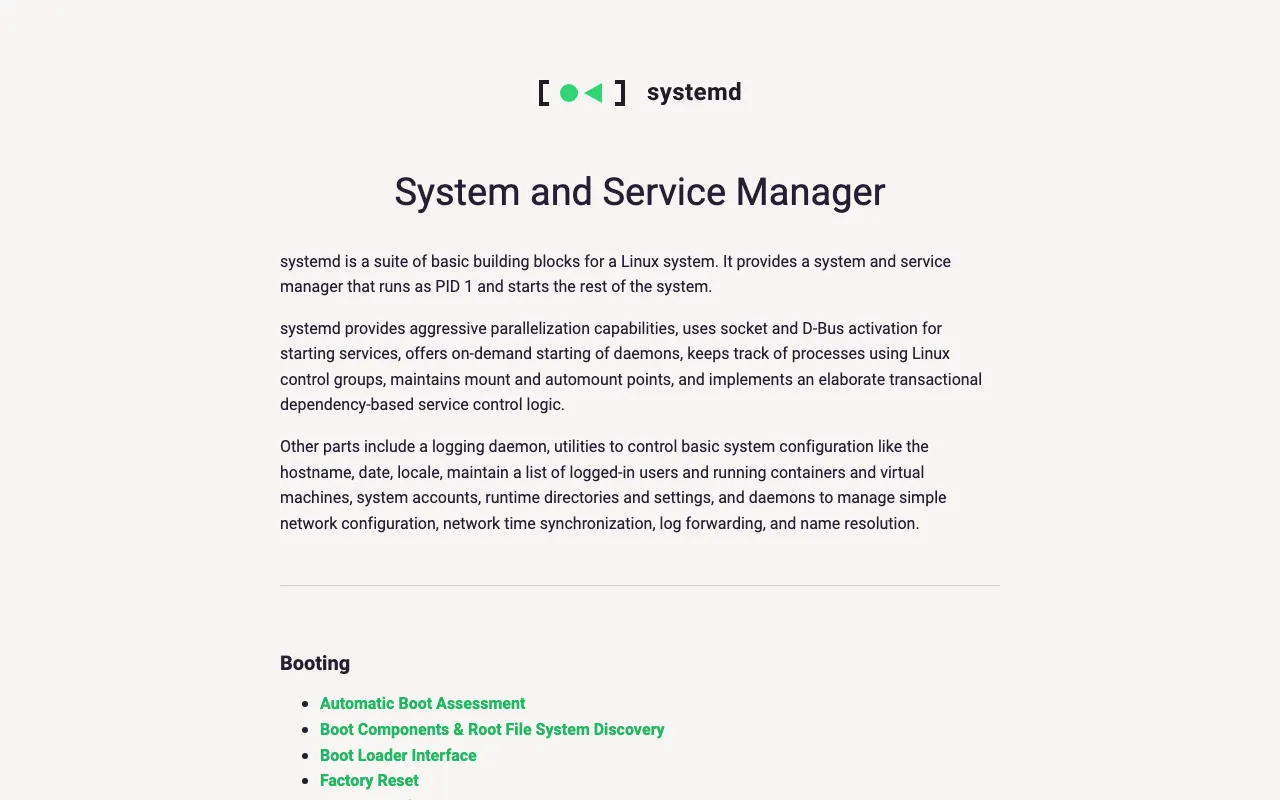
systemd is a suite of basic building blocks for Linux. Its system and service manager runs as PID 1 and is responsible for booting and supervising the rest of the system. Capabilities include parallel startup, socket and D-Bus activation, on-demand daemons, cgroup tracking, mount and automount handling, and dependency-based unit control.
Beyond init, the suite includes a logging daemon, tools to manage hostname, locale, time, logged-in users, containers and virtual machines, system accounts, runtime directories, and simple network configuration helpers. Additional daemons handle network time sync, log forwarding, and name resolution.
Administrators interact through unit files, systemctl, journalctl, and related interfaces covered in manuals for users and developers. Topics include compatibility with SysV init, portable services, homed user records, and boot loader integration such as systemd-boot.
Support channels include mailing lists, IRC, Matrix, issue trackers, and distribution-specific packages.
Key features
- PID 1 service manager
- Socket and D-Bus activation
- Cgroup process tracking
- Transactional unit dependencies
- Central logging daemon
- Network and time daemons
- Mount and automount management
- User and session tracking
Use cases
- Linux service lifecycle management
- Boot and dependency-ordered startup
- Centralized system logging
- Container and VM host integration
- Network and resolver configuration