
Lima
Linux virtual machines with container tooling
Lima starts Linux VMs with shared files and forwarded ports, aimed at running containerd, Docker, Podman, or Kubernetes on macOS and other hosts.
Open Source Alternative to:OrbStack

Secure lightweight microVM monitor for serverless workloads
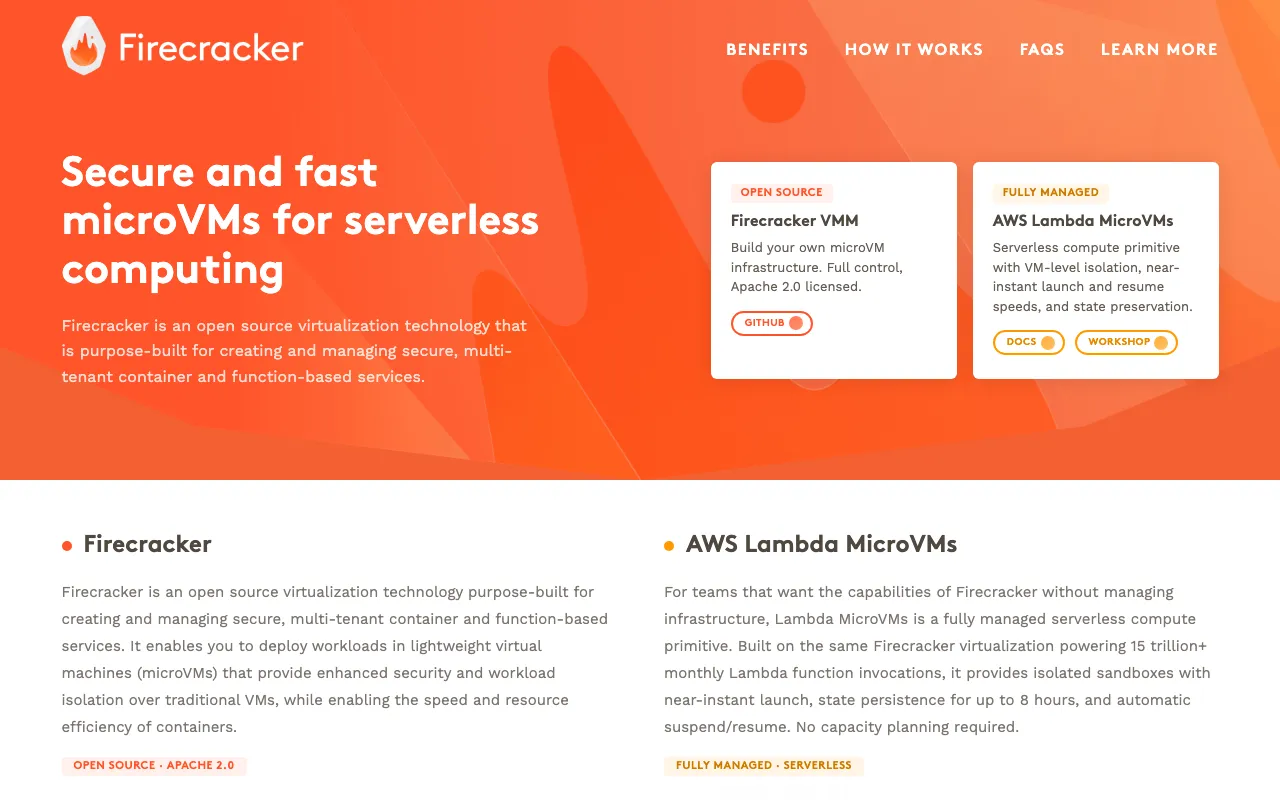
Firecracker is a virtualization stack for running container and function workloads in microVMs. It pairs hardware isolation with low overhead for multi-tenant serverless-style hosting.
Firecracker targets secure, multi-tenant execution of container and function workloads with minimal overhead. Workloads run inside lightweight virtual machines called microVMs that aim to combine KVM-style isolation with container-like startup and density.
The core is a virtual machine monitor that uses Linux KVM to create and run microVMs, with an optional path to run guests as Nitro Sandboxes on AWS instead of KVM. The design strips non-essential devices and guest-facing features to shrink memory use and attack surface, which also supports faster boot and higher utilization on a host.
Operators control each microVM through a REST API specified in OpenAPI. Typical actions include sizing vCPUs and memory, attaching network interfaces and file-backed block devices, rate-limiting virtio devices, configuring logging and metrics, and booting from a chosen kernel and root filesystem. A jailer companion process can add cgroup and namespace isolation and drop privileges in production setups.
Firecracker was created at Amazon Web Services for services such as Lambda and Fargate, and integrates with container ecosystems including Kata Containers and Flintlock. On 64-bit Intel, AMD, and Arm hosts with hardware virtualization, it is positioned as a focused alternative to general-purpose VMMs such as QEMU for serverless functions and containers.
Linux virtual machines with container tooling
Lima starts Linux VMs with shared files and forwarded ports, aimed at running containerd, Docker, Podman, or Kubernetes on macOS and other hosts.

Linux system and service manager suite
Core Linux building blocks centered on an init and service manager that runs as PID 1 and starts the rest of the system.
iPXE menu for network booting installers and live systems
netboot.xyz is an iPXE-based bootloader that lists OS installers, live distros, and utilities fetched over the network. Boot from USB, ISO, PXE, or EFI without curating local install media.

OCI-native Kubernetes container runtime daemon
CRI-O implements the Kubernetes Container Runtime Interface using OCI-compliant runtimes. It lets the kubelet launch and manage standard container images on cluster nodes.
Core operating system kernel for Linux systems
The Linux kernel is the core of any Linux operating system. It manages hardware, system resources, and provides fundamental services for other software.

Open-source container scheduling and management system
Kubernetes (K8s) manages containerized applications across many hosts. It automates deployment, scaling, and ongoing operations for grouped containers.