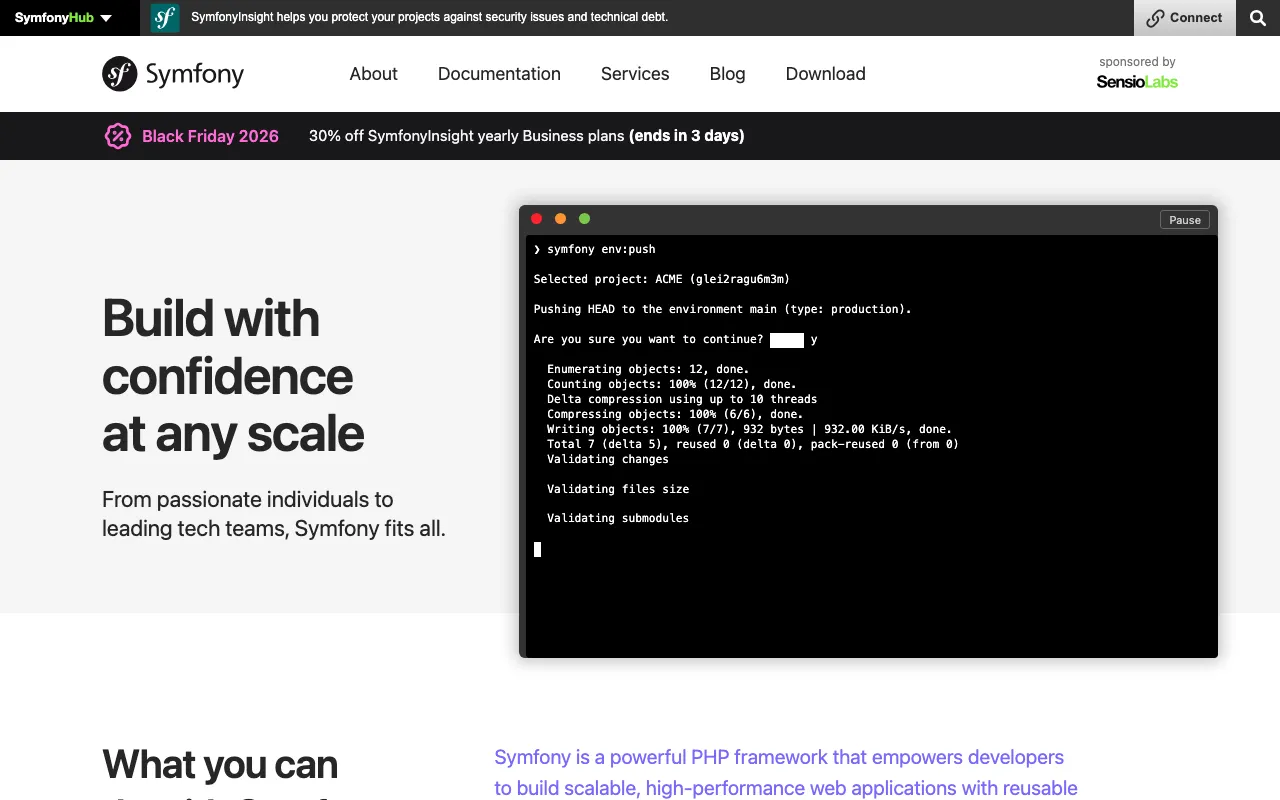
Symfony offers a full-stack PHP framework plus standalone components for web apps, APIs, microservices, and console tools.
Overview
Symfony is a PHP framework for building web applications, HTTP APIs, microservices, and command-line programs. As a full-stack framework it bundles routing, security, templating, ORM integration, validation, mail, and testing utilities.
Symfony Console underpins CLI applications and developer workflows from code generation through deployment. Symfony Components are modular PHP libraries reused by projects such as Drupal, Laravel, API Platform, and Composer itself.
API Platform and Symfony UX extend the stack for API design and interface patterns with Turbo and Stimulus. A reference demo application illustrates official best practices for structuring Symfony projects.
The ecosystem includes long-term support releases, documented security processes, predictable release cadence, training, and hosted offerings such as SymfonyCloud. The demo app can run via Symfony CLI, a conventional web server, or PHP’s built-in development server.
Key features
- Full-stack web application building blocks
- Symfony Console for CLI apps
- Reusable Symfony Components
- API Platform and Symfony UX integration
- Security, routing, and validation stack
- Long-term support release track
- Reference demo application
- MIT-licensed open-source core
Use cases
- Enterprise PHP web applications
- HTTP APIs and microservices
- Custom console automation tools
- Learning Symfony best practices via demo




 Ionic Enterprise


