qmetrics.net

Stormkit

Self-hosted web app deployment and platform stack

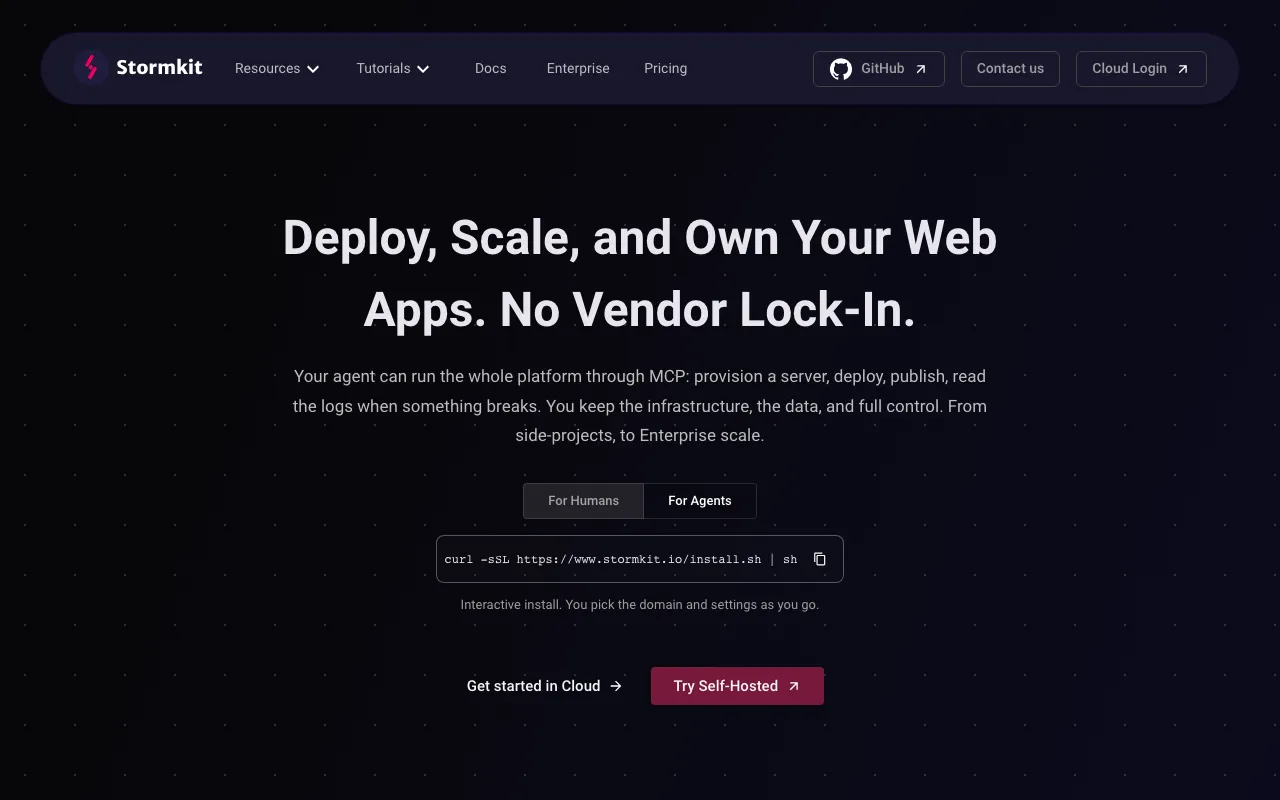
Stormkit screenshot

Stormkit deploys modern web applications with git-driven CI/CD, previews, databases, auth, email, cron, and analytics on infrastructure you control. It offers a managed cloud option or full self-hosted operation.

Overview

Stormkit is a self-hostable application platform for the web. It combines automated deployments from git pushes, UI uploads, zip files, or API calls with preview URLs per branch, environment-specific configuration, and status checks before publishing.

Beyond hosting, it can attach PostgreSQL with migrations on deploy, provide end-user authentication through email, password, magic links, and social providers, wire a transactional mailer to SMTP, run scheduled jobs without a separate cron host, and collect server-side analytics. Additional capabilities include volumes, serverless API routes and SSR, redirects, rewrites, custom headers, snippet injection, auth walls, and team roles.

Self-hosted operation runs on your own servers with Docker images, requiring PostgreSQL and Redis alongside the application. An agent-oriented install path can provision an instance over SSH, and the platform exposes MCP so coding agents can deploy and read logs. Stormkit Cloud provides the same feature set as a managed service when you do not want to operate the stack yourself.

Repository connections support GitHub, GitLab, and Bitbucket, with custom domains, automatic TLS, rolling updates, audit logs, and optional automated end-to-end tests after deployments. The project is open core, with community edition components under AGPL and commercially licensed enterprise pieces.

Key features

  • Git push deployments
  • Preview URL per branch
  • Managed PostgreSQL per environment
  • End-user authentication
  • SMTP transactional email
  • Scheduled job triggers
  • Server-side analytics
  • Custom domains with automatic TLS

Use cases

  • Self-hosted frontend and SSR apps
  • Teams needing preview environments
  • Infrastructure you own with CI/CD
  • Agent-driven deploy and operations

Open-source alternative to

Netlify
“Self-hostable alternative to Vercel/Netlify.” source
Vercel
“Self-hostable alternative to Vercel/Netlify.” source

Does the same job as

Stormkit doesn't name these products itself, but its own description shows it does the same job.

Tags

Compare Stormkit

Similar software

Coolify

Self-hostable PaaS for apps, databases, and one-click services

Coolify deploys static sites, databases, and full-stack apps on servers you control, with a dashboard similar to managed hosting platforms. Configurations stay on your machines over SSH.

★ 66.7k⟳ todayApache-2.0
Build & DeploymentSelf-hostable
Open Source Alternative to:HerokuNetlify+3

Dokploy

Self-hostable PaaS for apps and databases

Dokploy is a self-hostable platform-as-a-service for deploying applications and databases on your own VPS. It supports Docker, Compose, multi-server setups, backups, and monitoring.

★ 38.7k⟳ yesterdayApache-2.0
Build & DeploymentSelf-hostable
Open Source Alternative to:HerokuNetlify+3

Dokku

Docker-powered mini PaaS on your own hardware

Dokku is a small platform-as-a-service you install on a Linux VM. You push Git-based, Heroku-style apps that build with buildpacks and run in Docker containers.

★ 32.2k⟳ yesterdayMIT
Build & DeploymentSelf-hostable
Open Source Alternative to:HerokuNetlify+3

Colima

Minimal container runtimes on macOS and Linux

Colima launches Lima-based VMs with Docker, containerd, Kubernetes, or Incus so you can run containers locally on Mac or Linux with simple defaults and port forwarding.

★ 31.9k⟳ 1 month agoMIT
Build & DeploymentDesktop/CLI app
Open Source Alternative to:Docker Desktop

OpenTofu

Open-source infrastructure as code engine

OpenTofu is an open-source tool for building, changing, and versioning infrastructure safely. It manages popular cloud providers and custom in-house systems using declarative configuration.

★ 31k⟳ todayMPL-2.0
Build & DeploymentDesktop/CLI app
Open Source Alternative to:Terraform

Pulumi

Open-source infrastructure as code with familiar programming languages

Pulumi provisions and manages cloud resources through programs written in TypeScript, Python, Go, Java, and other languages. A CLI deploys stacks to AWS, Azure, Google Cloud, Kubernetes, and hundreds of providers.

★ 26k⟳ yesterdayApache-2.0
Build & DeploymentDesktop/CLI app
Open Source Alternative to:Terraform