 Heroku
 Netlify
 Vercel

Dokploy
Self-hostable PaaS for apps and databases
Dokploy is a self-hostable platform-as-a-service for deploying applications and databases on your own VPS. It supports Docker, Compose, multi-server setups, backups, and monitoring.

Self-hostable PaaS for apps, databases, and one-click services
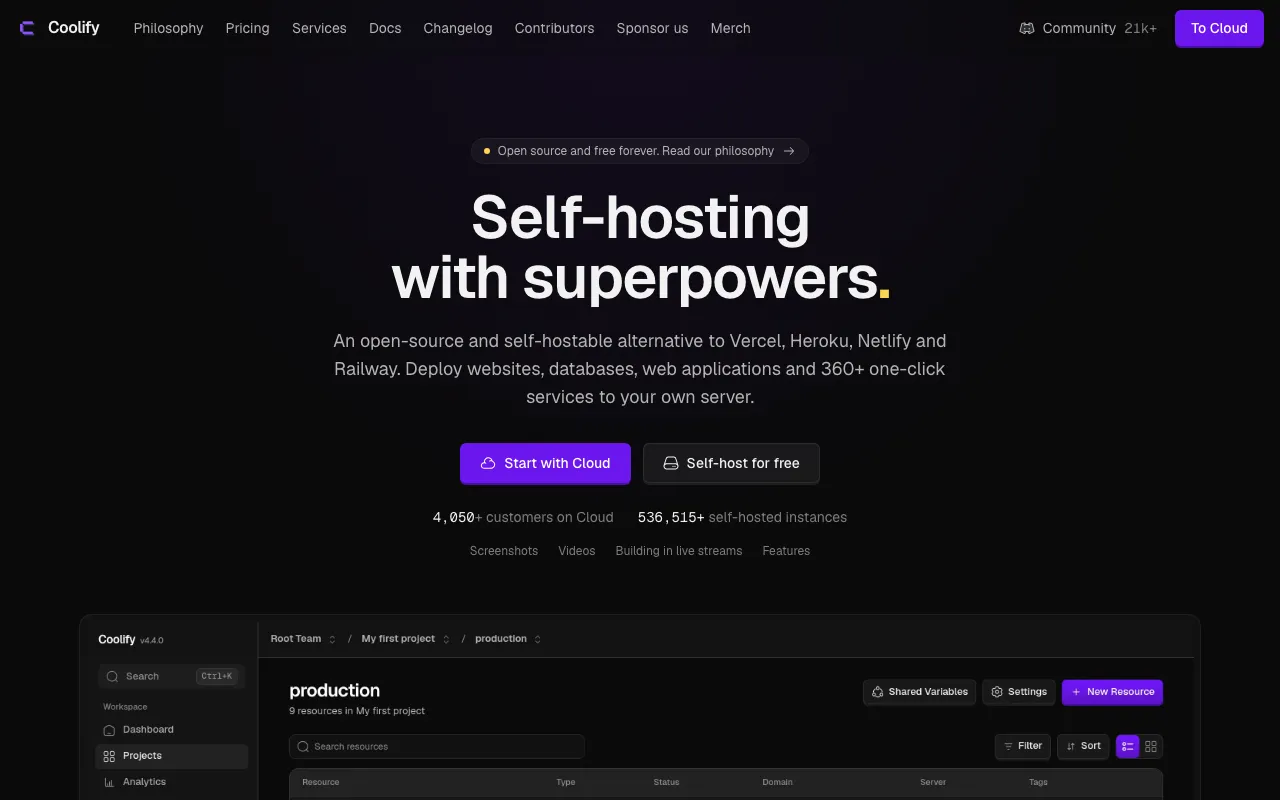
Coolify deploys static sites, databases, and full-stack apps on servers you control, with a dashboard similar to managed hosting platforms. Configurations stay on your machines over SSH.
Coolify is a self-hostable platform for deploying applications, databases, and services on your own servers. It targets VPS, bare metal, Raspberry Pi, or other Linux hosts and only requires SSH access to get started.
The dashboard covers projects, applications, domains, metrics, and notifications. You can deploy from GitHub, GitLab, Bitbucket, Gitea, or Docker images using Railpack, Dockerfiles, or Compose, with options for auto-deploy, pull request previews, webhooks, rolling updates, and rollbacks.
Networking features include a reverse proxy with automatic HTTPS, custom domains, and isolated Docker networks. You can run databases such as Postgres, MongoDB, and Redis, plus many one-click services, and manage unlimited servers or provision from supported providers.
Operations tooling covers scheduled backups, environment variables and secrets, real-time metrics and logs, a browser terminal, health checks, team access control, and a REST API, CLI, and MCP server for automation. An optional Coolify Cloud managed offering exists alongside the self-hosted edition.
Coolify doesn't name these products itself, but its own description shows it does the same job.
Self-hostable PaaS for apps and databases
Dokploy is a self-hostable platform-as-a-service for deploying applications and databases on your own VPS. It supports Docker, Compose, multi-server setups, backups, and monitoring.

Docker-powered mini PaaS on your own hardware
Dokku is a small platform-as-a-service you install on a Linux VM. You push Git-based, Heroku-style apps that build with buildpacks and run in Docker containers.

Minimal container runtimes on macOS and Linux
Colima launches Lima-based VMs with Docker, containerd, Kubernetes, or Incus so you can run containers locally on Mac or Linux with simple defaults and port forwarding.

Open-source infrastructure as code engine
OpenTofu is an open-source tool for building, changing, and versioning infrastructure safely. It manages popular cloud providers and custom in-house systems using declarative configuration.

Open-source infrastructure as code with familiar programming languages
Pulumi provisions and manages cloud resources through programs written in TypeScript, Python, Go, Java, and other languages. A CLI deploys stacks to AWS, Azure, Google Cloud, Kubernetes, and hundreds of providers.
Unified command-line interface for AWS
The AWS CLI provides one terminal interface to configure credentials and call Amazon Web Services APIs from scripts and interactive use.