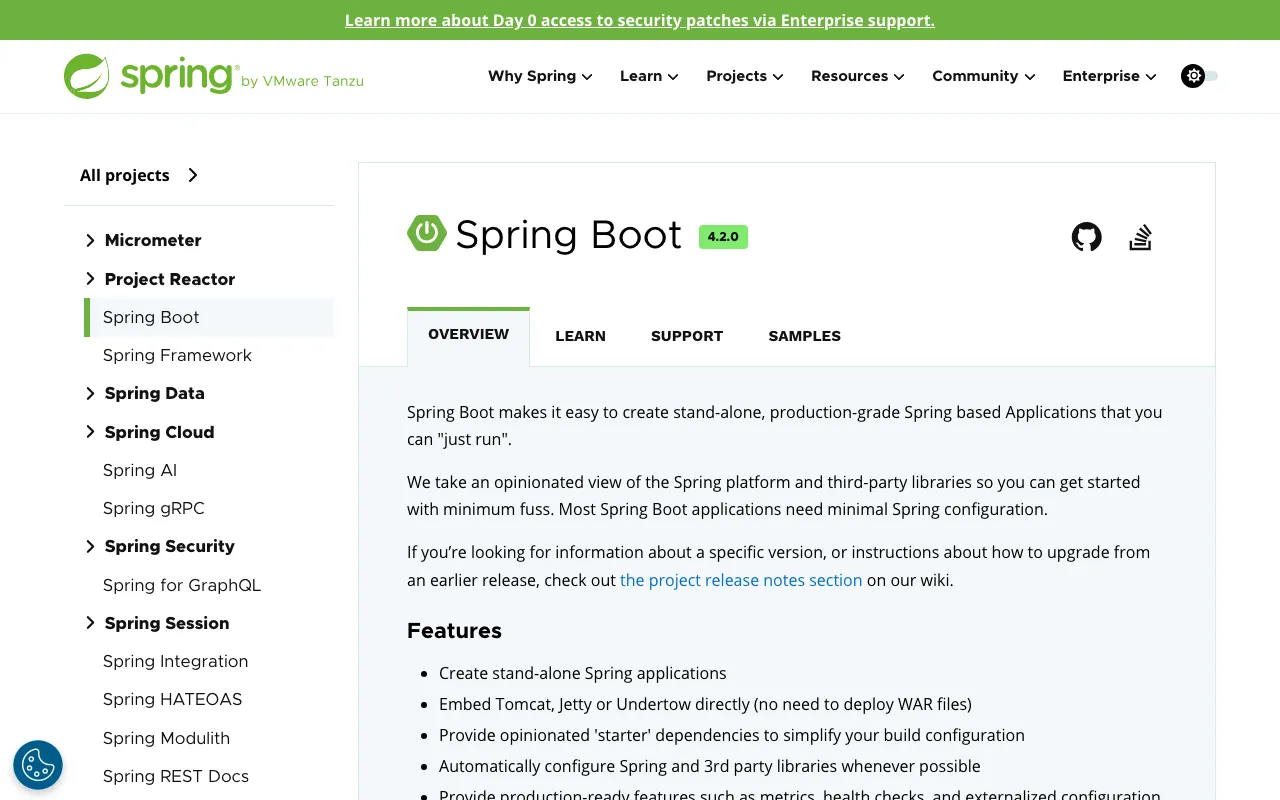
Spring Boot simplifies creating Spring-powered Java applications with embedded servers, starter dependencies, and auto-configuration. Apps can run as executable JARs or traditional WAR deployments.
Overview
Spring Boot sits on the Spring platform and aims to get Java projects running quickly with sensible defaults. It provides starter dependencies that bundle common library sets, auto-configuration for Spring and many third-party components, and support for stand-alone applications launched with java -jar as well as servlet container deployments.
Non-functional features aimed at production use include embedded Tomcat, Jetty, or Undertow, security hooks, metrics, health checks, and externalized configuration without XML or code generation requirements. A command-line runner can execute Spring scripts for alternative workflows.
Documentation includes installation instructions, a first-application tutorial, how-to guides, and samples for REST services with Actuator. Spring Initializr can bootstrap new projects. The framework is widely used as the entry point for the broader Spring ecosystem including Data, Security, Cloud, and Batch when those starters are added.
Teams adopt it when they want faster onboarding to Spring while retaining the ability to override defaults as requirements diverge.
Key features
- Starter dependencies for curated stacks
- Auto-configuration for common integrations
- Embedded servlet containers
- Executable JAR and WAR deployment modes
- Actuator metrics and health endpoints
- Externalized configuration support
- No XML requirement for typical apps
- Spring Initializr project bootstrap
Use cases
- Building REST APIs and microservices in Java
- Rapid Spring application prototypes
- Production services with health and metrics
- Migrating servlet apps to embedded servers
- Enterprise apps on the Spring ecosystem




 Ionic Enterprise


