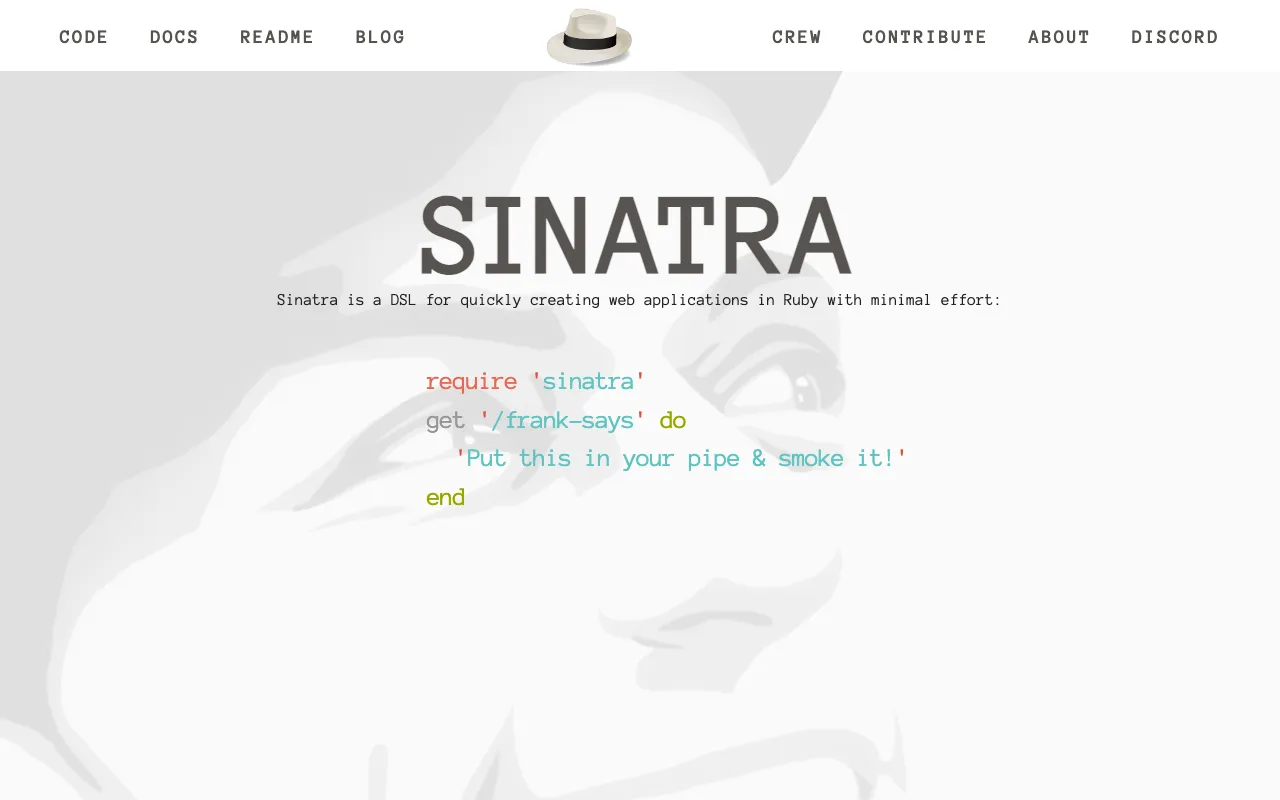
Sinatra is a Ruby domain-specific language for building small web applications with little boilerplate. Routes pair HTTP methods with URL patterns and blocks that return responses.
Overview
Sinatra sits on Rack and lets developers declare endpoints with concise syntax instead of a full-stack MVC layout. Each route matches in definition order and can use named parameters, splats, regular expressions, and conditional matchers for hosts, formats, or custom rules.
Responses can be plain strings, status codes, headers, streaming bodies, or full Rack triples. Built-in helpers cover halting, passing to other routes, redirects, caching, file downloads, sessions, and logging, with optional attack-protection settings.
Views are rendered through pluggable template engines including ERB, Haml, Slim, Liquid, Markdown, and many others, with layout and partial support. Static assets are served from a configurable public folder by default.
Applications can be structured in modular or classic style, mounted as Rack middleware, or wired through config.ru. Sinatra ships with extensive documentation for routes, templates, testing hooks, and lifecycle events for teams that want a lightweight Ruby web layer.
Key features
- HTTP route DSL on Rack
- Named and wildcard parameters
- Many template engine bindings
- Static file serving
- Sessions and cookie helpers
- Streaming response support
- Modular and classic app styles
- Middleware integration
Use cases
- Small HTTP APIs
- Prototypes and internal tools
- Webhook receivers
- Single-page backends
- Embedded Rack services




 Ionic Enterprise


