
whisper.cpp
Portable C/C++ inference for Whisper speech recognition
Whisper.cpp runs OpenAI Whisper ASR with a dependency-light C/C++ core and CLI tools. It targets CPUs and many GPU and NPU accelerators across common operating systems.
On-device speech ML toolkit with ONNX runtime
Local speech recognition, synthesis, and related audio ML using ONNX models without requiring an internet connection during inference.
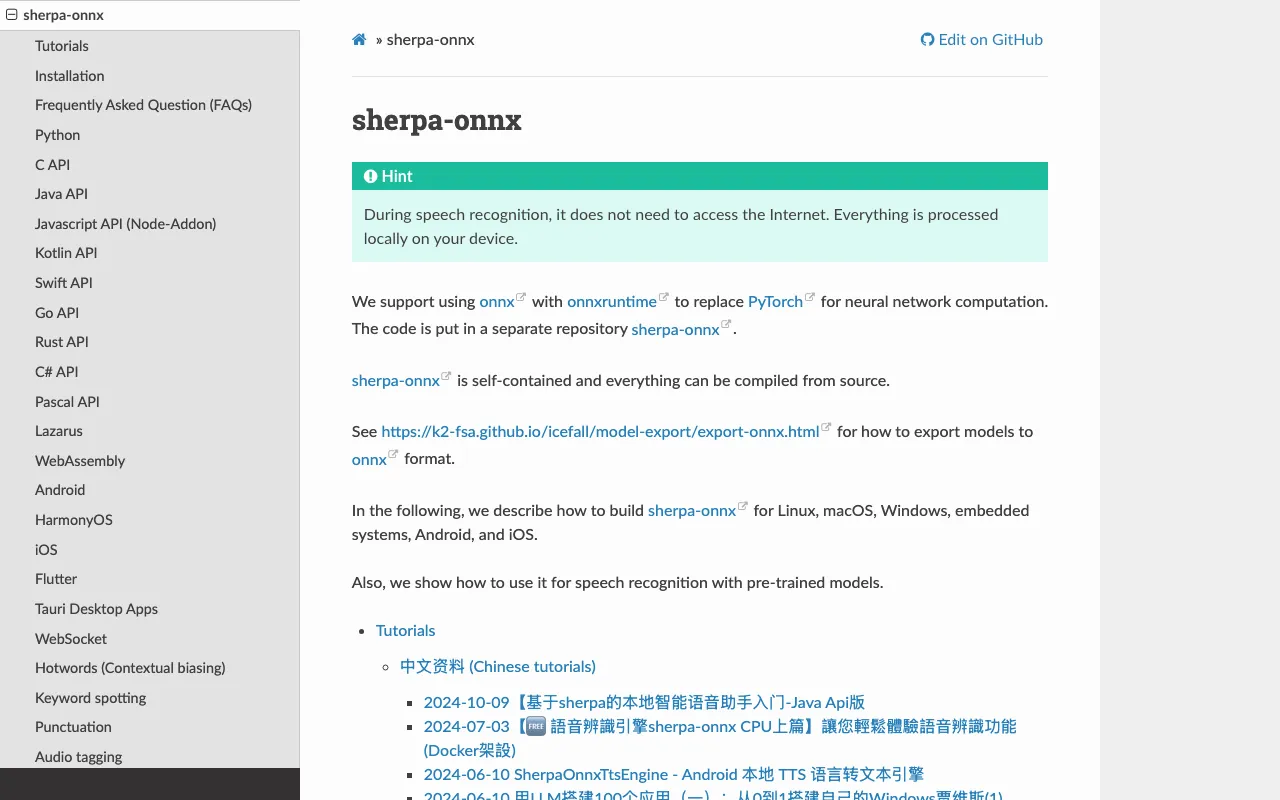
sherpa-onnx brings speech and audio machine learning pipelines to devices using ONNX and onnxruntime instead of PyTorch at inference time. The documented scope covers speech-to-text (streaming and offline), text-to-speech, speaker diarization, identification, verification, language ID, audio tagging, voice activity detection, keyword spotting, source separation, forced alignment, punctuation, and speech enhancement.
Runs are intended to stay on-device: documentation states that speech recognition does not need network access while processing. Bindings and examples span many languages, including C++, Python, Java, Kotlin, JavaScript, Go, C#, Swift, Rust, and others, plus WebAssembly and Flutter or Tauri demo apps. Hardware coverage in the materials lists x86, ARM, RISC-V, Android, iOS, HarmonyOS, embedded boards, and several NPU backends.
Pre-built binaries, APKs, and demo releases are linked for trying features on phones and desktops. Hugging Face and ModelScope spaces offer browser trials. Optional websocket server and client modes appear in the broader docs for streaming setups.
Models are distributed separately; the project describes how to export or obtain ONNX assets and compile the runtime for Linux, macOS, Windows, and embedded targets.
Portable C/C++ inference for Whisper speech recognition
Whisper.cpp runs OpenAI Whisper ASR with a dependency-light C/C++ core and CLI tools. It targets CPUs and many GPU and NPU accelerators across common operating systems.
Speech recognition with word timestamps and diarization
WhisperX transcribes audio with batched Whisper inference, then aligns words using phoneme models for sharper timestamps. Optional speaker diarization labels who spoke when you provide a Hugging Face token.

Multilingual end-to-end speech recognition model family
Fun-ASR provides speech recognition checkpoints from Tongyi Lab for Chinese, English, Japanese, dialects, and up to 31 languages. Inference runs through FunASR, Transformers, vLLM, or llama.cpp GGUF binaries.

End-to-end machine learning platform and tooling ecosystem
TensorFlow is a machine learning platform with Python and C++ APIs, optional GPU packages, and companion libraries for data, training, deployment, and visualization.

Run open AI models locally or in the cloud
Ollama runs open language models such as Gemma, Qwen, DeepSeek and gpt-oss on macOS, Windows and Linux, locally or in the cloud. It offers a CLI, a REST API, and Python and JavaScript libraries.

Shared model definitions for multimodal ML workloads
Transformers is a Python library that defines pretrained text, vision, audio, and multimodal models once in PyTorch for shared inference and training across the ecosystem.