
whisper.cpp
Portable C/C++ inference for Whisper speech recognition
Whisper.cpp runs OpenAI Whisper ASR with a dependency-light C/C++ core and CLI tools. It targets CPUs and many GPU and NPU accelerators across common operating systems.

Multilingual end-to-end speech recognition model family
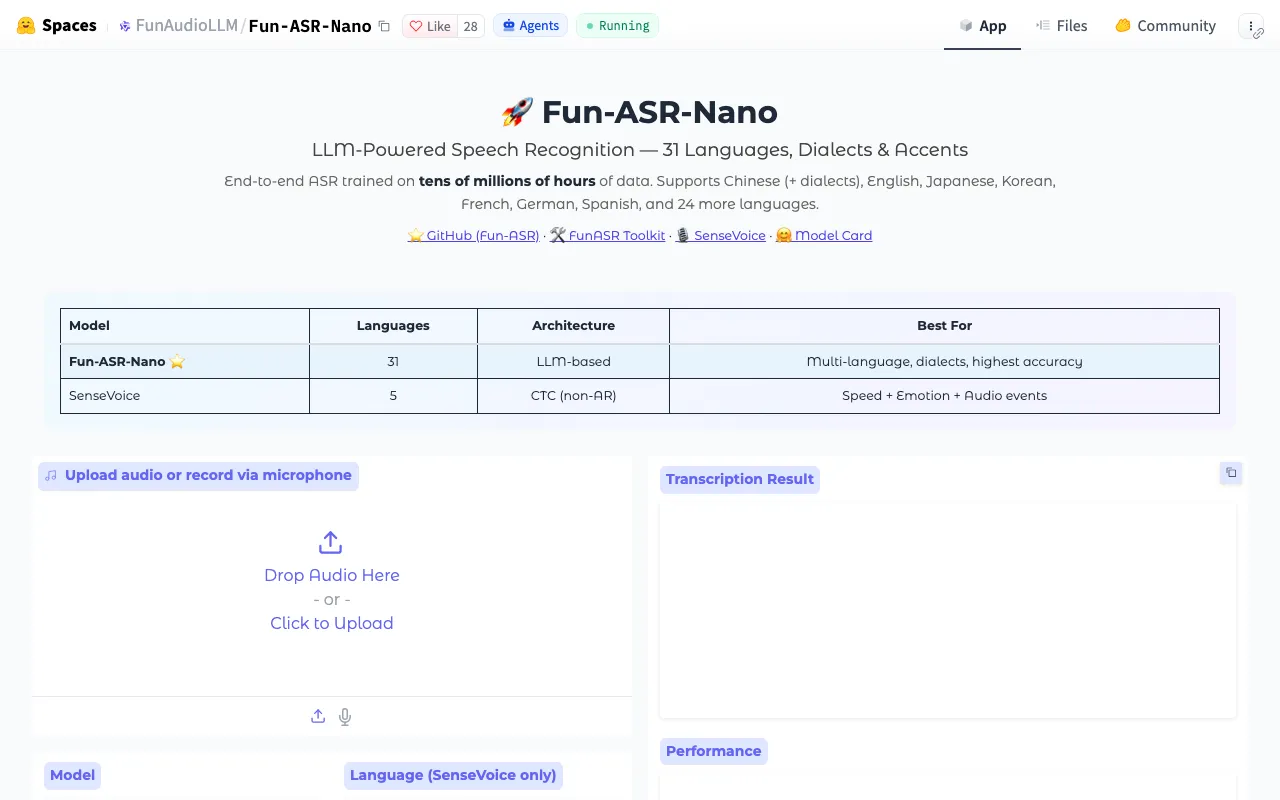
Fun-ASR provides speech recognition checkpoints from Tongyi Lab for Chinese, English, Japanese, dialects, and up to 31 languages. Inference runs through FunASR, Transformers, vLLM, or llama.cpp GGUF binaries.
Fun-ASR is a family of end-to-end speech recognition models. Checkpoints differ by scale and language coverage: one Nano variant targets Chinese, English, Japanese, and Chinese dialects and accents; a multilingual Nano variant covers 31 languages with emphasis on East and Southeast Asia.
Recognition is tuned for far-field and high-noise settings, regional Chinese dialects and accents, and lyrics under music background interference. Models integrate with the FunASR toolkit for inference, batch jobs, speaker diarization pipelines, streaming, and production serving.
You can transcribe via native Hugging Face Transformers, PyTorch through FunASR, high-throughput vLLM batch and streaming modes, or a self-contained llama.cpp GGUF runtime on CPU without Python. Optional pipelines combine VAD, transcription, speaker embedding models, and punctuation restoration.
Weights are distributed on ModelScope and Hugging Face. The project sits in the broader FunAudioLLM ecosystem alongside related audio tools.
Portable C/C++ inference for Whisper speech recognition
Whisper.cpp runs OpenAI Whisper ASR with a dependency-light C/C++ core and CLI tools. It targets CPUs and many GPU and NPU accelerators across common operating systems.
Speech recognition with word timestamps and diarization
WhisperX transcribes audio with batched Whisper inference, then aligns words using phoneme models for sharper timestamps. Optional speaker diarization labels who spoke when you provide a Hugging Face token.
On-device speech ML toolkit with ONNX runtime
Local speech recognition, synthesis, and related audio ML using ONNX models without requiring an internet connection during inference.

End-to-end machine learning platform and tooling ecosystem
TensorFlow is a machine learning platform with Python and C++ APIs, optional GPU packages, and companion libraries for data, training, deployment, and visualization.

Run open AI models locally or in the cloud
Ollama runs open language models such as Gemma, Qwen, DeepSeek and gpt-oss on macOS, Windows and Linux, locally or in the cloud. It offers a CLI, a REST API, and Python and JavaScript libraries.

Shared model definitions for multimodal ML workloads
Transformers is a Python library that defines pretrained text, vision, audio, and multimodal models once in PyTorch for shared inference and training across the ecosystem.