qmetrics.net

Serverless Application Model

AWS CloudFormation transform for serverless application templates

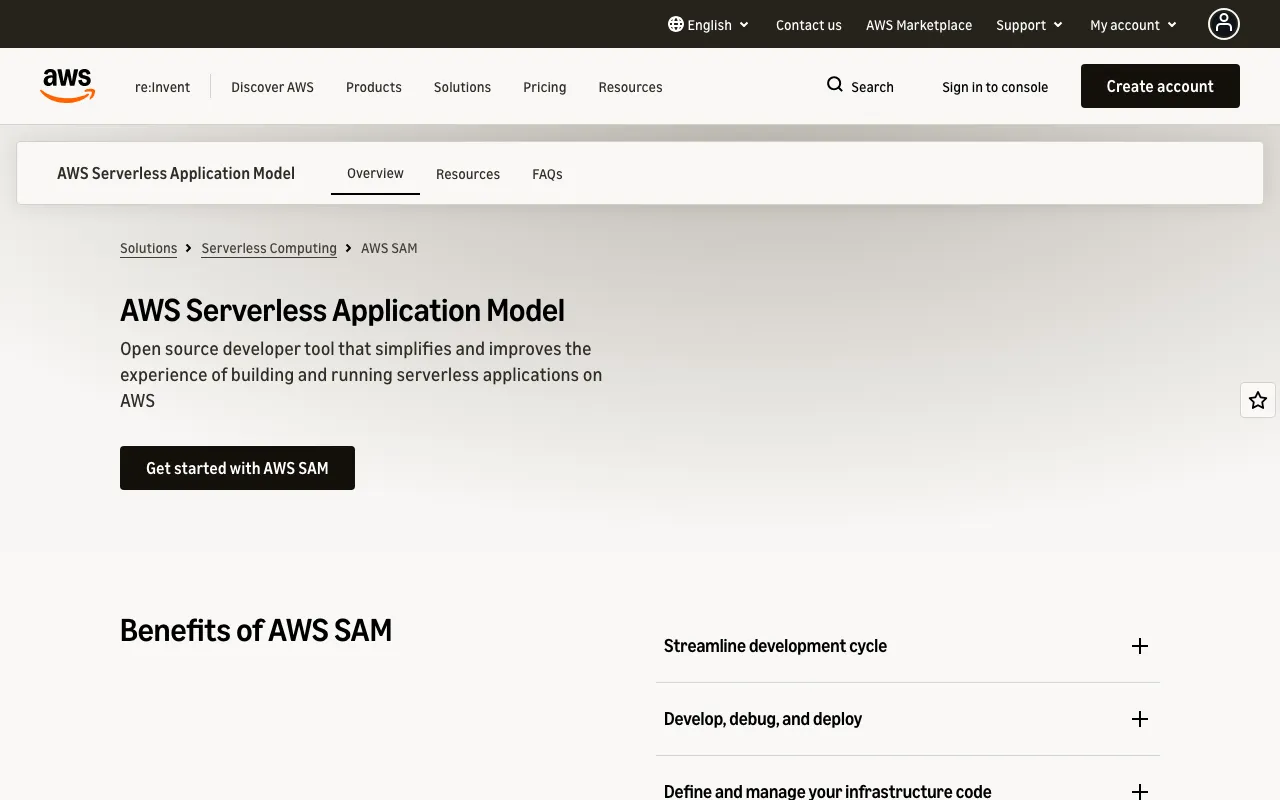
Serverless Application Model screenshot

AWS SAM is an open source model and tooling layer for defining and deploying serverless apps on AWS. The transform expands concise SAM templates into CloudFormation.

Overview

The AWS Serverless Application Model centers on a CloudFormation macro that transforms SAM templates into full CloudFormation templates when you declare AWS::Serverless-2016-10-31 in the Transform section. Short-hand resources such as AWS::Serverless::Function map to Lambda, IAM, and related AWS resources with defaults.

AWS documentation describes SAM as two parts: template syntax optimized for serverless infrastructure as code, and the SAM CLI for local build, test, debug, deploy, sync, pipeline generation, and remote Lambda invocation. Templates deploy through CloudFormation like any other stack.

Benefits stated in the project include built-in best practices, sane defaults, and an extension of CloudFormation’s syntax rather than a separate provisioning engine. Workshops cover hello-world deploys, cloud testing with the CLI, connectors, and policy templates.

The transform repository implements the macro logic developers reference when authoring template.yaml files consumed by sam build and sam deploy. Integrations also mention AWS CDK and Terraform-oriented SAM CLI workflows on AWS’s product pages.

Key features

  • SAM to CloudFormation macro
  • AWS::Serverless resource types
  • SAM CLI build and deploy
  • sam sync for rapid cloud dev
  • Pipeline and CI/CD helpers
  • Lambda-focused IaC defaults
  • SAM Accelerate cloud testing
  • CDK and Terraform CLI extensions

Use cases

  • Serverless API on AWS Lambda
  • IaC for event-driven apps
  • Team pipelines for SAM stacks
  • Local then cloud Lambda debugging
  • Standardized serverless templates

Tags

Similar software

Coolify

Self-hostable PaaS for apps, databases, and one-click services

Coolify deploys static sites, databases, and full-stack apps on servers you control, with a dashboard similar to managed hosting platforms. Configurations stay on your machines over SSH.

★ 66.7k⟳ todayApache-2.0
Build & DeploymentSelf-hostable
Open Source Alternative to:HerokuNetlify+3

Dokploy

Self-hostable PaaS for apps and databases

Dokploy is a self-hostable platform-as-a-service for deploying applications and databases on your own VPS. It supports Docker, Compose, multi-server setups, backups, and monitoring.

★ 38.7k⟳ yesterdayApache-2.0
Build & DeploymentSelf-hostable
Open Source Alternative to:HerokuNetlify+3

Dokku

Docker-powered mini PaaS on your own hardware

Dokku is a small platform-as-a-service you install on a Linux VM. You push Git-based, Heroku-style apps that build with buildpacks and run in Docker containers.

★ 32.2k⟳ yesterdayMIT
Build & DeploymentSelf-hostable
Open Source Alternative to:HerokuNetlify+3

Colima

Minimal container runtimes on macOS and Linux

Colima launches Lima-based VMs with Docker, containerd, Kubernetes, or Incus so you can run containers locally on Mac or Linux with simple defaults and port forwarding.

★ 31.9k⟳ 1 month agoMIT
Build & DeploymentDesktop/CLI app
Open Source Alternative to:Docker Desktop

OpenTofu

Open-source infrastructure as code engine

OpenTofu is an open-source tool for building, changing, and versioning infrastructure safely. It manages popular cloud providers and custom in-house systems using declarative configuration.

★ 31k⟳ todayMPL-2.0
Build & DeploymentDesktop/CLI app
Open Source Alternative to:Terraform

Pulumi

Open-source infrastructure as code with familiar programming languages

Pulumi provisions and manages cloud resources through programs written in TypeScript, Python, Go, Java, and other languages. A CLI deploys stacks to AWS, Azure, Google Cloud, Kubernetes, and hundreds of providers.

★ 26k⟳ yesterdayApache-2.0
Build & DeploymentDesktop/CLI app
Open Source Alternative to:Terraform