qmetrics.net

SerpBear

Self-hosted Google SERP rank tracking and keyword research

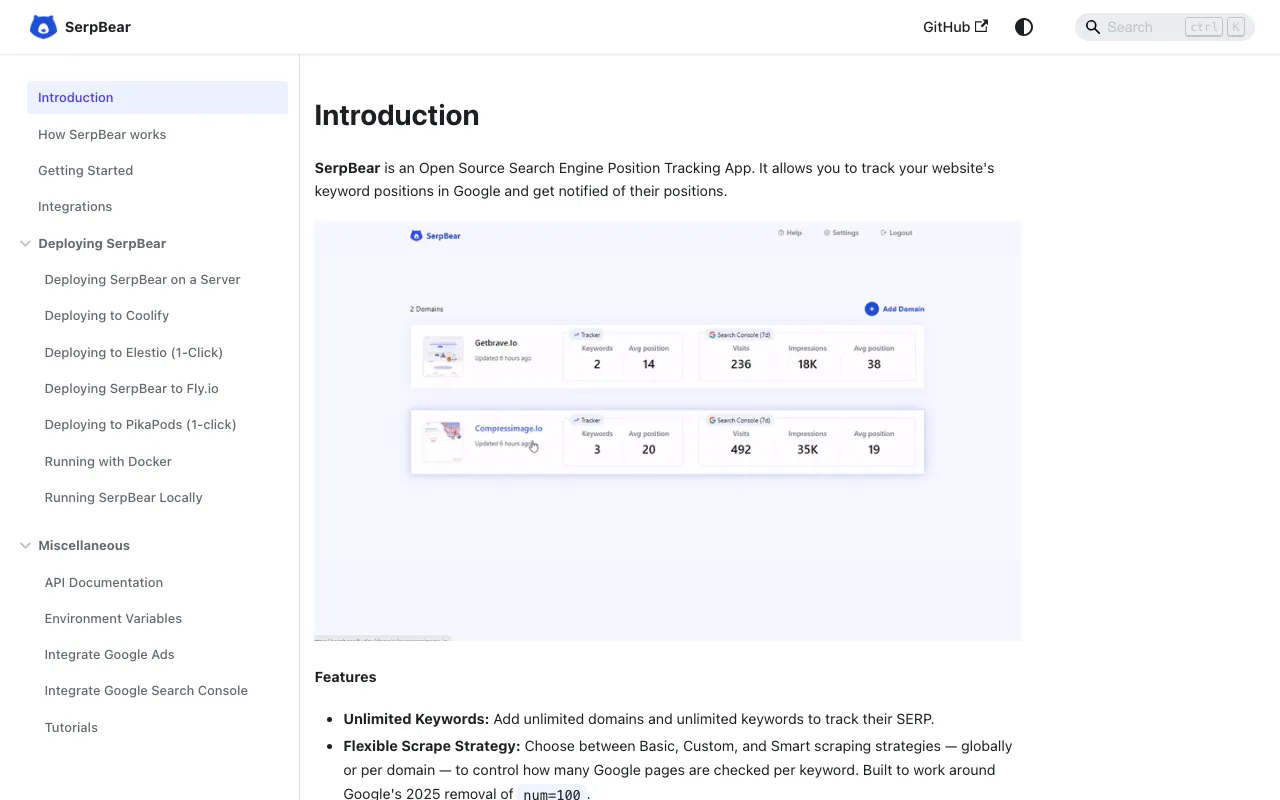
SerpBear screenshot

SerpBear tracks keyword positions in Google for your domains, sends email alerts, and offers a built-in API. It runs as a Next.js app with SQLite that you deploy yourself.

Overview

SerpBear is an open source application for search engine rank tracking and keyword research. You add domains and keywords, then the app monitors whether your site appears in Google results and records position changes over time.

Rank checks rely on third-party SERP scrapers such as SerpAPI, SearchApi, HasData, or proxy IPs you configure, since the app does not scrape Google directly without those backends. A scrape strategy system supports Basic, Custom, and Smart modes globally or per domain to cope with Google limiting results per request.

Optional integrations include Google Search Console for visits and impressions, Google Ads test accounts for search volume and keyword ideas, SMTP for scheduled email alerts, CSV export, a built-in SERP API for other tools, and a installable PWA for mobile use.

The stack uses Next.js for frontend and backend with SQLite for storage. Documentation describes deployment with Docker or from source, settings for scraper keys, and comparison to paid rank trackers on cost and API access.

Key features

  • Unlimited domains and keywords
  • Email rank change notifications
  • Built-in SERP reporting API
  • Google Search Console linking
  • Google Ads keyword research
  • Basic, Custom, and Smart scrape modes
  • CSV export and PWA mobile shell
  • Third-party scraper integrations

Use cases

  • In-house SEO rank monitoring
  • Agency client SERP tracking
  • Keyword research with Ads data
  • Marketing dashboard data feeds
  • Alerting on position drops

Similar software

New Term Radar

Daily early-signal radar for rising AI product names

new-term-radar produces a daily report of surging AI-related names from social, GitHub, sitemaps, and related sources. It builds a keyword table with search volume, trends, and page-one checks.

★ 2.2k⟳ 2 days agoMIT

Firecrawl

Web scrape crawl and search infrastructure for AI agents

Firecrawl turns websites into LLM-ready markdown and structured data via API, CLI, and MCP. It supports scrape, crawl, map, batch jobs, optional cloud scale, and self-hosted server deployment.

★ 211.5k⟳ todayAGPL-3.0
Open Source Alternative to:TavilyZyte

Sherlock Project

Username search across many social networks

Sherlock checks a username against hundreds of social sites and writes matches to per-user text files. It runs from the command line, with Docker and community packages on several Linux distributions.

★ 118.5k⟳ 26 days agoMIT

Agent Reach

CLI toolkit for AI agents to search and read many web platforms

Agent Reach installs platform connectors so AI agents can search and read sites such as GitHub, YouTube, Reddit, Bilibili, and Xiaohongshu from one command line, without relying on paid APIs for default channels.

★ 115.3k⟳ 3 days agoMIT

Scrapling

Python framework for fetching and crawling the web

Scrapling combines HTTP and browser fetchers, parsing, concurrent spiders, exports, and an MCP server for AI agents. It targets static pages, JavaScript sites, stealthy sessions, and full-site crawls from one library.

★ 106.3k⟳ 3 days agoBSD-3-Clause

Puppeteer

JavaScript library for automating Chrome and Firefox

Puppeteer exposes a high-level JavaScript API to drive Chrome or Firefox through the DevTools Protocol or WebDriver BiDi. It defaults to headless browser control for scripts and tests.

★ 95.9k⟳ yesterdayApache-2.0