Scrapling combines HTTP and browser fetchers, parsing, concurrent spiders, exports, and an MCP server for AI agents. It targets static pages, JavaScript sites, stealthy sessions, and full-site crawls from one library.
Overview
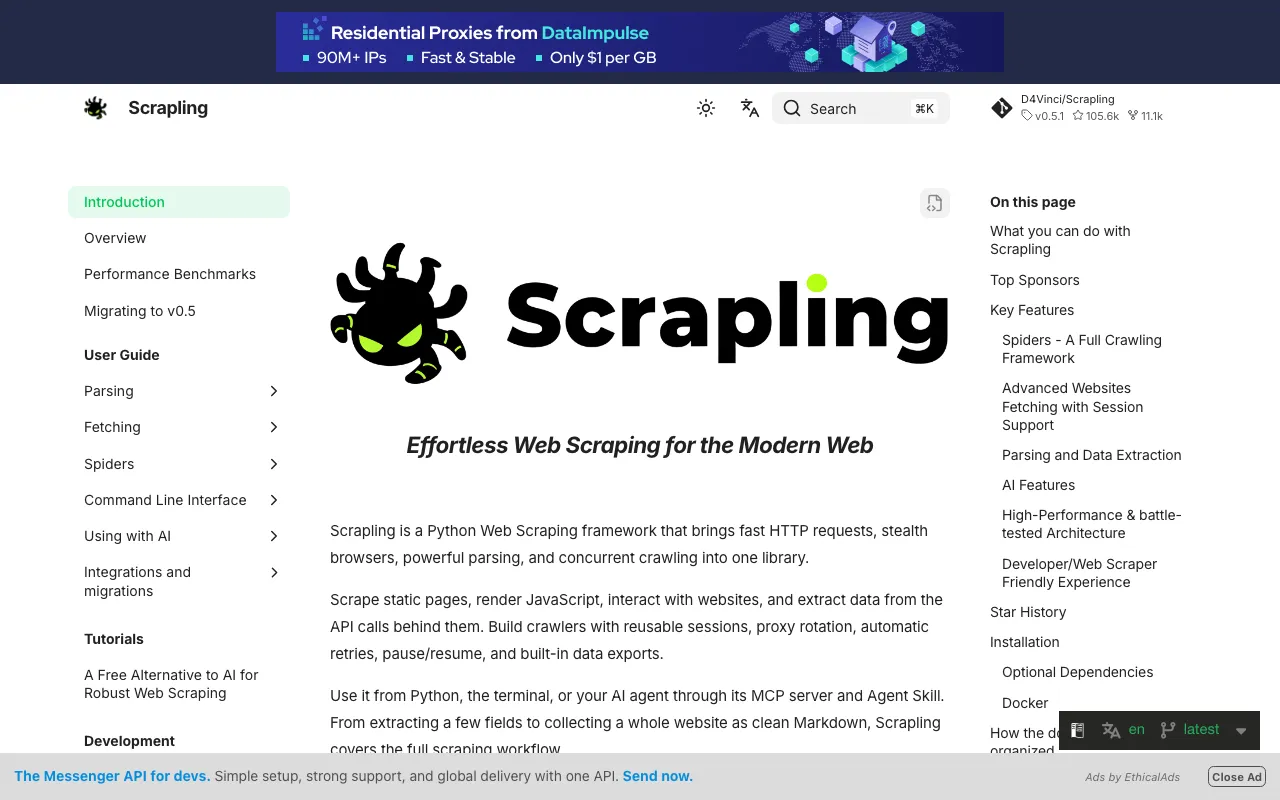
Scrapling is a Python web scraping framework that unifies fast HTTP requests, stealthy browser automation, parsing, and crawling. You can pull a single page, render JavaScript, capture background API traffic, or run concurrent spiders with retries, throttling, and structured exports.
Fetching layers include a Fetcher for HTTP with browser-like TLS fingerprints, StealthyFetcher with Playwright-backed Chromium or Chrome, persistent sessions, proxy rotation, and optional Cloudflare Turnstile handling. Parsing supports CSS and XPath, adaptive element tracking, regex search, and Markdown output suited for downstream LLM workflows.
The spider API mirrors common crawling patterns with pause and resume, streaming results, AutoThrottle, robots.txt obedience, templates such as SitemapSpider and ShopifySpider, and built-in JSON, JSONL, CSV, and XML exporters.
Operators can work from Python, a terminal interface, an interactive shell, or an MCP server and agent skill that expose the same capabilities to coding agents.
Key features
- HTTP and stealth browser fetchers
- Playwright JavaScript rendering
- CSS, XPath, and adaptive selectors
- Concurrent spiders with AutoThrottle
- Proxy rotation and session cookies
- Pause-resume crawl checkpoints
- MCP server and agent skill
- JSON, CSV, and XML exports
Use cases
- Single-page extraction scripts
- JavaScript-heavy site scraping
- Large crawls with exports
- Agent-driven browsing via MCP
- Markdown corpora for RAG pipelines