
SerpBear
Self-hosted Google SERP rank tracking and keyword research
SerpBear tracks keyword positions in Google for your domains, sends email alerts, and offers a built-in API. It runs as a Next.js app with SQLite that you deploy yourself.

Daily early-signal radar for rising AI product names
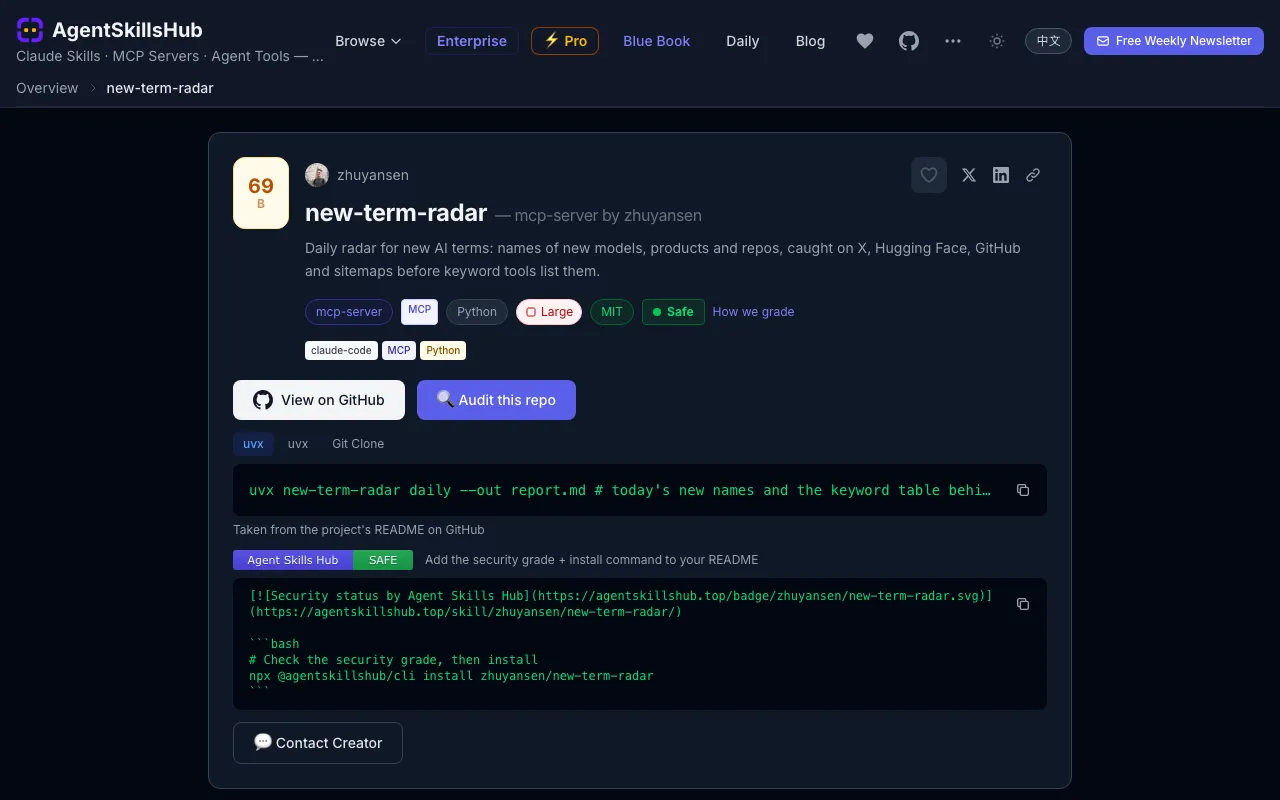
new-term-radar produces a daily report of surging AI-related names from social, GitHub, sitemaps, and related sources. It builds a keyword table with search volume, trends, and page-one checks.
new-term-radar is built for people who publish pages, newsletters, or directories around new AI terms and want notice before keyword tools show traction. Each run aggregates signals such as first-time mentions from tracked X accounts, Hugging Face trending entries, young high-velocity GitHub repos, sitemap word spikes on listed directories, new indexing sites, community asks, and payment-link storefronts.
The output centers on a keyword table that pairs each emerging name with evidence, candidate search phrases, volume and trend data, page-one shape, markets, and suggested actions such as new page versus update existing content. Optional hooks connect Google Search Console impressions, TrustMRR revenue listings, and retrospective checks against DataForSEO Trends.
Configuration is JSON-driven and can integrate with MCP for agents. Runs pull from external APIs where configured; costs depend on which signals are enabled and how often accounts are polled.
Compared with conventional keyword research, the tool reads earlier lifecycle steps—labs posting names, repos accelerating, directories adding listings—rather than waiting for broad trend curves alone.
Self-hosted Google SERP rank tracking and keyword research
SerpBear tracks keyword positions in Google for your domains, sends email alerts, and offers a built-in API. It runs as a Next.js app with SQLite that you deploy yourself.

Web scrape crawl and search infrastructure for AI agents
Firecrawl turns websites into LLM-ready markdown and structured data via API, CLI, and MCP. It supports scrape, crawl, map, batch jobs, optional cloud scale, and self-hosted server deployment.

Username search across many social networks
Sherlock checks a username against hundreds of social sites and writes matches to per-user text files. It runs from the command line, with Docker and community packages on several Linux distributions.
CLI toolkit for AI agents to search and read many web platforms
Agent Reach installs platform connectors so AI agents can search and read sites such as GitHub, YouTube, Reddit, Bilibili, and Xiaohongshu from one command line, without relying on paid APIs for default channels.

Python framework for fetching and crawling the web
Scrapling combines HTTP and browser fetchers, parsing, concurrent spiders, exports, and an MCP server for AI agents. It targets static pages, JavaScript sites, stealthy sessions, and full-site crawls from one library.
JavaScript library for automating Chrome and Firefox
Puppeteer exposes a high-level JavaScript API to drive Chrome or Firefox through the DevTools Protocol or WebDriver BiDi. It defaults to headless browser control for scripts and tests.