
TensorFlow
End-to-end machine learning platform and tooling ecosystem
TensorFlow is a machine learning platform with Python and C++ APIs, optional GPU packages, and companion libraries for data, training, deployment, and visualization.
Graph-native semantic layer for enterprise AI systems
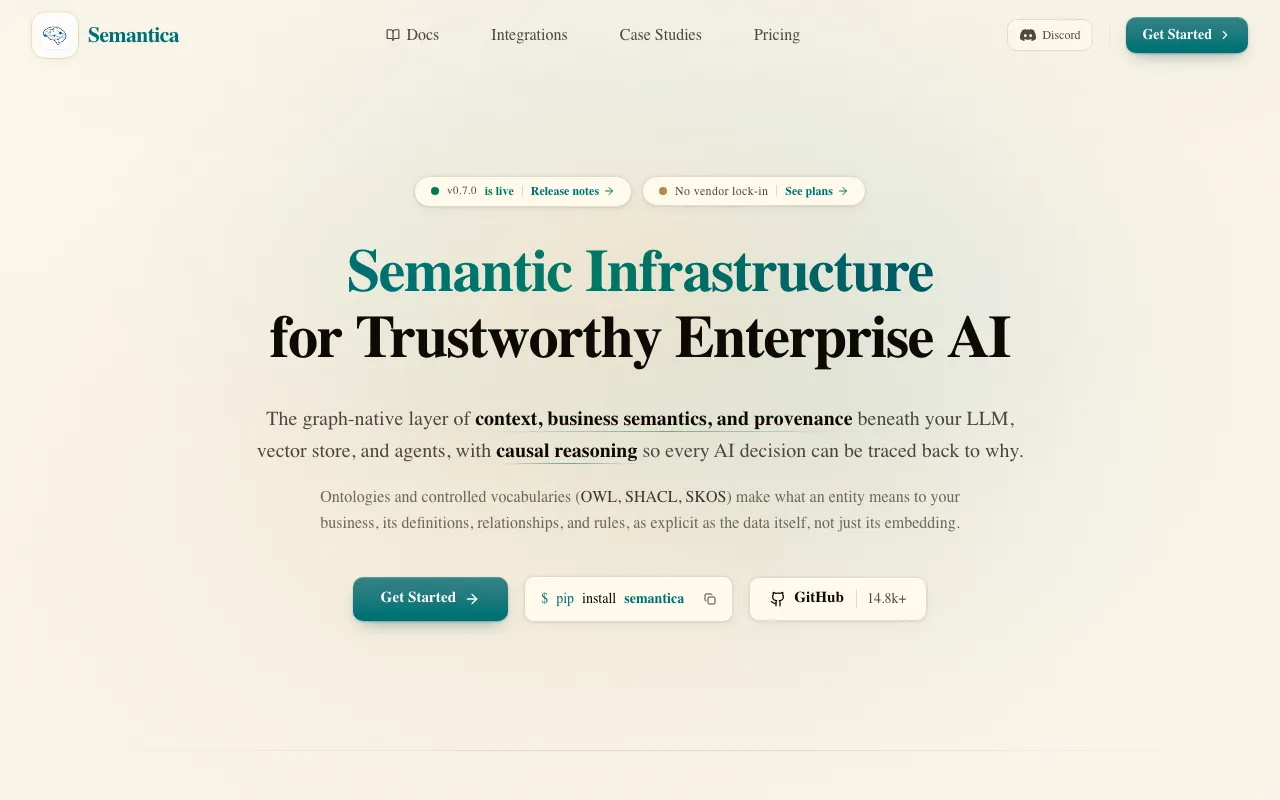
Semantica ingests enterprise data, builds context graphs and ontologies, and adds provenance-aware reasoning atop existing LLM stacks.
Semantica is Python infrastructure that sits under LLMs, vector databases, and agent frameworks. It ingests documents, warehouse tables, and streams, then extracts entities and relations, resolves conflicts, and assembles a queryable context graph with business semantics instead of flat embeddings alone.
Ontology tooling supports OWL, SHACL, and SKOS for vocabularies and validation. Deterministic reasoning engines include forward chaining, Rete, Datalog, and SPARQL with explainable paths. Decision records become graph nodes linked to evidence, policies, and W3C PROV-O provenance exportable for audits.
Storage adapters span RDF triple stores, labeled property graphs such as Neo4j and FalkorDB, and multiple vector backends, swappable without rewriting application code. Connectors target Databricks Unity Catalog, Snowflake, SAP OData, and common file or API sources. Integrations include LangChain, CrewAI, Agno, MCP servers, REST APIs, and editor plugins.
Teams can install the package locally or choose managed or forward-deployed hosting described on the vendor site, while keeping existing models and vector indexes in place. The design emphasizes regulated domains that need traceable answers about why an automated decision was made.
End-to-end machine learning platform and tooling ecosystem
TensorFlow is a machine learning platform with Python and C++ APIs, optional GPU packages, and companion libraries for data, training, deployment, and visualization.

Shared model definitions for multimodal ML workloads
Transformers is a Python library that defines pretrained text, vision, audio, and multimodal models once in PyTorch for shared inference and training across the ecosystem.

Open-source RAG engine and agent context platform
RAGFlow ingests heterogeneous documents, builds retrievable knowledge, and supports agent workflows with citations. It can run on your own hardware with Docker or a from-source server stack.

Local LLM context compression library and proxy
Headroom shrinks tool outputs, logs, JSON, and chat history before LLM calls to cut input tokens while preserving retrievable originals. It offers a Python library, proxy, MCP tools, and agent wrappers.

Local desktop workspace to run and fine-tune AI models
Unsloth is a desktop application to chat with, fine-tune, and serve LLMs, diffusion, audio, and embedding models on your own hardware with optional agent integrations.

TensorFlow reference models and modeling utilities collection
The TensorFlow Model Garden hosts implementations of models and modeling solutions for TensorFlow, installable via pip as tf-models-official.