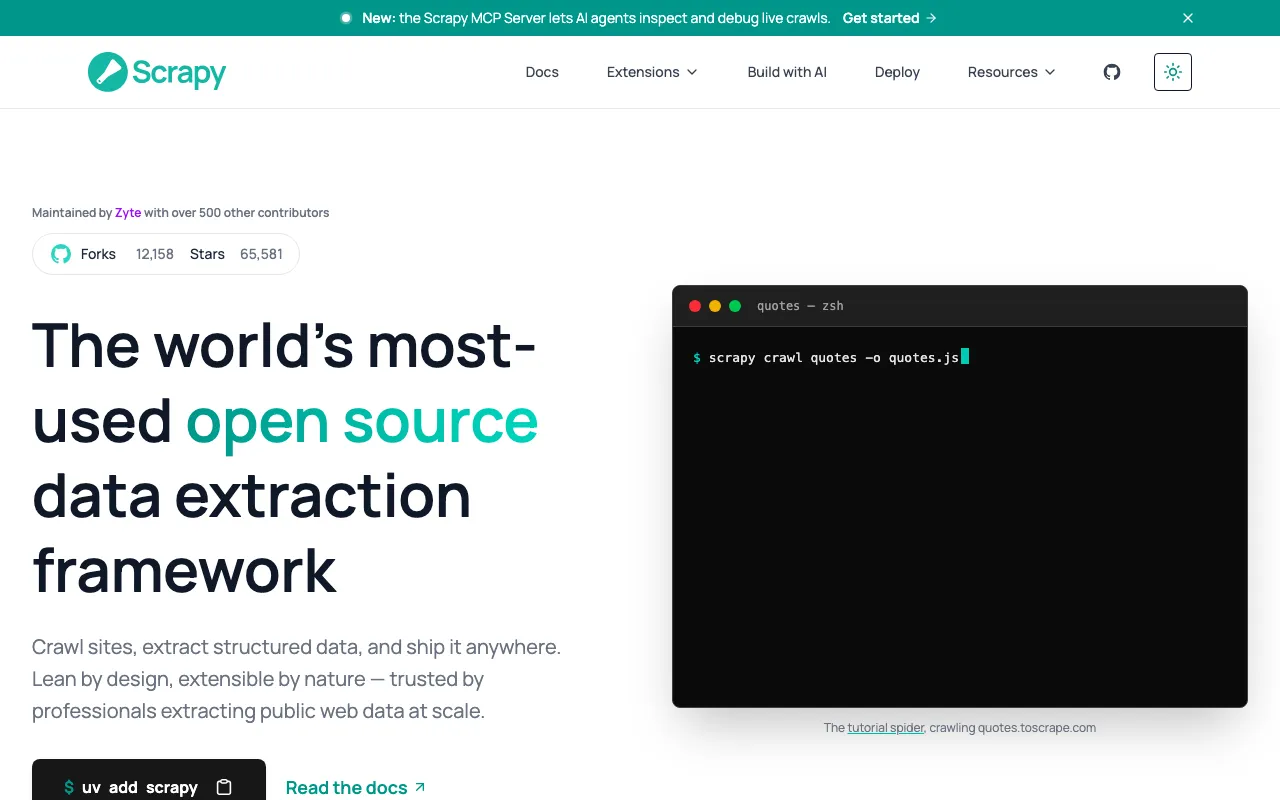
Scrapy is a Python framework for crawling websites and pulling structured data from pages. It runs cross-platform on Python 3.11+ and is maintained by Zyte with community contributors.
Overview
Scrapy targets developers who need to crawl sites, extract structured records, and send results to files or downstream systems. Spiders receive HTTP responses, parse them with CSS or XPath selectors, yield items, and follow links to discover more pages.
The design centers on a small asynchronous engine with pluggable parts: a scheduler queues requests, a downloader fetches pages concurrently, spiders hold parsing logic, item pipelines validate and store data, and feed exports write JSON, CSV, S3, and other formats. Generic spiders such as CrawlSpider and SitemapSpider cover common crawl patterns.
Community and vendor extensions add browser rendering, monitoring, anti-ban proxies, page-object patterns, and an MCP server so agents can inspect running crawls. Workflow tooling includes project scaffolding, an interactive shell for selector trials, cloud deploy hooks, and data validation alerts.
Install via pip and use the documented tutorial flow; the same project layout is intended to scale from a laptop crawl to very large page volumes.
Key features
- Asynchronous crawl engine with pluggable components
- CSS and XPath parsing in user-defined spiders
- Item pipelines and multi-format feed exports
- Interactive shell for live selector testing
- Generic crawl and sitemap spider types
- CLI for projects, runs, and debugging
- Optional browser rendering and monitoring extensions
- MCP server for agent access to live crawls
Use cases
- Extracting structured product or article data from websites
- Large-scale public web data collection pipelines
- Building custom crawlers with Python
- Feeding scraped data to analytics or storage
- Prototyping selectors before production spiders