PaddleOCR parses PDFs and images into structured Markdown or JSON with multilingual text and layout models.
Overview
PaddleOCR is an OCR toolkit and document AI engine focused on turning PDFs and images into structured data such as JSON or Markdown. The project targets pipelines where parsed documents feed retrieval, agents, or downstream language models.
Layout parsing models convert complex pages into Markdown or JSON, with newer vision-language models aimed at formulas, tables, charts, and specialized elements like seals. PP-OCR recognition lines cover many languages, including unified multilingual models and expanded scripts in recent releases.
Developers can run pipelines locally, use high-performance inference with multiple backends, export ONNX models, and deploy service-oriented Docker images with open-sourced SDK customization. Integrations with agent platforms such as Dify, RAGFlow, Pathway, and Cherry Studio are supported.
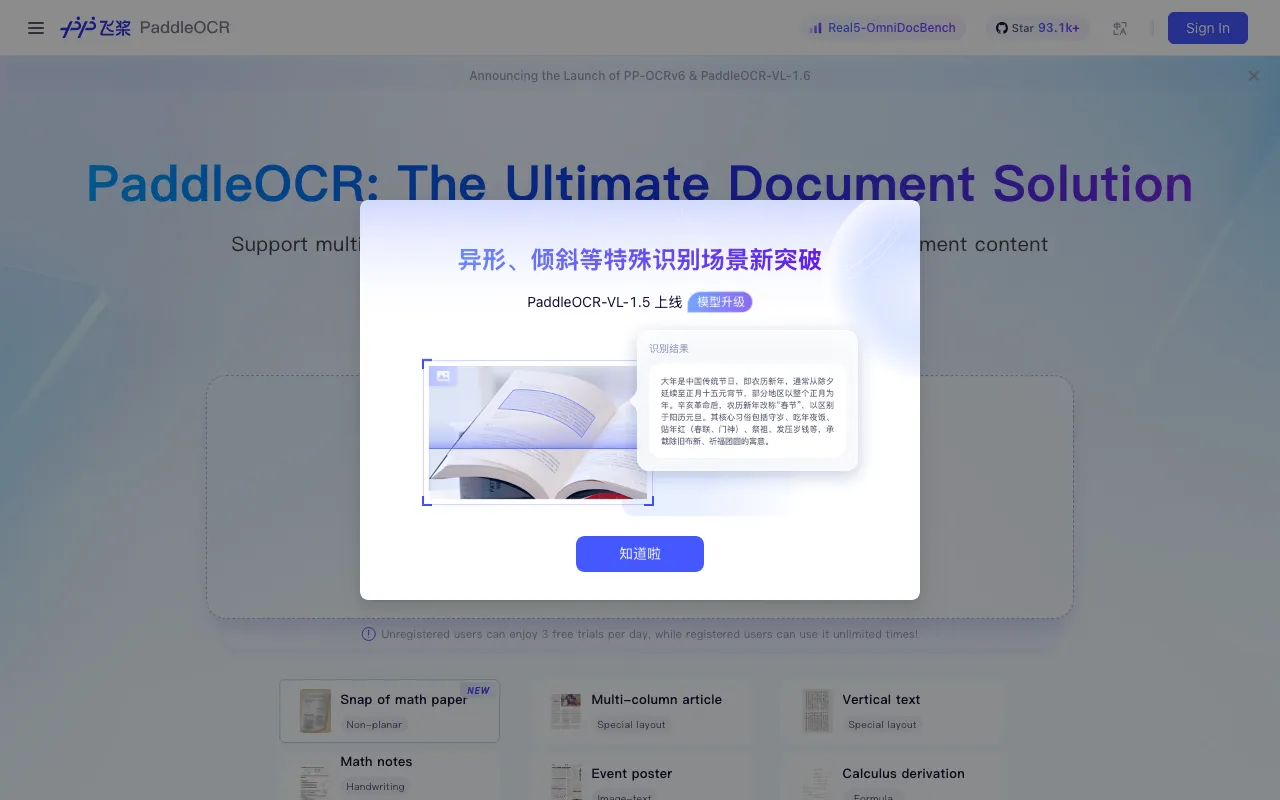
Benchmarking hooks, Windows GPU support, and per-character coordinates for OCR output are available. Online trials without local setup allow quick evaluation.
Key features
- PDF and image to Markdown or JSON
- Layout, table, and formula parsing models
- Multilingual scene text recognition
- ONNX and high-performance inference
- Open service deployment with Docker
- C++, C#, and Java serving integrations
- Agent platform integrations
- Online experience center
Use cases
- RAG document ingestion
- Invoice and form digitization
- Multilingual OCR in mobile apps
- Self-hosted OCR microservices
- Agent workflows needing text from scans