
REA
MCP and CLI reverse-engineering toolkit for agents
REA connects coding agents and terminals to local analysis tools for binaries, Electron apps, websites, .NET, and Android targets. Setup registers MCP access and investigation skills via npm.

Automated open-source project security health checks
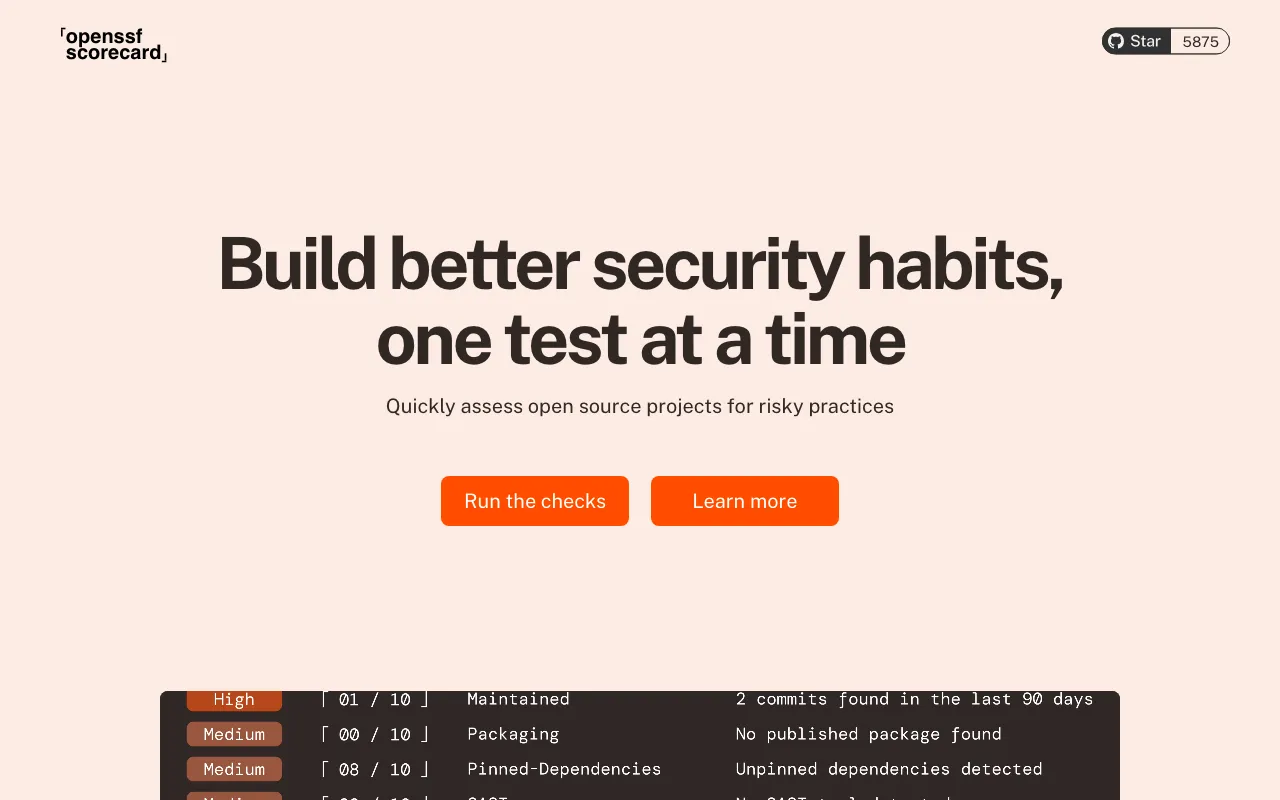
OpenSSF Scorecard runs automated checks on open-source repositories and scores security-related practices from 0 to 10. It helps maintainers and consumers assess dependency risk.
OpenSSF Scorecard is an automated tool that assesses security-related heuristics for open-source projects. Each check receives a score from 0 to 10 so maintainers can see where to improve and consumers can judge risks in dependencies they adopt.
Checks cover areas such as binary artifacts, code review, dangerous workflows, dependency update tooling, licensing, maintenance, branch protection, pinned dependencies, and signed releases. Results can include risk levels, aggregate scores, and remediation hints. Scorecard is associated with the Open Source Security Foundation and is widely referenced for supply-chain hygiene.
You can run Scorecard on repositories you do not own via a command-line interface, with optional GitHub or GitLab authentication to avoid API rate limits. Docker images and standalone binaries are published, with install paths for package managers such as Nix on NixOS. A GitHub Action runs scans on owned repos, and a REST API exposes pre-calculated results from large weekly scans.
Additional interfaces include badges for README display, an MCP server that serves published results over stdio, and experimental catalog evaluation against security baselines. Per-check scoring criteria and beginner-oriented guides are included.
MCP and CLI reverse-engineering toolkit for agents
REA connects coding agents and terminals to local analysis tools for binaries, Electron apps, websites, .NET, and Android targets. Setup registers MCP access and investigation skills via npm.

Browser-based toolkit for encoding and crypto operations
CyberChef runs in the browser and chains many data operations into recipes. Processing stays on your machine, with optional local Docker or Node.js builds.
CLI for disassembling and rebuilding Android APK packages
Apktool reverse engineers third-party Android APK binaries, decodes resources and smali, supports edits, and rebuilds installable packages from a project-like tree.

Pattern-based static analysis for many languages
Semgrep scans source code with rules that resemble real code to find bugs and enforce standards. It runs locally in the CLI, IDE hooks, pre-commit, or CI.

JavaScript and Node.js source code obfuscator
A package that rewrites JavaScript to hinder reverse engineering, with local transforms, CLI batching, and optional cloud VM obfuscation.
Java and Android bytecode reverse engineering workbench
Bytecode Viewer is a Java desktop suite to open JARs, APKs, DEX, and related formats, decompile or disassemble them, search code, and edit with plugins.