
REA
MCP and CLI reverse-engineering toolkit for agents
REA connects coding agents and terminals to local analysis tools for binaries, Electron apps, websites, .NET, and Android targets. Setup registers MCP access and investigation skills via npm.

JavaScript and Node.js source code obfuscator
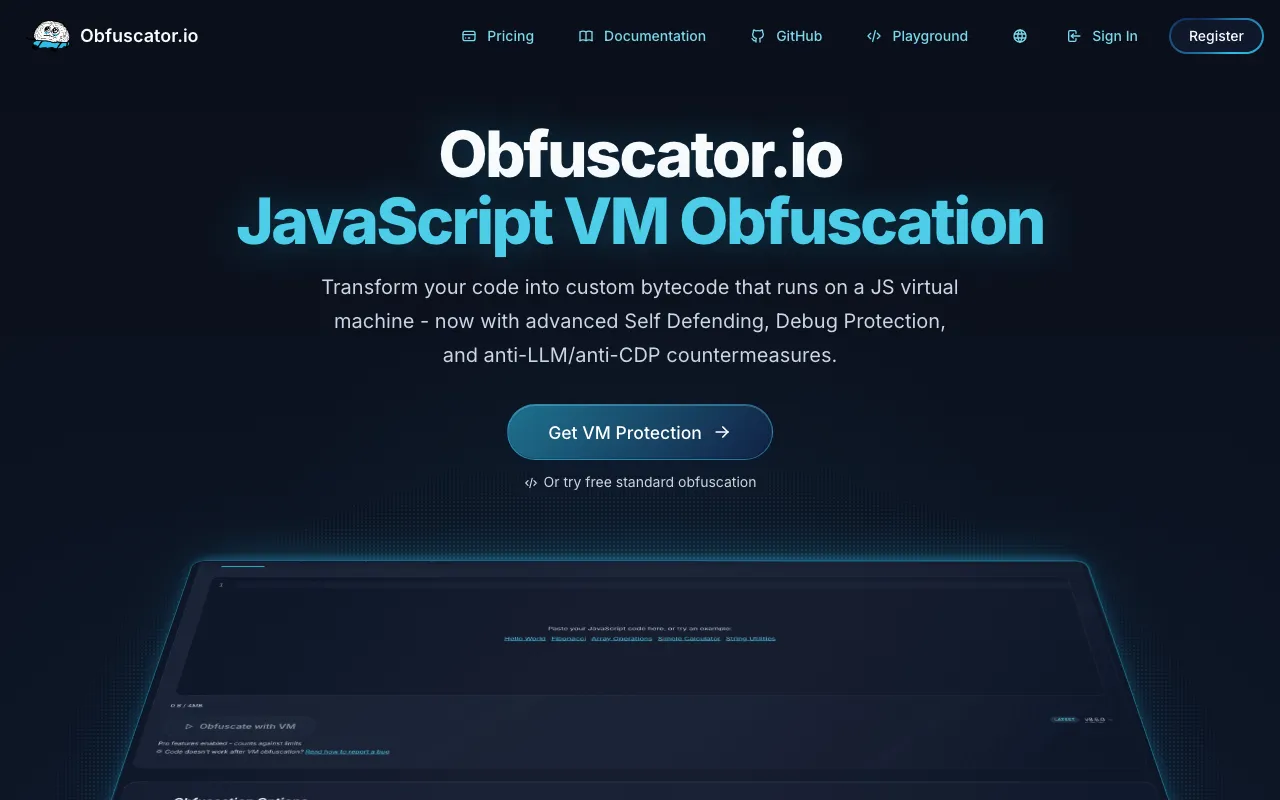
A package that rewrites JavaScript to hinder reverse engineering, with local transforms, CLI batching, and optional cloud VM obfuscation.
JavaScript Obfuscator transforms JavaScript source into a harder-to-read form for browser and Node.js deployments. Local obfuscation supports identifier renaming, string extraction and encoding, control-flow flattening, dead code injection, debug and self-defending guards, and related structural changes exposed through programmatic and command-line interfaces.
The obfuscate API returns an obfuscation result with the transformed code and optional source maps or identifier caches depending on options. Batch obfuscateMultiple handles multiple named inputs; presets bundle common option sets. Conditional comments can disable or enable obfuscation for specific regions of a file.
Advanced VM-based bytecode protection is offered through the separate Obfuscator.io Pro API, which requires a token and network access, while the free tier runs offline. Documentation warns that obfuscated output can be slower and larger and discourages obfuscating vendor or polyfill bundles.
Integrations include npm or Yarn installation, browser consumption from CDNs, directory and single-file CLI workflows, and optional large-file upload support when an additional blob client package is present.
MCP and CLI reverse-engineering toolkit for agents
REA connects coding agents and terminals to local analysis tools for binaries, Electron apps, websites, .NET, and Android targets. Setup registers MCP access and investigation skills via npm.

Browser-based toolkit for encoding and crypto operations
CyberChef runs in the browser and chains many data operations into recipes. Processing stays on your machine, with optional local Docker or Node.js builds.
CLI for disassembling and rebuilding Android APK packages
Apktool reverse engineers third-party Android APK binaries, decodes resources and smali, supports edits, and rebuilds installable packages from a project-like tree.

Pattern-based static analysis for many languages
Semgrep scans source code with rules that resemble real code to find bugs and enforce standards. It runs locally in the CLI, IDE hooks, pre-commit, or CI.
Java and Android bytecode reverse engineering workbench
Bytecode Viewer is a Java desktop suite to open JARs, APKs, DEX, and related formats, decompile or disassemble them, search code, and edit with plugins.

Automated open-source project security health checks
OpenSSF Scorecard runs automated checks on open-source repositories and scores security-related practices from 0 to 10. It helps maintainers and consumers assess dependency risk.