qmetrics.net

SciPy

Python library for scientific and numerical computing

Frameworks & PlatformsDesktop/CLI app
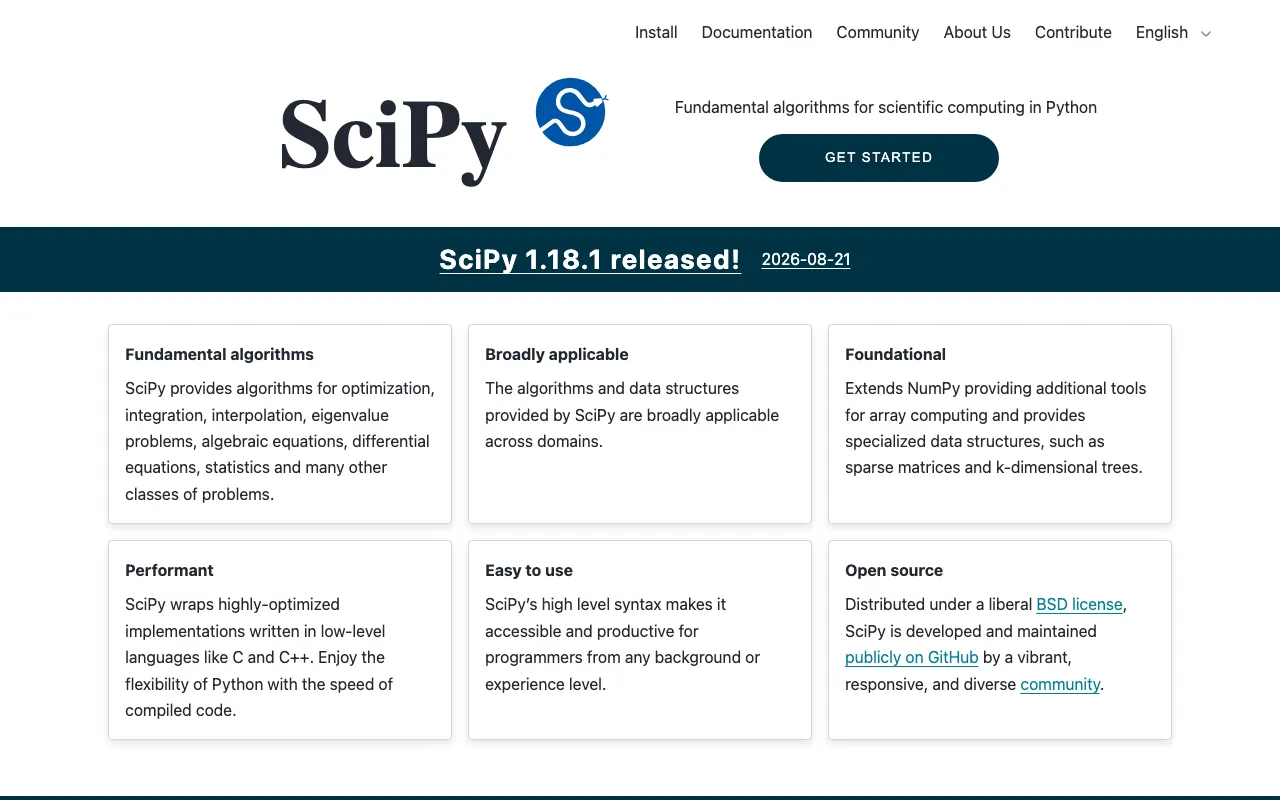
SciPy screenshot

SciPy adds algorithms for statistics, optimization, integration, linear algebra, signal processing, and related scientific tasks on top of NumPy. It installs as a Python package used across common desktop operating systems.

Overview

SciPy is a software library for mathematics, science, and engineering built to operate on NumPy arrays. It bundles user-oriented numerical routines for integration, optimization, interpolation, eigenvalue problems, algebraic and differential equations, statistics, Fourier analysis, signal and image processing, and additional specialized domains.

The project extends NumPy with extra array tooling and data structures such as sparse matrices and k-dimensional trees. Performance-sensitive pieces wrap lower-level implementations while exposing a high-level Python API intended to stay approachable for varied backgrounds.

Algorithms are meant to apply broadly across scientific domains rather than tie to one vertical. Documentation and releases are maintained in public alongside the source, with install guidance published for getting started in a Python environment.

SciPy is meant to be imported into application and research code rather than run as a standalone server or GUI product. It complements NumPy for numeric workflows that need established scientific methods without reimplementing them.

Key features

  • NumPy array integration
  • Numerical integration routines
  • Optimization algorithms
  • Linear algebra solvers
  • Signal and image processing
  • Statistics modules
  • Sparse matrix support
  • Compiled low-level backends

Use cases

  • Scientific computation in Python
  • Signal processing pipelines
  • Numerical optimization problems
  • Statistical analysis scripts
  • Solving differential equations

Tags

Similar software

ECC

Open-source agent engineering toolkit for coding harnesses

ECC adds planning, verification, review, memory, skills, and security scanning to coding agents such as Claude Code, Codex, and Cursor. It installs as plugins, packages, and managed adapters across multiple harnesses.

★ 311.7k⟳ 8 days agoMIT
Frameworks & PlatformsDesktop/CLI app

React

JavaScript library for web and native user interfaces

React helps developers build interfaces from reusable components that manage their own state. Views update declaratively when underlying data changes.

★ 253k⟳ 2 days agoMIT
Frameworks & PlatformsDesktop/CLI app

Flutter

Open-source UI framework for multi-platform apps from one codebase

Flutter is an SDK for building user experiences for mobile, web, and desktop from a single codebase. It uses the Dart language and compiles to native machine code or web targets.

★ 181.5k⟳ todayBSD-3-Clause
Open Source Alternative to:Ionic Enterprise

Bootstrap

Responsive HTML, CSS, and JavaScript front-end toolkit

Bootstrap supplies CSS, JavaScript, and Sass-based styles for building responsive, mobile-first sites. It ships prebuilt grid layouts, UI components, and optional JavaScript plugins.

★ 175.1k⟳ 2 days agoMIT

Langflow

Visual low-code builder for AI agents and workflows

Langflow is a visual builder for AI agents and workflows. Flows can be customized in Python and deployed as an API or as an MCP server, with support for major LLMs and vector databases.

★ 157k⟳ todayMIT
Open Source Alternative to:Relevance AIVoiceflow

LangChain

Framework for agents and LLM-powered applications

LangChain helps developers chain interoperable components and integrations to build agents and LLM-powered applications. It offers a standard interface for models, embeddings, vector stores, and related pieces.

★ 150.1k⟳ 2 days agoMIT