qmetrics.net

Sceptre

CLI orchestration layer for AWS CloudFormation stacks

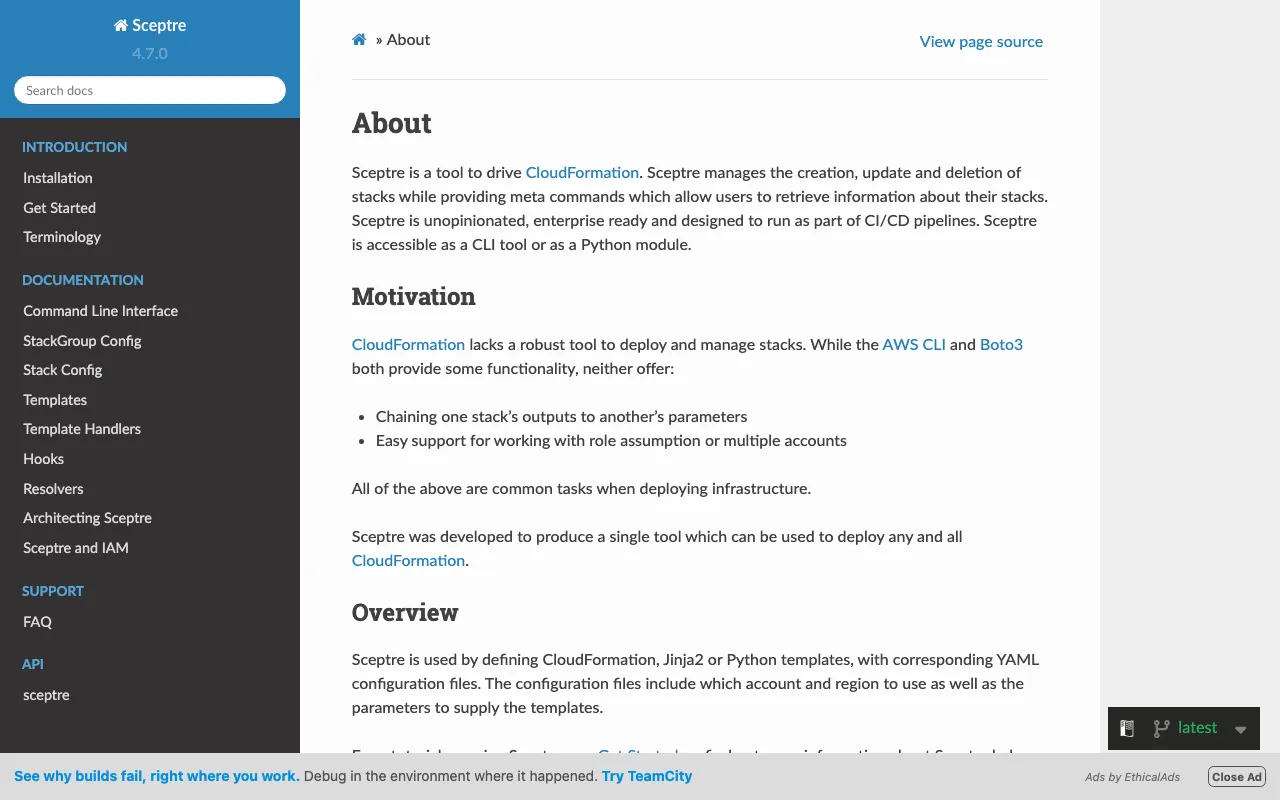
Sceptre screenshot

Sceptre drives AWS CloudFormation stack create, update, and delete flows. It separates templates from YAML stack config, resolves dependencies, and supports stack groups and hooks.

Overview

Sceptre is a tool for creating, updating, and deleting CloudFormation stacks, with meta commands to query stack state. It is designed to run in CI/CD pipelines and is available as a command-line program or importable Python module.

Stacks live in stack groups defined by YAML configuration beside JSON, YAML, Jinja2, or Python templates. Outputs from one stack can flow automatically into parameters of dependent stacks across groups. Group-level commands create or delete many stacks at once, respecting dependency order.

Features include parallel builds, multi-account and multi-region support, customizable resolvers for dynamic template values, and hooks to run code before or after stack operations. Template reuse comes from splitting each stack’s template from its configuration.

Installation is documented via pip or a published Docker image that mounts the project directory and AWS credentials. The project stays unopinionated about directory layout while using cloud-native CloudFormation without separate state files.

Key features

  • Stack and stack group YAML config
  • Automatic cross-stack output wiring
  • JSON, YAML, Jinja2, and Python templates
  • Stack group bulk create and delete
  • Parallel stack builds
  • Multi-account and multi-region support
  • Resolvers and build hooks
  • CLI and Python module API

Use cases

  • Organized CloudFormation deployments
  • VPC then subnet dependency chains
  • CI/CD infrastructure pipelines
  • Querying and protecting live stacks

Tags

Similar software

Coolify

Self-hostable PaaS for apps, databases, and one-click services

Coolify deploys static sites, databases, and full-stack apps on servers you control, with a dashboard similar to managed hosting platforms. Configurations stay on your machines over SSH.

★ 66.7k⟳ todayApache-2.0
Build & DeploymentSelf-hostable
Open Source Alternative to:HerokuNetlify+3

Dokploy

Self-hostable PaaS for apps and databases

Dokploy is a self-hostable platform-as-a-service for deploying applications and databases on your own VPS. It supports Docker, Compose, multi-server setups, backups, and monitoring.

★ 38.7k⟳ yesterdayApache-2.0
Build & DeploymentSelf-hostable
Open Source Alternative to:HerokuNetlify+3

Dokku

Docker-powered mini PaaS on your own hardware

Dokku is a small platform-as-a-service you install on a Linux VM. You push Git-based, Heroku-style apps that build with buildpacks and run in Docker containers.

★ 32.2k⟳ yesterdayMIT
Build & DeploymentSelf-hostable
Open Source Alternative to:HerokuNetlify+3

Colima

Minimal container runtimes on macOS and Linux

Colima launches Lima-based VMs with Docker, containerd, Kubernetes, or Incus so you can run containers locally on Mac or Linux with simple defaults and port forwarding.

★ 31.9k⟳ 1 month agoMIT
Build & DeploymentDesktop/CLI app
Open Source Alternative to:Docker Desktop

OpenTofu

Open-source infrastructure as code engine

OpenTofu is an open-source tool for building, changing, and versioning infrastructure safely. It manages popular cloud providers and custom in-house systems using declarative configuration.

★ 31k⟳ todayMPL-2.0
Build & DeploymentDesktop/CLI app
Open Source Alternative to:Terraform

Pulumi

Open-source infrastructure as code with familiar programming languages

Pulumi provisions and manages cloud resources through programs written in TypeScript, Python, Go, Java, and other languages. A CLI deploys stacks to AWS, Azure, Google Cloud, Kubernetes, and hundreds of providers.

★ 26k⟳ yesterdayApache-2.0
Build & DeploymentDesktop/CLI app
Open Source Alternative to:Terraform