
TensorFlow
End-to-end machine learning platform and tooling ecosystem
TensorFlow is a machine learning platform with Python and C++ APIs, optional GPU packages, and companion libraries for data, training, deployment, and visualization.

Rust NLP pipelines and transformer model bindings
Rust BERT has had no code changes for over 18 months (last commit 1 year ago).
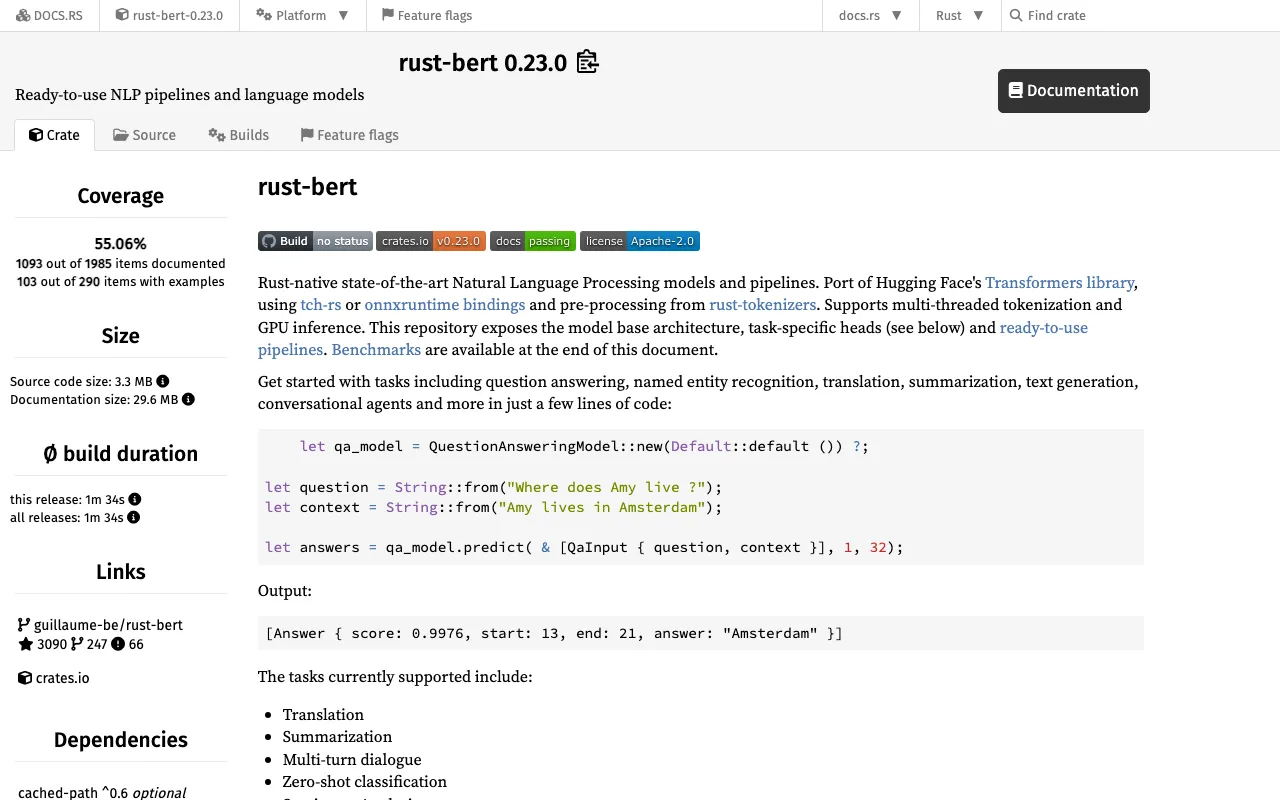
rust-bert exposes ready-made Rust pipelines and transformer architectures for tasks such as QA, NER, translation, and text generation, ported from Hugging Face Transformers via tch-rs or ONNX.
rust-bert is a Rust crate that brings transformer-based NLP models and end-to-end pipelines into native applications. It mirrors much of Hugging Face Transformers, using tch-rs bindings to Libtorch or optional ONNX runtime support, with tokenization from rust-tokenizers and support for multi-threaded tokenization and GPU inference.
Task-specific heads and pretrained pipelines cover translation, summarization, dialogue, zero-shot classification, sentiment, named entity recognition, part-of-speech tagging, question answering, language generation, masked language modeling, sentence embeddings, and keyword extraction. Many encoder, decoder, and encoder–decoder architectures appear in the supported model matrix.
Setup requires Libtorch (manual install or download-libtorch feature) or ONNX libraries when the onnx feature is enabled. Pretrained weights download to a configurable cache directory defaulting under the user home.
Optional ONNX paths aim for compatibility with models exported through Optimum, with separate encoder and decoder artifacts where needed. Base model APIs remain available for custom checkpoints imported from PyTorch with aligned parameter naming.
End-to-end machine learning platform and tooling ecosystem
TensorFlow is a machine learning platform with Python and C++ APIs, optional GPU packages, and companion libraries for data, training, deployment, and visualization.

Shared model definitions for multimodal ML workloads
Transformers is a Python library that defines pretrained text, vision, audio, and multimodal models once in PyTorch for shared inference and training across the ecosystem.

Open-source RAG engine and agent context platform
RAGFlow ingests heterogeneous documents, builds retrievable knowledge, and supports agent workflows with citations. It can run on your own hardware with Docker or a from-source server stack.

Local LLM context compression library and proxy
Headroom shrinks tool outputs, logs, JSON, and chat history before LLM calls to cut input tokens while preserving retrievable originals. It offers a Python library, proxy, MCP tools, and agent wrappers.

Local desktop workspace to run and fine-tune AI models
Unsloth is a desktop application to chat with, fine-tune, and serve LLMs, diffusion, audio, and embedding models on your own hardware with optional agent integrations.

TensorFlow reference models and modeling utilities collection
The TensorFlow Model Garden hosts implementations of models and modeling solutions for TensorFlow, installable via pip as tf-models-official.