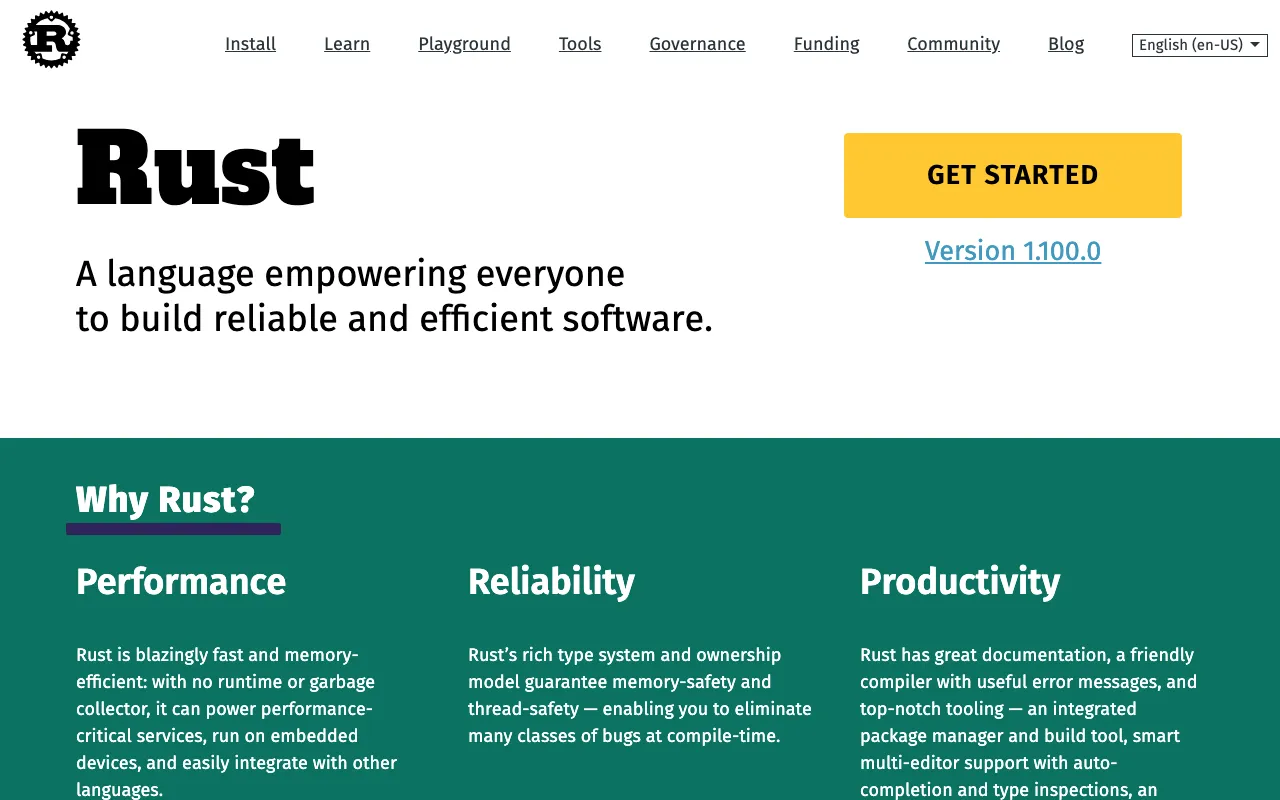
Rust is a programming language aimed at reliable, efficient software. Its type system and ownership model catch many memory and threading mistakes at compile time, and the ecosystem includes Cargo, rustfmt, Clippy, and rust-analyzer.
Overview
Rust is a programming language for building reliable and efficient software. The main project ships the compiler, standard library, and language documentation that learners and developers use to write and maintain Rust code.
The language emphasizes performance without a garbage collector, suited for services, embedded targets, and integration with other languages. A rich type system and ownership rules aim for memory safety and thread safety before runtime.
Day-to-day work is supported by Cargo as package manager and build tool, rustfmt for formatting, Clippy as a linter, and rust-analyzer for editor assistance. The compiler provides detailed diagnostics.
Rust sees use in command-line tools, WebAssembly modules, web applications, network services, and embedded systems. Documentation includes an official book, online guides, and contribution resources for those who want to extend the language or toolchain.
Key features
- Ownership-based memory safety
- Compile-time thread safety checks
- Cargo package and build tool
- rustfmt code formatter
- Clippy linter
- rust-analyzer editor support
- No runtime garbage collector
- Embedded and systems targets
Use cases
- Command-line utilities
- Network services
- WebAssembly with JavaScript
- Web applications
- Embedded and resource-constrained devices




 Ionic Enterprise


