qmetrics.net

Routing

Symfony component for HTTP request URL routing

Frameworks & PlatformsDesktop/CLI app
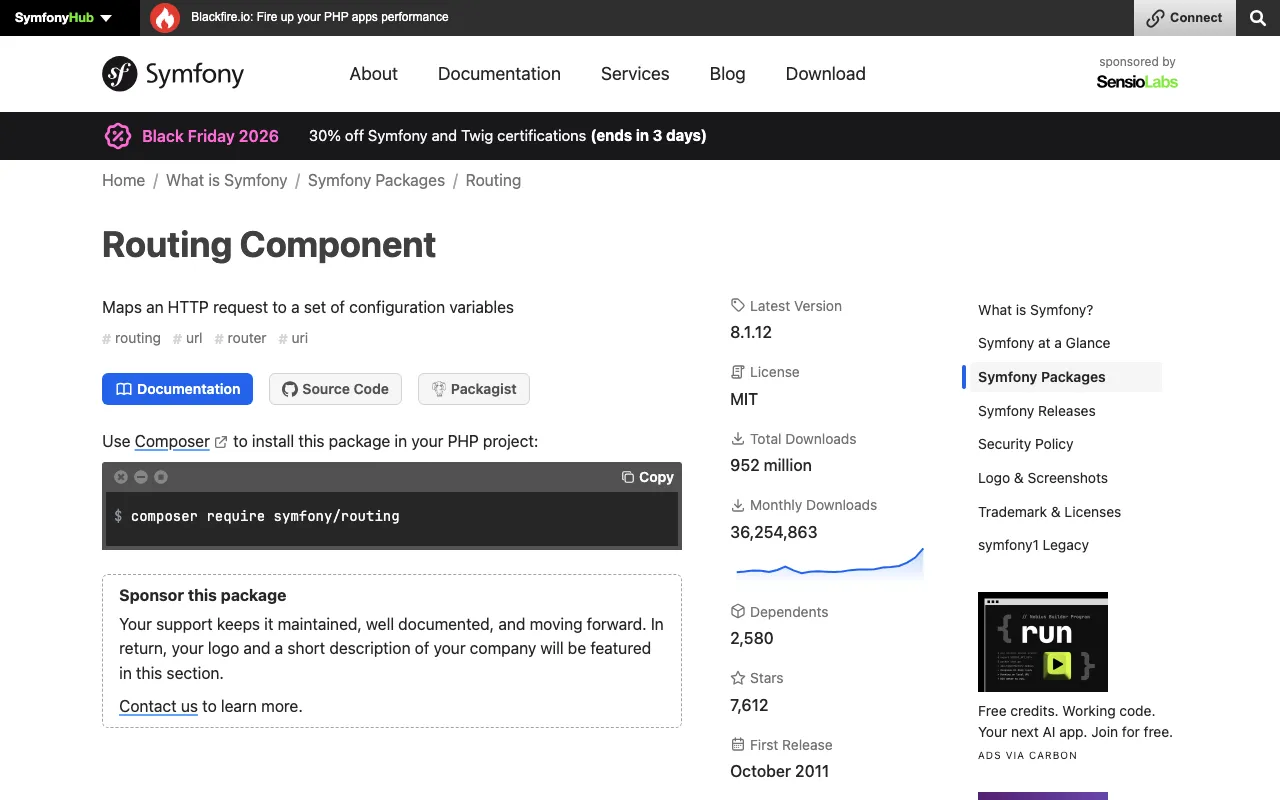
Routing screenshot

The Routing component matches incoming HTTP requests to routes and extracts configuration variables such as controller and parameters. It is installed as a Composer package for PHP apps.

Overview

Symfony Routing maps an HTTP request to a set of configuration variables that downstream code uses to dispatch the application. It is distributed as a standalone Symfony package that PHP projects add with Composer alongside other Symfony components or full-stack Symfony applications.

The component focuses on defining routes, matching request paths and methods, and generating URLs from route names and parameters. Documentation and source are published on the Symfony packages site; releases follow the broader Symfony versioning cadence.

Many PHP content management, commerce, and framework projects depend on this router, including Drupal, TYPO3, PrestaShop, Laravel integrations, and Symfony itself, as listed on the package page. It is MIT-licensed and widely reused outside the Symfony framework core.

For adopters, installation is a single Composer require of the symfony/routing package. The package is maintained as part of the Symfony ecosystem with public issue tracking and contribution flows through the main Symfony project.

Key features

  • HTTP request to route matching
  • Route parameter extraction
  • URL generation from route definitions
  • Composer-installable PHP package
  • Symfony component documentation
  • Integration with Symfony HttpFoundation
  • Used across major PHP CMS and shops
  • MIT-licensed reusable library

Use cases

  • Defining REST and web routes in PHP
  • Building custom PHP microframeworks
  • Sharing routing logic in Symfony apps
  • Migrating apps that need named routes
  • Centralizing URL generation in CMS plugins

Tags

Similar software

ECC

Open-source agent engineering toolkit for coding harnesses

ECC adds planning, verification, review, memory, skills, and security scanning to coding agents such as Claude Code, Codex, and Cursor. It installs as plugins, packages, and managed adapters across multiple harnesses.

★ 311.7k⟳ 8 days agoMIT
Frameworks & PlatformsDesktop/CLI app

React

JavaScript library for web and native user interfaces

React helps developers build interfaces from reusable components that manage their own state. Views update declaratively when underlying data changes.

★ 253k⟳ 2 days agoMIT
Frameworks & PlatformsDesktop/CLI app

Flutter

Open-source UI framework for multi-platform apps from one codebase

Flutter is an SDK for building user experiences for mobile, web, and desktop from a single codebase. It uses the Dart language and compiles to native machine code or web targets.

★ 181.5k⟳ todayBSD-3-Clause
Open Source Alternative to:Ionic Enterprise

Bootstrap

Responsive HTML, CSS, and JavaScript front-end toolkit

Bootstrap supplies CSS, JavaScript, and Sass-based styles for building responsive, mobile-first sites. It ships prebuilt grid layouts, UI components, and optional JavaScript plugins.

★ 175.1k⟳ 2 days agoMIT

Langflow

Visual low-code builder for AI agents and workflows

Langflow is a visual builder for AI agents and workflows. Flows can be customized in Python and deployed as an API or as an MCP server, with support for major LLMs and vector databases.

★ 157k⟳ todayMIT
Open Source Alternative to:Relevance AIVoiceflow

LangChain

Framework for agents and LLM-powered applications

LangChain helps developers chain interoperable components and integrations to build agents and LLM-powered applications. It offers a standard interface for models, embeddings, vector stores, and related pieces.

★ 150.1k⟳ 2 days agoMIT






