qmetrics.net

Req

Batteries-included HTTP client for Elixir

Frameworks & PlatformsDesktop/CLI app
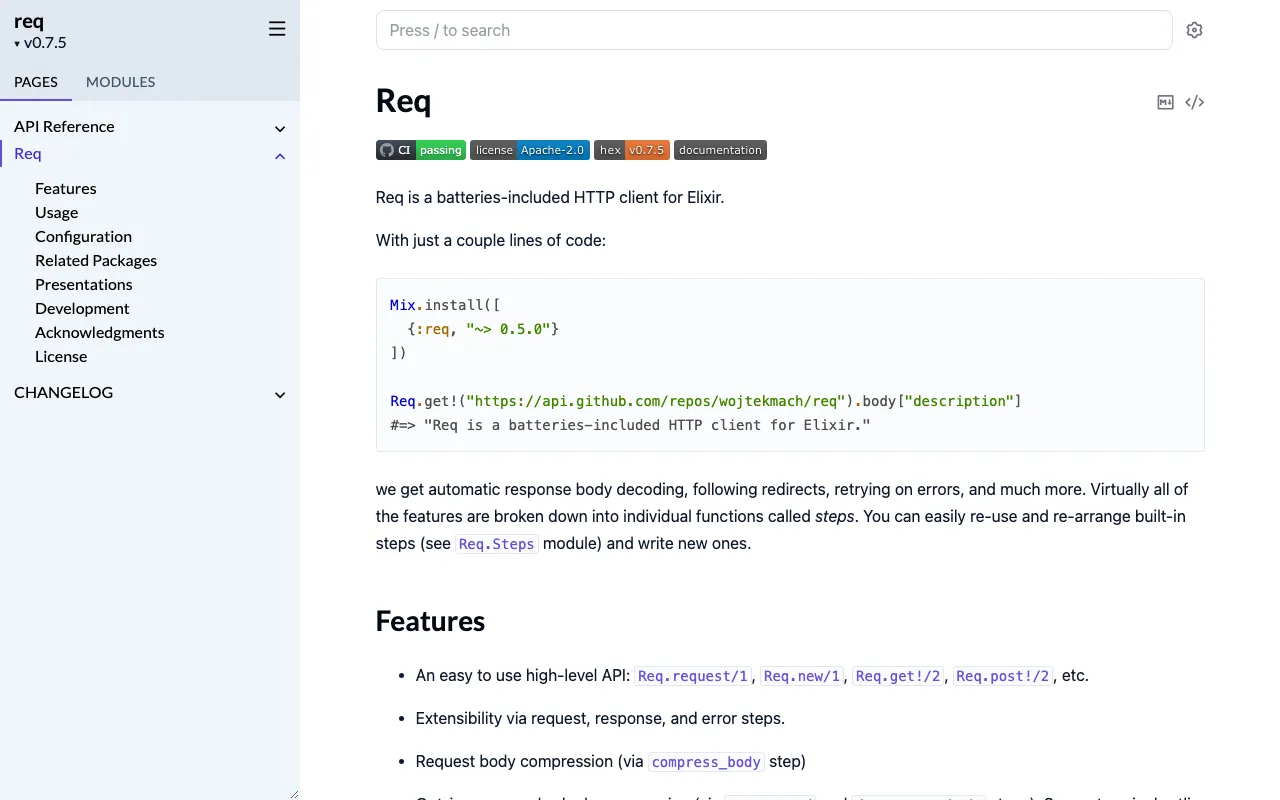
Req screenshot

Req is an Elixir HTTP client with a high-level API and composable steps for decoding, redirects, retries, auth, and streaming.

Overview

Req is a batteries-included HTTP client for Elixir. With a few lines of setup you get automatic response decoding, redirect following, error retries, and related behavior. Features are split into individual steps that you can reorder, reuse, or replace with custom logic.

The library exposes convenience calls such as get and post, streaming APIs, and a request struct for shared defaults like base URLs. Built-in steps cover body compression and decompression (gzip, brotli, zstd), JSON and form encoding, query params, path templates, several authentication styles, AWS Sig V4, ranges, checksum verification, redirects, retries, and HTTP error handling.

Request and response bodies can stream from enumerables or into collectables or callbacks. Req plugs into Finch by default with swappable adapters, supports running against a Plug for tests via Req.Test, and allows packaging custom steps as plugins. Related community packages extend S3, GitHub OAuth, HTML parsing, proxies, and server-sent events.

Configuration is centralized on Req.new with lower-level pool and timeout options documented for the Finch adapter. The design draws on patterns from common HTTP tools while staying idiomatic to Elixir's step pipeline model.

Key features

  • Composable request and response steps
  • Automatic decode and decompression
  • Redirect follow and retry on errors
  • JSON, multipart, and urlencoded bodies
  • Bearer, Digest, Basic, and AWS auth
  • Request and response streaming
  • Plug-based test doubles
  • Finch adapter by default

Use cases

  • Calling REST APIs from Elixir
  • Shared HTTP client with base URL
  • Custom middleware via steps or plugins
  • Streaming uploads and downloads

Tags

Similar software

ECC

Open-source agent engineering toolkit for coding harnesses

ECC adds planning, verification, review, memory, skills, and security scanning to coding agents such as Claude Code, Codex, and Cursor. It installs as plugins, packages, and managed adapters across multiple harnesses.

★ 311.7k⟳ 8 days agoMIT
Frameworks & PlatformsDesktop/CLI app

React

JavaScript library for web and native user interfaces

React helps developers build interfaces from reusable components that manage their own state. Views update declaratively when underlying data changes.

★ 253k⟳ 2 days agoMIT
Frameworks & PlatformsDesktop/CLI app

Flutter

Open-source UI framework for multi-platform apps from one codebase

Flutter is an SDK for building user experiences for mobile, web, and desktop from a single codebase. It uses the Dart language and compiles to native machine code or web targets.

★ 181.5k⟳ todayBSD-3-Clause
Open Source Alternative to:Ionic Enterprise

Bootstrap

Responsive HTML, CSS, and JavaScript front-end toolkit

Bootstrap supplies CSS, JavaScript, and Sass-based styles for building responsive, mobile-first sites. It ships prebuilt grid layouts, UI components, and optional JavaScript plugins.

★ 175.1k⟳ 2 days agoMIT

Langflow

Visual low-code builder for AI agents and workflows

Langflow is a visual builder for AI agents and workflows. Flows can be customized in Python and deployed as an API or as an MCP server, with support for major LLMs and vector databases.

★ 157k⟳ todayMIT
Open Source Alternative to:Relevance AIVoiceflow

LangChain

Framework for agents and LLM-powered applications

LangChain helps developers chain interoperable components and integrations to build agents and LLM-powered applications. It offers a standard interface for models, embeddings, vector stores, and related pieces.

★ 150.1k⟳ 2 days agoMIT






