qmetrics.net

Relay

GraphQL client framework for React apps

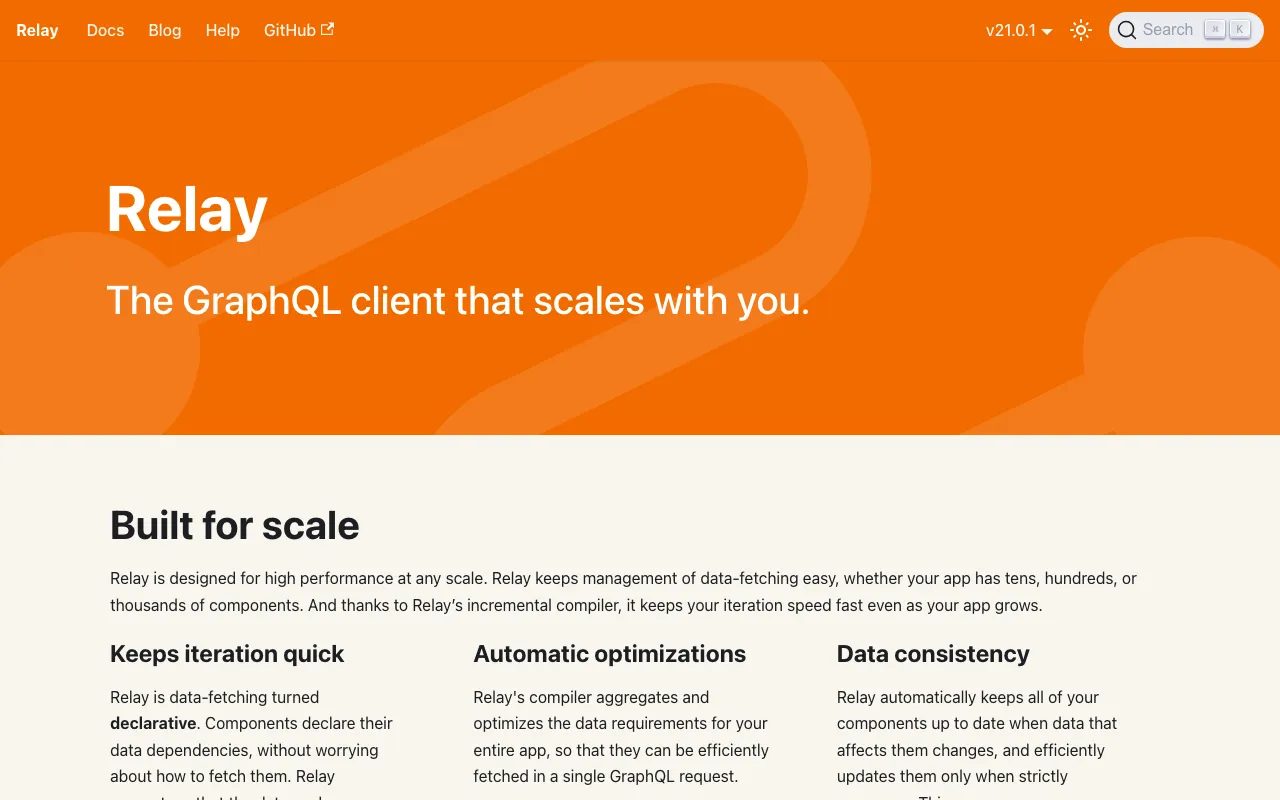
Relay screenshot

Relay connects React views to GraphQL backends with declarative data requirements, colocated queries, and compiler-driven network batching.

Overview

Relay is a JavaScript framework for React applications that load and update server data through GraphQL. Components declare what fields they need via GraphQL fragments and queries placed beside the UI that consumes them, so data dependencies stay local and readable.

A build-time compiler aggregates fragment and query requirements across the app, deduplicates fields, and issues efficient GraphQL requests. Runtime APIs such as loadQuery, usePreloadedQuery, useFragment, and mutation helpers keep the store consistent, support optimistic updates, and limit re-renders when related records change.

The design assumes GraphQL conventions including connections for pagination, global object identification via the Node interface, and standard fragment composition. It integrates with Create React App and Next.js and targets both web React and React Native codebases.

Compared with imperative store access, Relay emphasizes declarative fetching, automatic cache updates after mutations, and optional Flow or TypeScript types generated per component.

Key features

  • Colocated GraphQL queries and fragments
  • Compiler-optimized query aggregation
  • Declarative loadQuery data loading
  • GraphQL mutation and optimistic updates
  • Automatic store consistency on changes
  • Connection-based list pagination
  • Global object identification support
  • Generated Flow or TypeScript types

Use cases

  • Large-scale React data layers
  • GraphQL-backed web applications
  • React Native mobile clients
  • Paginated list UIs
  • Teams wanting typed component data

Similar software

ECC

Open-source agent engineering toolkit for coding harnesses

ECC adds planning, verification, review, memory, skills, and security scanning to coding agents such as Claude Code, Codex, and Cursor. It installs as plugins, packages, and managed adapters across multiple harnesses.

★ 311.7k⟳ 8 days agoMIT
Frameworks & PlatformsDesktop/CLI app

React

JavaScript library for web and native user interfaces

React helps developers build interfaces from reusable components that manage their own state. Views update declaratively when underlying data changes.

★ 253k⟳ 2 days agoMIT
Frameworks & PlatformsDesktop/CLI app

Flutter

Open-source UI framework for multi-platform apps from one codebase

Flutter is an SDK for building user experiences for mobile, web, and desktop from a single codebase. It uses the Dart language and compiles to native machine code or web targets.

★ 181.5k⟳ todayBSD-3-Clause
Open Source Alternative to:Ionic Enterprise

Bootstrap

Responsive HTML, CSS, and JavaScript front-end toolkit

Bootstrap supplies CSS, JavaScript, and Sass-based styles for building responsive, mobile-first sites. It ships prebuilt grid layouts, UI components, and optional JavaScript plugins.

★ 175.1k⟳ 2 days agoMIT

Langflow

Visual low-code builder for AI agents and workflows

Langflow is a visual builder for AI agents and workflows. Flows can be customized in Python and deployed as an API or as an MCP server, with support for major LLMs and vector databases.

★ 157k⟳ todayMIT
Open Source Alternative to:Relevance AIVoiceflow

LangChain

Framework for agents and LLM-powered applications

LangChain helps developers chain interoperable components and integrations to build agents and LLM-powered applications. It offers a standard interface for models, embeddings, vector stores, and related pieces.

★ 150.1k⟳ 2 days agoMIT