qmetrics.net

Redux Saga

Redux middleware for generator-based side effects

Frameworks & PlatformsDesktop/CLI app
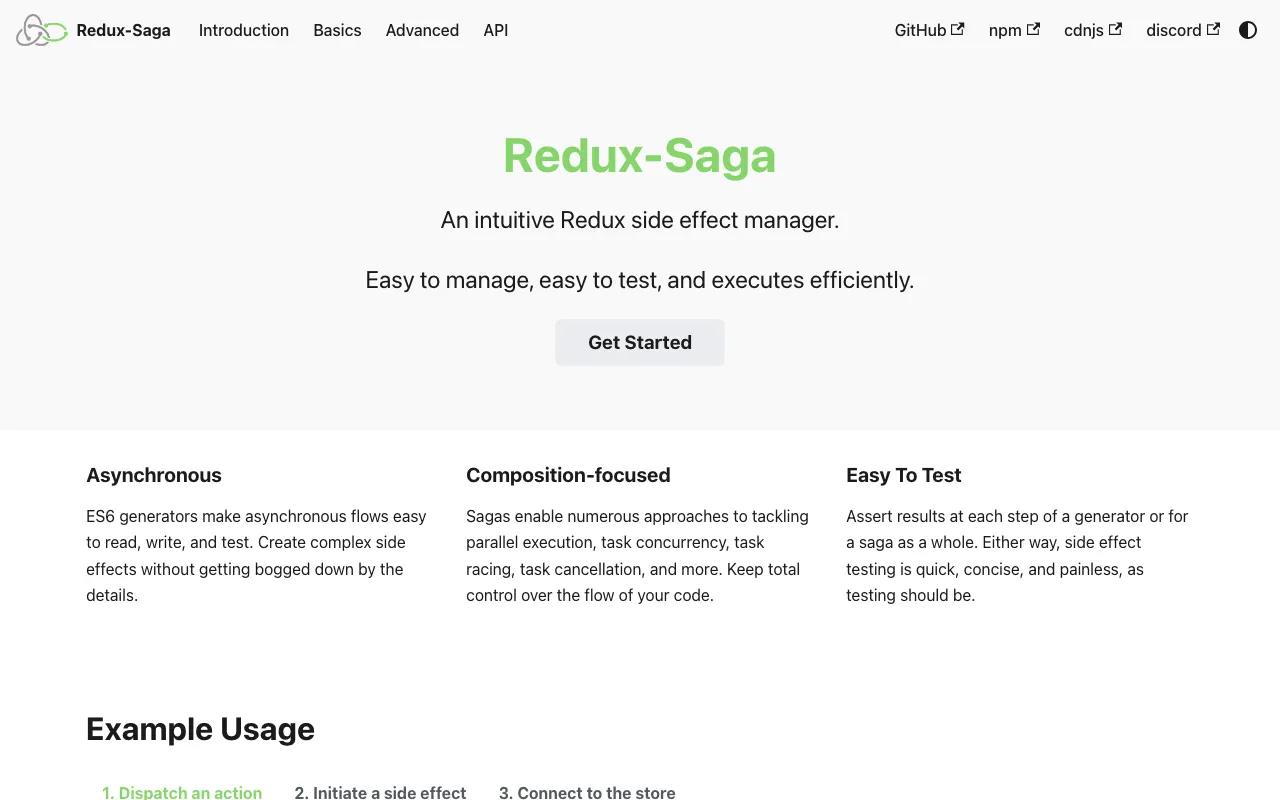
Redux Saga screenshot

Redux Saga runs asynchronous workflows—such as API calls—in a separate saga thread controlled through Redux actions, using ES6 generators for readable effect flows.

Overview

Redux Saga is middleware for Redux applications that isolates side effects in sagas, described as threads responsible only for asynchronous and impure work. Sagas can be started, paused, and cancelled with normal Redux actions, read the full store state, and dispatch further actions, which keeps reducers focused on pure state updates.

Effects such as takeEvery, call, and put let developers express data fetching, parallelism, racing tasks, and cancellation without deeply nested callbacks. Generator syntax is intentionally retained rather than async/await alone because it preserves fine-grained control over when effects run and how they are cancelled.

Integration follows a common pattern: create saga middleware, attach it when configuring the store, run root sagas after the store exists, and listen for action types like user fetch requests to trigger worker sagas that call APIs and dispatch success or failure actions. Documentation covers concepts, recipes, TypeScript setup requirements, and browser UMD builds for non-bundler experiments.

Teams reach for Redux Saga when Redux Thunk-style chains become hard to test or when they need explicit orchestration of concurrent asynchronous workflows inside Redux apps.

Key features

  • Generator-based saga middleware
  • takeEvery, call, and put effects
  • Task cancellation and concurrency control
  • Full access to Redux state and dispatch
  • Testable step-by-step saga flows
  • Works with Redux Toolkit configureStore
  • Browser UMD build for simple demos
  • Documented patterns and API reference

Use cases

  • Data fetching pipelines in Redux apps
  • Long-running background synchronization
  • Parallel and racing async operations
  • Replacing callback-heavy thunk logic
  • User workflows triggered by Redux actions

Tags

Similar software

ECC

Open-source agent engineering toolkit for coding harnesses

ECC adds planning, verification, review, memory, skills, and security scanning to coding agents such as Claude Code, Codex, and Cursor. It installs as plugins, packages, and managed adapters across multiple harnesses.

★ 311.7k⟳ 8 days agoMIT
Frameworks & PlatformsDesktop/CLI app

React

JavaScript library for web and native user interfaces

React helps developers build interfaces from reusable components that manage their own state. Views update declaratively when underlying data changes.

★ 253k⟳ 2 days agoMIT
Frameworks & PlatformsDesktop/CLI app

Flutter

Open-source UI framework for multi-platform apps from one codebase

Flutter is an SDK for building user experiences for mobile, web, and desktop from a single codebase. It uses the Dart language and compiles to native machine code or web targets.

★ 181.5k⟳ todayBSD-3-Clause
Open Source Alternative to:Ionic Enterprise

Bootstrap

Responsive HTML, CSS, and JavaScript front-end toolkit

Bootstrap supplies CSS, JavaScript, and Sass-based styles for building responsive, mobile-first sites. It ships prebuilt grid layouts, UI components, and optional JavaScript plugins.

★ 175.1k⟳ 2 days agoMIT

Langflow

Visual low-code builder for AI agents and workflows

Langflow is a visual builder for AI agents and workflows. Flows can be customized in Python and deployed as an API or as an MCP server, with support for major LLMs and vector databases.

★ 157k⟳ todayMIT
Open Source Alternative to:Relevance AIVoiceflow

LangChain

Framework for agents and LLM-powered applications

LangChain helps developers chain interoperable components and integrations to build agents and LLM-powered applications. It offers a standard interface for models, embeddings, vector stores, and related pieces.

★ 150.1k⟳ 2 days agoMIT






