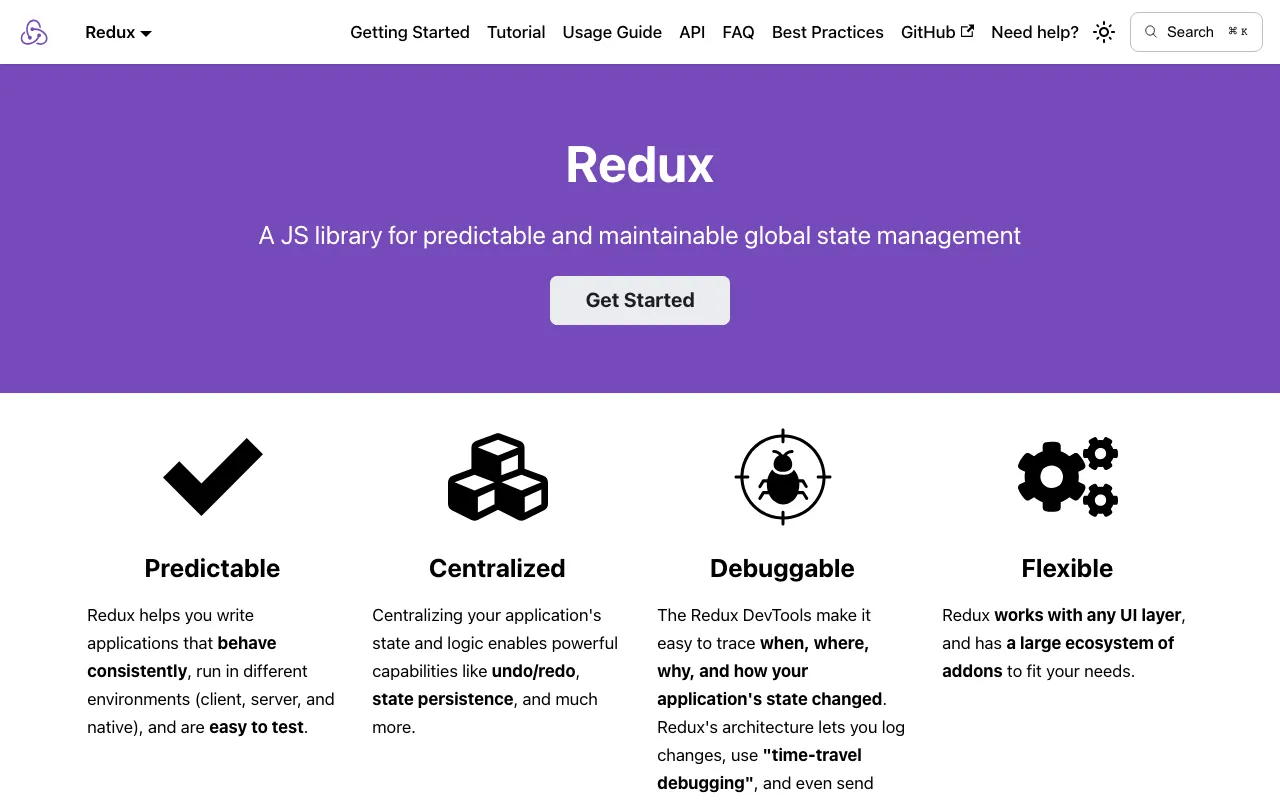
Redux is a JavaScript library for predictable, maintainable global state in applications. It stores app state in a single store updated by dispatched actions and reducer functions.
Overview
Redux helps applications keep behavior consistent across client, server, and native environments and supports testing through a clear data flow. The global state lives in one store; the only way to change it is to dispatch actions that reducers use to compute the next state.
Redux works with React or other view libraries. The core is small and has an ecosystem of add-ons. Redux Toolkit is the recommended way to write Redux logic: it wraps the core, bakes in suggested patterns, simplifies common tasks, and reduces typical mistakes.
Centralizing state and logic enables capabilities such as undo and redo, state persistence, and detailed change tracing. Redux DevTools support time-travel debugging, logging, and error reporting. Official companions include React Redux bindings, Reselect for memoized selectors, and Redux Toolkit as an opinionated toolset.
New projects can start from official Redux Toolkit templates for Vite, Next.js, or React Native with Expo. Documentation covers introductions, tutorials, usage guides, and API references for both the core and Redux Toolkit.
Key features
- Single centralized application store
- Actions and pure reducer updates
- Redux Toolkit recommended workflows
- Works with React and other UI layers
- DevTools with time-travel debugging
- Undo, redo, and persistence patterns
- Small core with addon ecosystem
- Official React Redux bindings
Use cases
- Shared state across many UI components
- Apps with frequent data changes over time
- Need for a single source of truth
- Testable predictable state transitions




 Ionic Enterprise


