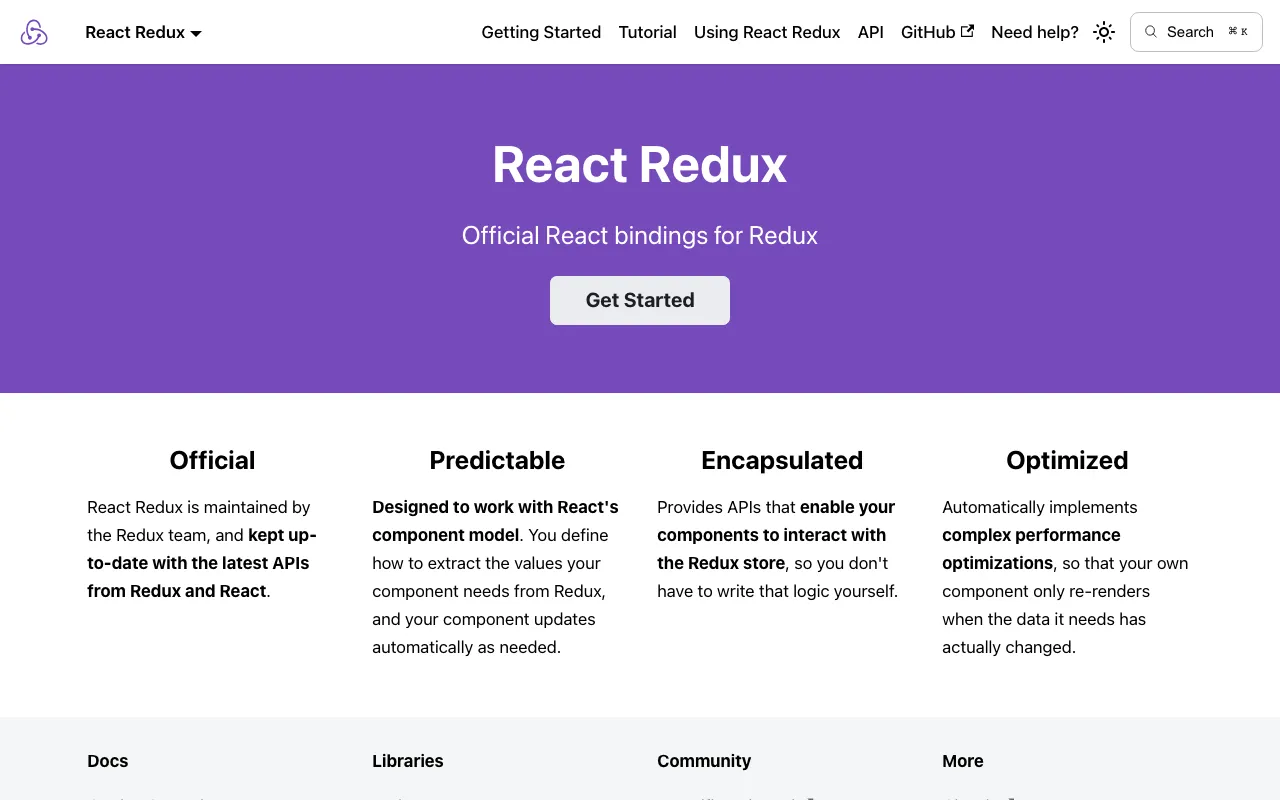
React Redux connects React components to a Redux store with hooks and bindings maintained by the Redux team, requiring current React releases for recent versions.
Overview
React Redux provides the supported way to read Redux state and dispatch actions from React components. It is performant and flexible, with APIs that let each component subscribe only to the store slices it needs so updates stay targeted.
The library integrates with the wider Redux ecosystem, including Redux Toolkit templates for Vite and Next.js that already wire up store configuration. For existing applications you install React Redux alongside Redux itself and connect a store created in your app. Guides cover how bindings evolved, how subscription logic avoids unnecessary renders, and how to structure selectors and dispatch patterns.
React Redux is the official companion to Redux and Reselect, with guides, tutorials, FAQs, and API references. It assumes a modern React runtime and module bundler workflow, though historical UMD builds on CDNs remain available for legacy experiments.
Application teams use it when they want maintained, predictable glue between React’s component model and Redux’s centralized state container instead of hand-rolling context wiring.
Key features
- Hooks and connect APIs for Redux
- Selective re-render optimizations
- Maintained by the Redux core team
- Works with Redux Toolkit templates
- Selector-friendly component subscriptions
- Published docs and usage guides
- Supports modern React releases
- Integrates with standard bundlers
Use cases
- React apps with centralized Redux state
- Migrating class components to hooks
- Large dashboards with shared store data
- Next.js or Vite apps using Redux Toolkit
- Teams wanting official Redux integration




 Ionic Enterprise


