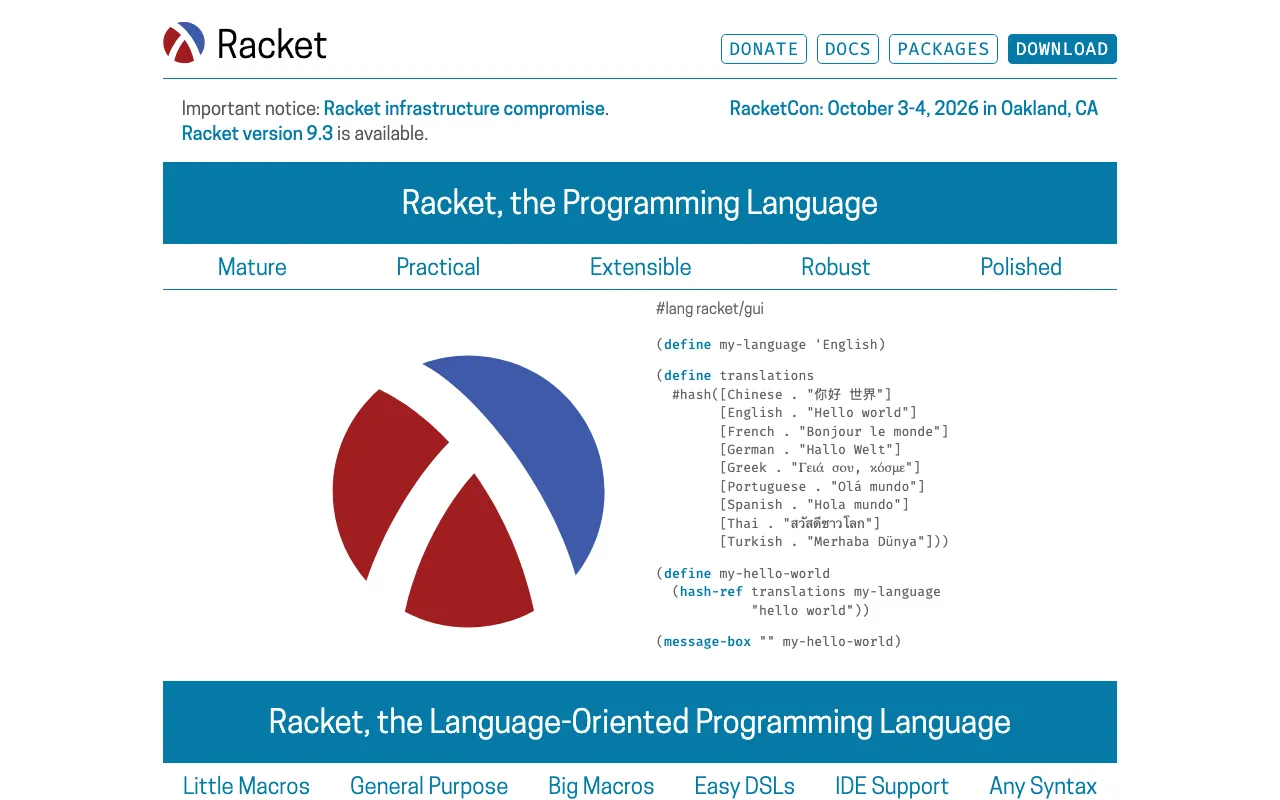
Programming language and runtime with macros, cross-platform GUI, package system, and tooling for building embedded domain-specific languages.
Overview
Racket is a general-purpose language centered on language-oriented programming: programmers extend syntax with macros and can define new languages as libraries. Pre-built binaries and source distributions install a runtime, extensive standard libraries, and documentation.
The ecosystem includes a cross-platform GUI framework, web server libraries, math and database packages, gradual typing via Typed Racket, and higher-order software contracts. Thousands of community packages add graphics, simulations, education tools, and more, installable from the built-in package manager.
DrRacket is the primary IDE, with support extended to alternative surface syntax through source-location-aware macros. Editors such as VS Code, Emacs, and Vim have Racket integrations. Standalone executables and a foreign-function interface help deliver applications.
Racket emphasizes creating DSLs quickly inside the IDE, combining functional and object-oriented styles via libraries rather than core syntax. Educational materials, books, and a summer school support learners and researchers.
Key features
- Powerful hygienic macros
- Cross-platform GUI library
- Package manager and catalog
- Typed Racket gradual typing
- Higher-order software contracts
- DrRacket interactive IDE
- Web server and networking libs
- Domain-specific language tooling
Use cases
- Teaching programming and CS courses
- Research languages and DSLs
- Cross-platform desktop GUI apps
- Web applications in Racket
- Language experimentation in IDE




 Ionic Enterprise


