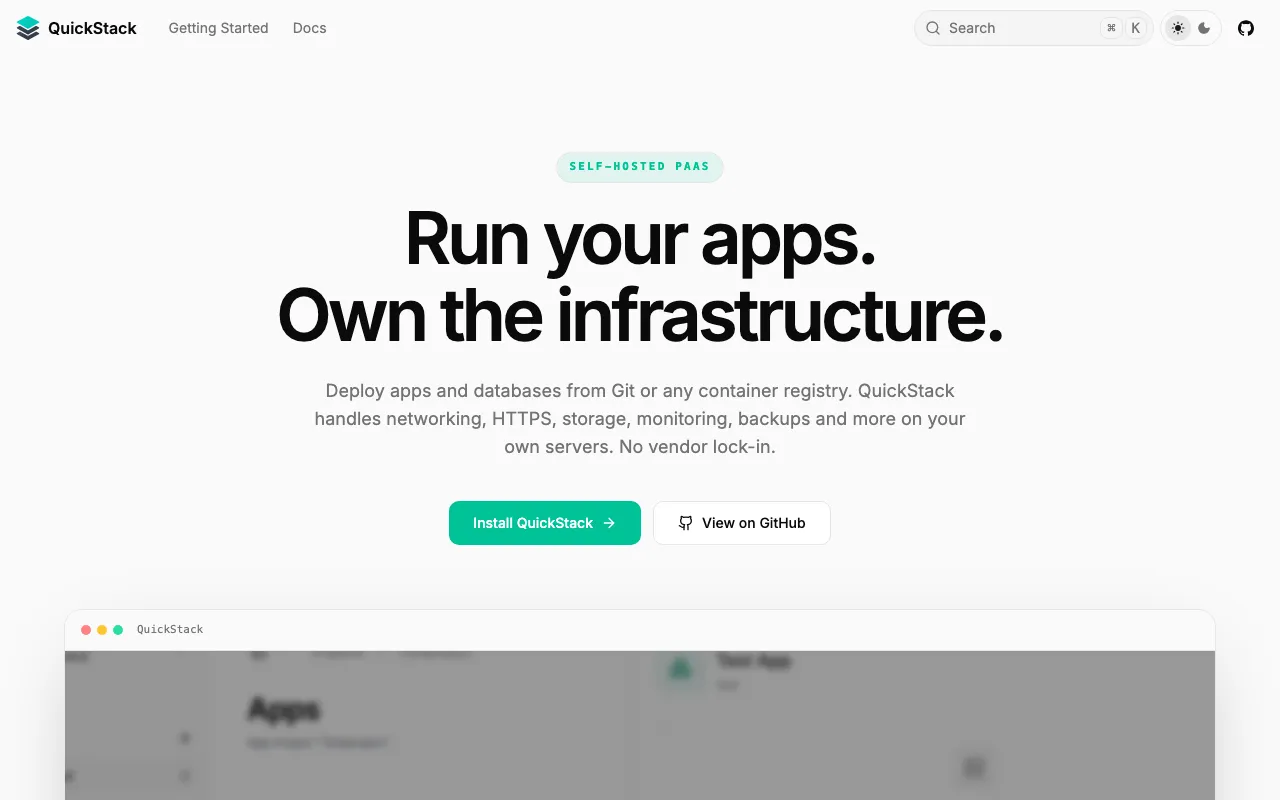
QuickStack deploys Git repos and container images to your VPS or bare metal through a web UI, with databases, HTTPS, backups, monitoring, and team access.
Overview
QuickStack is a self-hosted platform-as-a-service that installs on your own Linux servers and manages application and database deployments from a browser-based interface. It targets teams that want git-push style workflows without giving up ownership of the underlying machines.
Installations use a one-line shell bootstrap on a fresh Ubuntu or Debian host meeting minimum CPU, RAM, and disk requirements. The platform builds from public or private Git repositories and registries using guided framework presets or custom Dockerfiles, then routes traffic with automatic Let's Encrypt certificates.
A project canvas groups apps, databases, networks, configuration, builds, logs, backups, and lifecycle actions. One-click templates provision PostgreSQL, MySQL, MariaDB, MongoDB, and Redis, while Longhorn-backed volumes support multi-node storage. Operators can scale replicas, set resources, stream logs, open web terminals, schedule S3-compatible backups, and roll back releases.
Under the hood QuickStack manages K3s Kubernetes and exposes those primitives through simplified UI flows. Team features include user groups, roles, OIDC SSO, two-factor authentication, expiring API keys, webhooks, and optional MCP integration for AI clients.
Key features
- One-command server installation
- Git and registry deploy pipelines
- Framework and Dockerfile builds
- One-click databases and Redis
- Automatic HTTPS custom domains
- Logs, metrics, and web terminal
- S3-compatible scheduled backups
- OIDC SSO, 2FA, and API keys
Use cases
- Run production apps on your own VPS
- Host client projects with staging URLs
- Operate databases beside app containers
- Give a team a shared deploy dashboard
- Avoid vendor lock-in for PaaS workflows
Open-source alternative to
 Heroku
“Open-source, self-hostable alternative to Vercel, Netlify, Railway and Heroku.” source
 Netlify
“Open-source, self-hostable alternative to Vercel, Netlify, Railway and Heroku.” source
RRailway“Open-source, self-hostable alternative to Vercel, Netlify, Railway and Heroku.” source
 Vercel
“Free, open-source, self-hosted PaaS alternative to Vercel, Netlify, Railway and Heroku.” source
Does the same job as
QuickStack doesn't name these products itself, but its own description shows it does the same job.