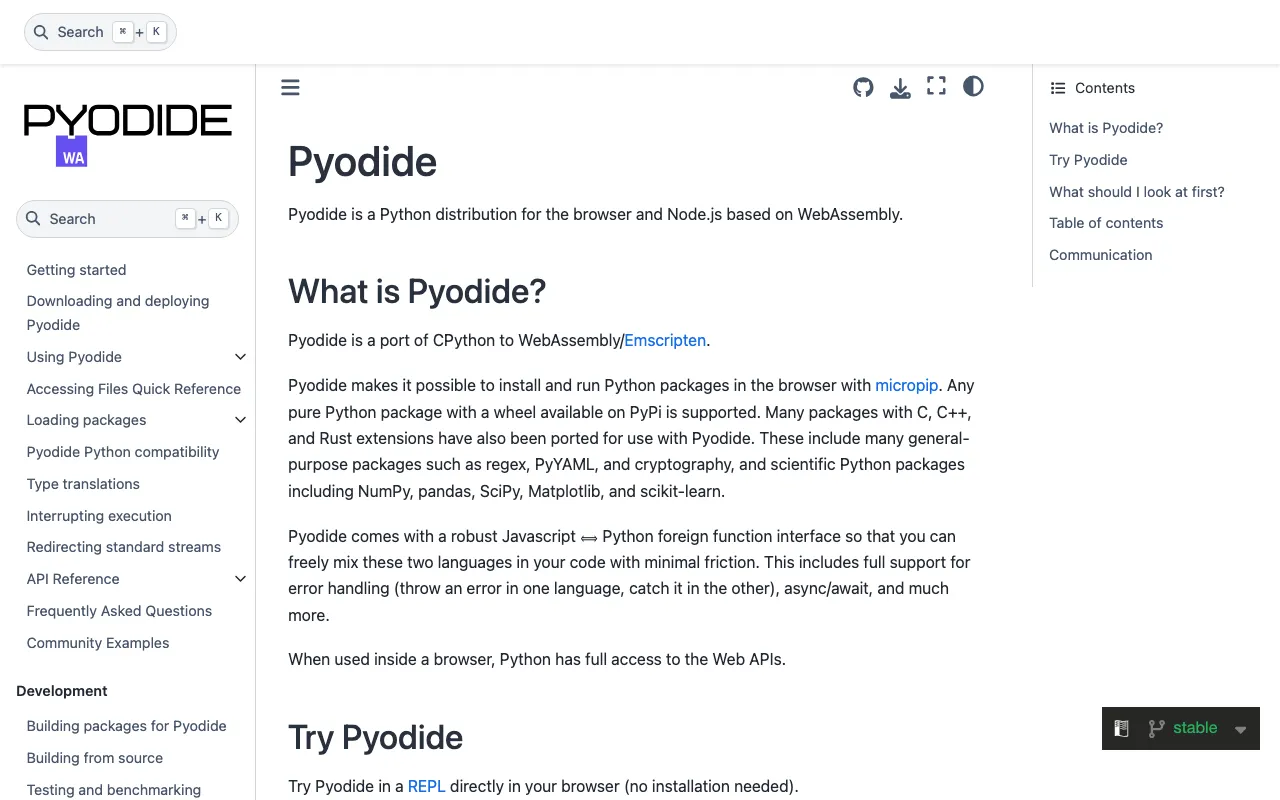
Pyodide ports CPython to WebAssembly so Python runs in browsers or Node.js. micropip installs wheels, including many scientific packages.
Overview
Pyodide is a Python distribution built on a CPython build compiled to WebAssembly with Emscripten. It targets JavaScript hosts such as web browsers and Node.js, letting pages or bundler-driven apps embed a full interpreter rather than calling a remote server.
Package installation inside the runtime uses micropip against PyPI wheels for pure Python projects, plus a growing set of native extensions repackaged for WebAssembly. Named examples span general libraries and scientific stacks including NumPy, pandas, SciPy, Matplotlib, and scikit-learn. A JavaScript-to-Python foreign function interface supports mixed-language code with errors, async, and callbacks bridged across runtimes.
When execution happens in a browser, Python code can reach Web APIs exposed to JavaScript. Consumers may use hosted distributions, download release artifacts to self-serve with a web server, or integrate via modern bundlers. The effort began as part of the discontinued Iodide notebook experiment and continues as a community-governed runtime with documentation, REPL demos, and tooling for package maintainers.
Key features
- CPython on WebAssembly
- Browser and Node.js hosts
- micropip package installer
- JavaScript Python FFI
- Scientific package ports
- Browser Web API access
- Bundler integration docs
- In-browser REPL demo
Use cases
- Interactive Python in web pages
- Client-side data science demos
- Mixed JS and Python web apps
- Teaching Python without installs
- Self-hosted Pyodide deployments




 Ionic Enterprise


