qmetrics.net

Pybind11

Header-only C++11 bindings generator for Python

Frameworks & PlatformsDesktop/CLI app
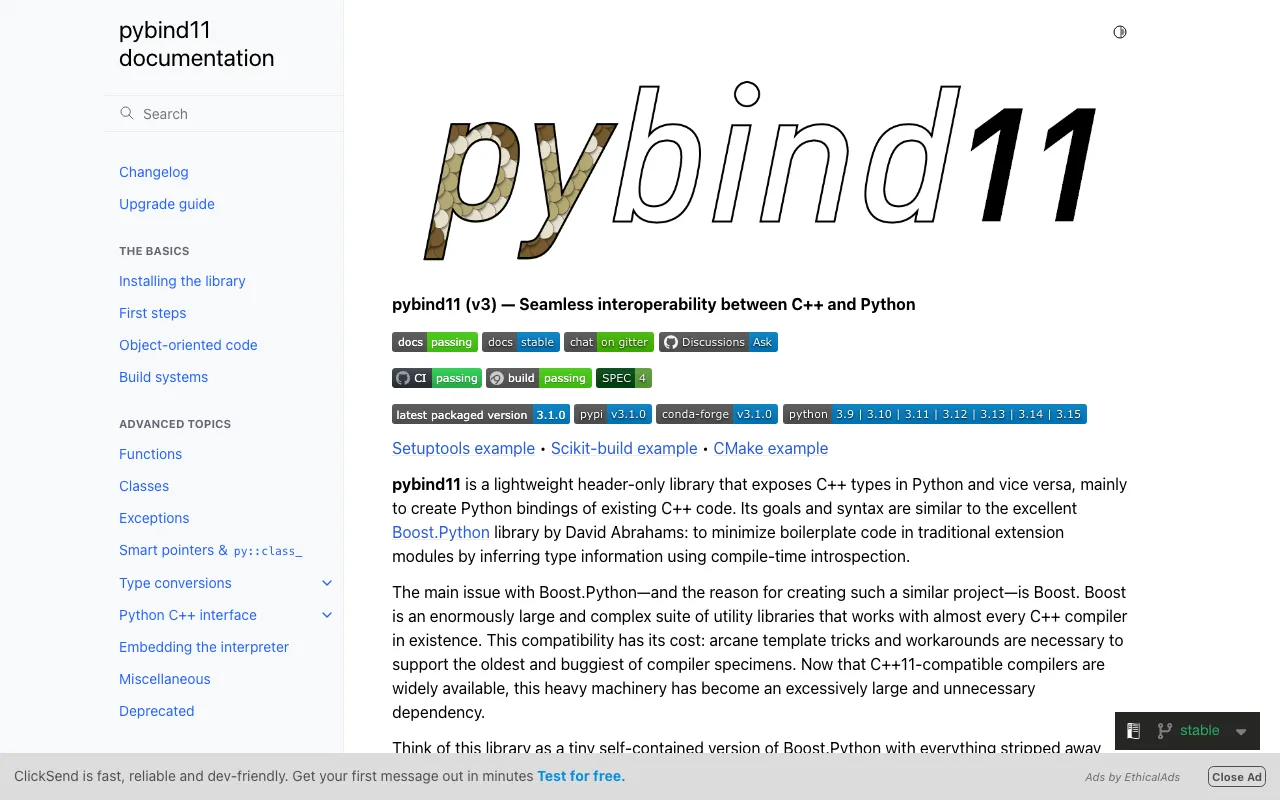
Pybind11 screenshot

pybind11 exposes C++ types in Python and vice versa with minimal boilerplate. It targets extension authors who want a compact alternative to large binding stacks.

Overview

pybind11 is a lightweight, header-only library for creating Python bindings to existing C++ code and bridging types between the languages. Its design goals parallel Boost.Python—reducing boilerplate through compile-time introspection—while avoiding a dependency on the full Boost distribution.

Core mappings include functions with value, reference, or pointer semantics; instance and static methods; overloaded functions; attributes; exceptions; enumerations; callbacks; iterators; operators; inheritance; STL containers; and smart pointers. Virtual C++ methods can be overridden from Python, and integrated NumPy support is documented.

The library stays in a small set of headers with no extra link libraries required. It supports CPython, PyPy, and GraalPy through an implementation-agnostic interface, uses C++11 features such as lambdas and variadic templates, and documents buffer protocol exposure, vectorized NumPy calls, slice access, and optional pickling for bound types.

Tutorial and API reference material is published on pybind11.readthedocs.io, with build examples for CMake, setuptools, scikit-build, and related tooling. Continuous integration exercises multiple operating systems, Python versions, and compilers, though specific OS names are not enumerated in the summary source beyond general platform coverage.

Key features

  • Header-only binding macros
  • C++11 lambda and STL support
  • NumPy and buffer protocol integration
  • Multiple and virtual inheritance
  • Smart pointer reference counting
  • Overloaded functions and operators
  • CPython, PyPy, and GraalPy support
  • Pickle support for bound types

Use cases

  • Wrapping performance-critical C++ for Python
  • Exposing C++ classes to Python packages
  • Migrating off heavier binding frameworks
  • NumPy-accelerated scientific extensions

Tags

Similar software

ECC

Open-source agent engineering toolkit for coding harnesses

ECC adds planning, verification, review, memory, skills, and security scanning to coding agents such as Claude Code, Codex, and Cursor. It installs as plugins, packages, and managed adapters across multiple harnesses.

★ 311.7k⟳ 8 days agoMIT
Frameworks & PlatformsDesktop/CLI app

React

JavaScript library for web and native user interfaces

React helps developers build interfaces from reusable components that manage their own state. Views update declaratively when underlying data changes.

★ 253k⟳ 2 days agoMIT
Frameworks & PlatformsDesktop/CLI app

Flutter

Open-source UI framework for multi-platform apps from one codebase

Flutter is an SDK for building user experiences for mobile, web, and desktop from a single codebase. It uses the Dart language and compiles to native machine code or web targets.

★ 181.5k⟳ todayBSD-3-Clause
Open Source Alternative to:Ionic Enterprise

Bootstrap

Responsive HTML, CSS, and JavaScript front-end toolkit

Bootstrap supplies CSS, JavaScript, and Sass-based styles for building responsive, mobile-first sites. It ships prebuilt grid layouts, UI components, and optional JavaScript plugins.

★ 175.1k⟳ 2 days agoMIT

Langflow

Visual low-code builder for AI agents and workflows

Langflow is a visual builder for AI agents and workflows. Flows can be customized in Python and deployed as an API or as an MCP server, with support for major LLMs and vector databases.

★ 157k⟳ todayMIT
Open Source Alternative to:Relevance AIVoiceflow

LangChain

Framework for agents and LLM-powered applications

LangChain helps developers chain interoperable components and integrations to build agents and LLM-powered applications. It offers a standard interface for models, embeddings, vector stores, and related pieces.

★ 150.1k⟳ 2 days agoMIT






