qmetrics.net

Proto.Actor .NET

.NET distributed actor model runtime

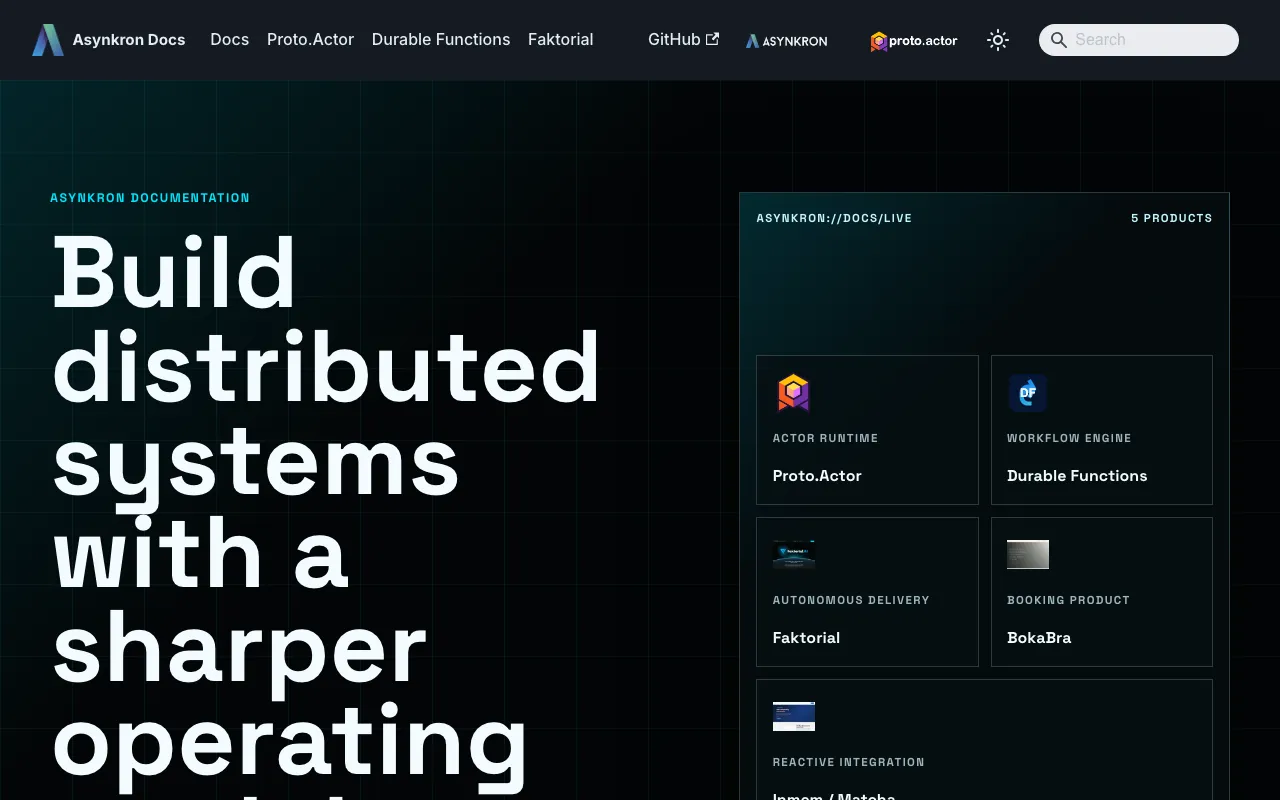
Proto.Actor .NET screenshot

Proto.Actor for .NET is a cross-platform actor library with clustering and message-driven concurrency. Install it as a NuGet package and spawn actors from C# code.

Overview

Proto.Actor is the .NET implementation of the Proto Actor family, offering ultra-fast distributed actors alongside Go and Java/Kotlin variants. Developers define message types, implement actors that handle those messages, spawn instances, and send messages asynchronously within a .NET application.

The design favors a small API, explicit serialization with Protobuf, and building on existing infrastructure such as gRPC streams for networking and Consul for clustering rather than bespoke stacks. The .NET runtime provides a layer for actors, virtual actors, clustering, supervision, and local affinity within a broader distributed-systems product set.

The package ships as Proto.Actor on NuGet. Learning paths point to bundled examples and external docs for concepts like cluster membership gossip and event streams. Getting started covers minimal hello-world spawn and receive patterns, test coverage workflows, and design principles around performance and passing data instead of opaque object graphs.

The codebase covers the .NET runtime only; other language runtimes live in sibling projects. It targets teams building message-driven concurrent systems who want actor semantics with optional clustering extensions documented separately.

Key features

  • Actor spawn and message passing
  • Protobuf-oriented messaging
  • Clustering via documented gossip model
  • gRPC-based networking integration
  • Virtual actors and supervision concepts
  • Minimal public API surface
  • NuGet package distribution
  • Example-driven getting started

Use cases

  • Concurrent services with isolated actor state
  • Distributed .NET systems using actor clustering
  • Message-driven domain logic in C#
  • Prototyping actor patterns before production
  • Learning actor models on .NET

Tags

Similar software

ECC

Open-source agent engineering toolkit for coding harnesses

ECC adds planning, verification, review, memory, skills, and security scanning to coding agents such as Claude Code, Codex, and Cursor. It installs as plugins, packages, and managed adapters across multiple harnesses.

★ 311.7k⟳ 8 days agoMIT
Frameworks & PlatformsDesktop/CLI app

React

JavaScript library for web and native user interfaces

React helps developers build interfaces from reusable components that manage their own state. Views update declaratively when underlying data changes.

★ 253k⟳ 2 days agoMIT
Frameworks & PlatformsDesktop/CLI app

Flutter

Open-source UI framework for multi-platform apps from one codebase

Flutter is an SDK for building user experiences for mobile, web, and desktop from a single codebase. It uses the Dart language and compiles to native machine code or web targets.

★ 181.5k⟳ todayBSD-3-Clause
Open Source Alternative to:Ionic Enterprise

Bootstrap

Responsive HTML, CSS, and JavaScript front-end toolkit

Bootstrap supplies CSS, JavaScript, and Sass-based styles for building responsive, mobile-first sites. It ships prebuilt grid layouts, UI components, and optional JavaScript plugins.

★ 175.1k⟳ 2 days agoMIT

Langflow

Visual low-code builder for AI agents and workflows

Langflow is a visual builder for AI agents and workflows. Flows can be customized in Python and deployed as an API or as an MCP server, with support for major LLMs and vector databases.

★ 157k⟳ todayMIT
Open Source Alternative to:Relevance AIVoiceflow

LangChain

Framework for agents and LLM-powered applications

LangChain helps developers chain interoperable components and integrations to build agents and LLM-powered applications. It offers a standard interface for models, embeddings, vector stores, and related pieces.

★ 150.1k⟳ 2 days agoMIT