
TensorFlow
End-to-end machine learning platform and tooling ecosystem
TensorFlow is a machine learning platform with Python and C++ APIs, optional GPU packages, and companion libraries for data, training, deployment, and visualization.
Self-hosted large language model inference stack
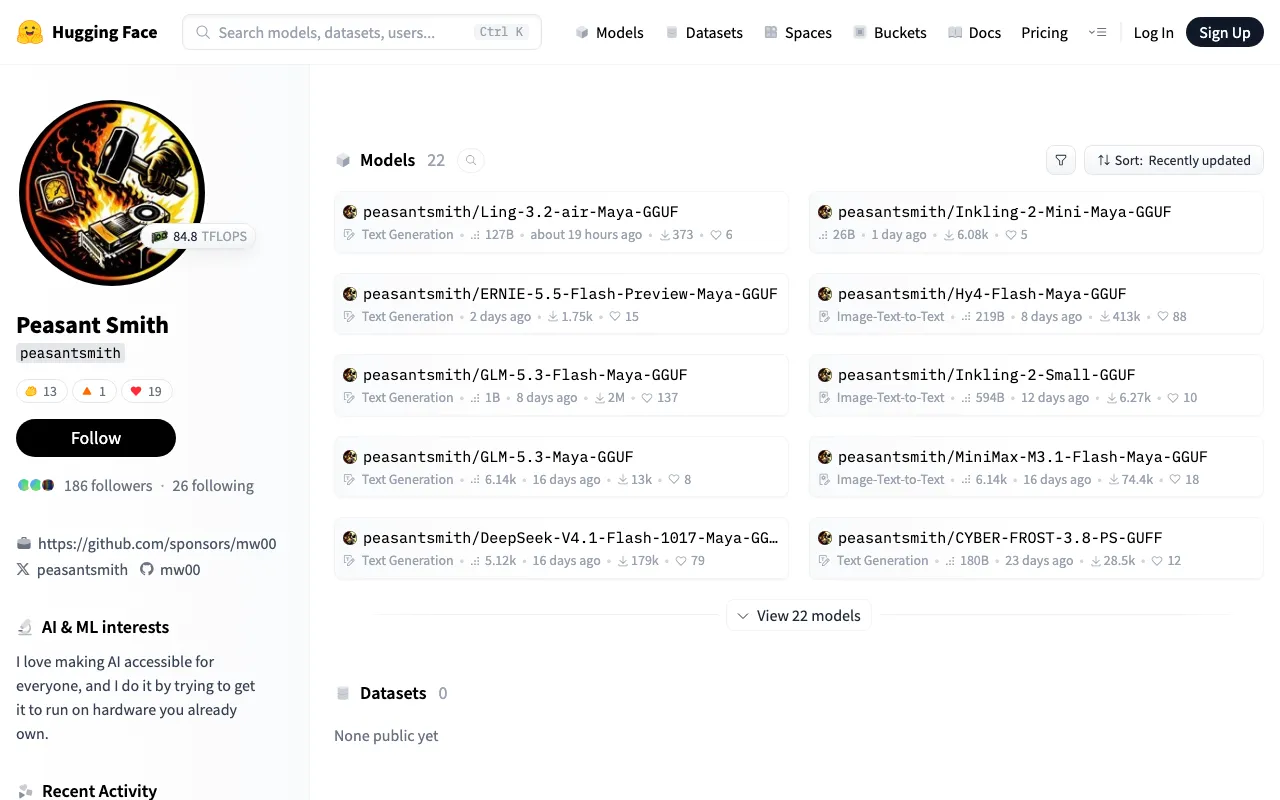
Project Maya runs quantized mixture-of-experts models on local NVIDIA or AMD GPUs. It offers a browser UI, live monitor, and OpenAI- and Anthropic-compatible APIs.
Project Maya is software for serving very large language and multimodal models on hardware you already own instead of remote datacenters. It ships custom quantized builds of models such as GLM-5.3-Flash, DeepSeek-V4.1-Flash, MiniMax-M3.1-Flash, Hy4-Flash, Ling-3.2-air, and Inkling 2 Mini, each with an engine tuned to that architecture.
Inference tiers labeled XS through L trade disk size against fidelity and target memory pools combining VRAM and RAM. Active experts stay on the GPU, the next candidates sit in RAM, and the remainder can live on NVMe, with movement as conversations progress. Setup scripts measure GPUs, CPU, memory, and storage and recommend a quant; during normal use nothing leaves the machine.
The stack exposes chat and monitoring in a browser, picture input on supported models, thinking levels, a models page to download and load weights, and concurrent requests on several Flash variants. Tool calls work through APIs meant to match OpenAI and Anthropic clients, which suits coding agents and local multi-session use.
Supported hardware spans NVIDIA from V100 and RTX 20 series onward, AMD Radeon and Ryzen AI paths on Linux, and Windows via a batch-based starter in addition to shell setup. Documentation covers memory requirements per model and optional community or upstream quants beyond the default Maya builds.
End-to-end machine learning platform and tooling ecosystem
TensorFlow is a machine learning platform with Python and C++ APIs, optional GPU packages, and companion libraries for data, training, deployment, and visualization.

Shared model definitions for multimodal ML workloads
Transformers is a Python library that defines pretrained text, vision, audio, and multimodal models once in PyTorch for shared inference and training across the ecosystem.

Open-source RAG engine and agent context platform
RAGFlow ingests heterogeneous documents, builds retrievable knowledge, and supports agent workflows with citations. It can run on your own hardware with Docker or a from-source server stack.

Local LLM context compression library and proxy
Headroom shrinks tool outputs, logs, JSON, and chat history before LLM calls to cut input tokens while preserving retrievable originals. It offers a Python library, proxy, MCP tools, and agent wrappers.

Local desktop workspace to run and fine-tune AI models
Unsloth is a desktop application to chat with, fine-tune, and serve LLMs, diffusion, audio, and embedding models on your own hardware with optional agent integrations.

TensorFlow reference models and modeling utilities collection
The TensorFlow Model Garden hosts implementations of models and modeling solutions for TensorFlow, installable via pip as tf-models-official.