 Drata
 Vanta

lynis
Agentless security auditing for Unix-like systems
Lynis runs on the host to scan Linux, macOS, and other UNIX systems for hardening gaps, vulnerable packages, and compliance issues.

Open-source, self-hostable GRC platform for engineering and security teams
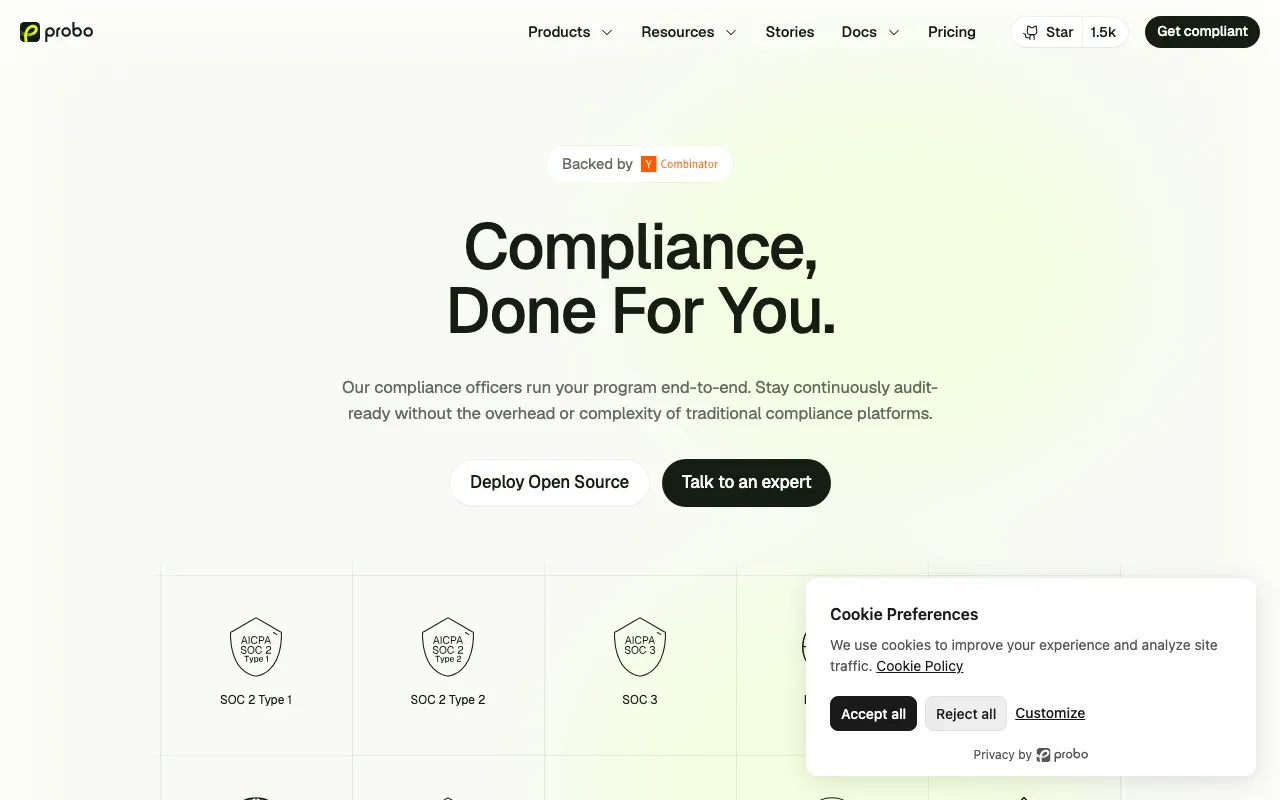
Self-hostable governance, risk and compliance platform covering risks, controls, vendors, privacy, access reviews, audits and document approvals, with a web console, CLI, GraphQL API and MCP API for automation.
Probo is a governance, risk, and compliance (GRC) platform aimed at engineering and security teams. It covers risk identification, control tracking, vendor risk, data privacy, access reviews, audit programs, and document approval workflows, and is used for frameworks such as SOC 2, ISO 27001, GDPR and HIPAA.
Every entity in the platform can be reached through a web console, a command-line client called prb, a GraphQL API, and a Model Context Protocol (MCP) API with 270+ tools. This lets compliance work be scripted or handed to MCP-compatible LLM agents that read and write GRC data, draft policies or generate evidence packs. A community node for n8n adds no-code automation over the GraphQL API.
Feature areas include a risk register with inherent and residual scoring, a control library with maturity levels and Statement of Applicability, vendor inventory with DPA/BAA tracking, DPIA and transfer impact assessments, access review campaigns, audit scoping and finding tracking, evidence collection, versioned documents with approval quorums and electronic signatures, a public compliance page with NDA management, and cookie banner and consent management.
For auditability it offers policy-based RBAC, immutable audit logs and evidence chains. It can be self-hosted with Docker Compose or Kubernetes. The backend uses Go and PostgreSQL, and the frontend uses React. The company also offers a managed service in which compliance officers run the program for customers.
Agentless security auditing for Unix-like systems
Lynis runs on the host to scan Linux, macOS, and other UNIX systems for hardening gaps, vulnerable packages, and compliance issues.

Unified metadata context layer for data and AI workflows
OpenMetadata is a platform that unifies technical metadata, quality signals, lineage, semantics, and organizational memory into one graph for people and AI agents.

Multi-cloud security scanning with CLI and local console
Prowler runs thousands of configurable cloud and SaaS checks, maps results to compliance frameworks, and can be used from CLI, API, or a self-hosted web UI.

Database governance for schema changes, access and compliance
Bytebase is a control plane between people, AI agents and databases. It unifies change review, access rules and audit logging across many database engines.

General-purpose policy engine with declarative Rego rules
Open Policy Agent centralizes authorization and policy decisions across your stack. Services query OPA instead of hardcoding rules, using the Rego language and JSON input data.

Pluggable SDK for detecting and anonymizing sensitive data
Presidio finds and de-identifies personally identifiable information in text, images, and structured data. Teams plug in recognizers, connect external models, and run flows in Python, Spark, Docker, or Kubernetes.