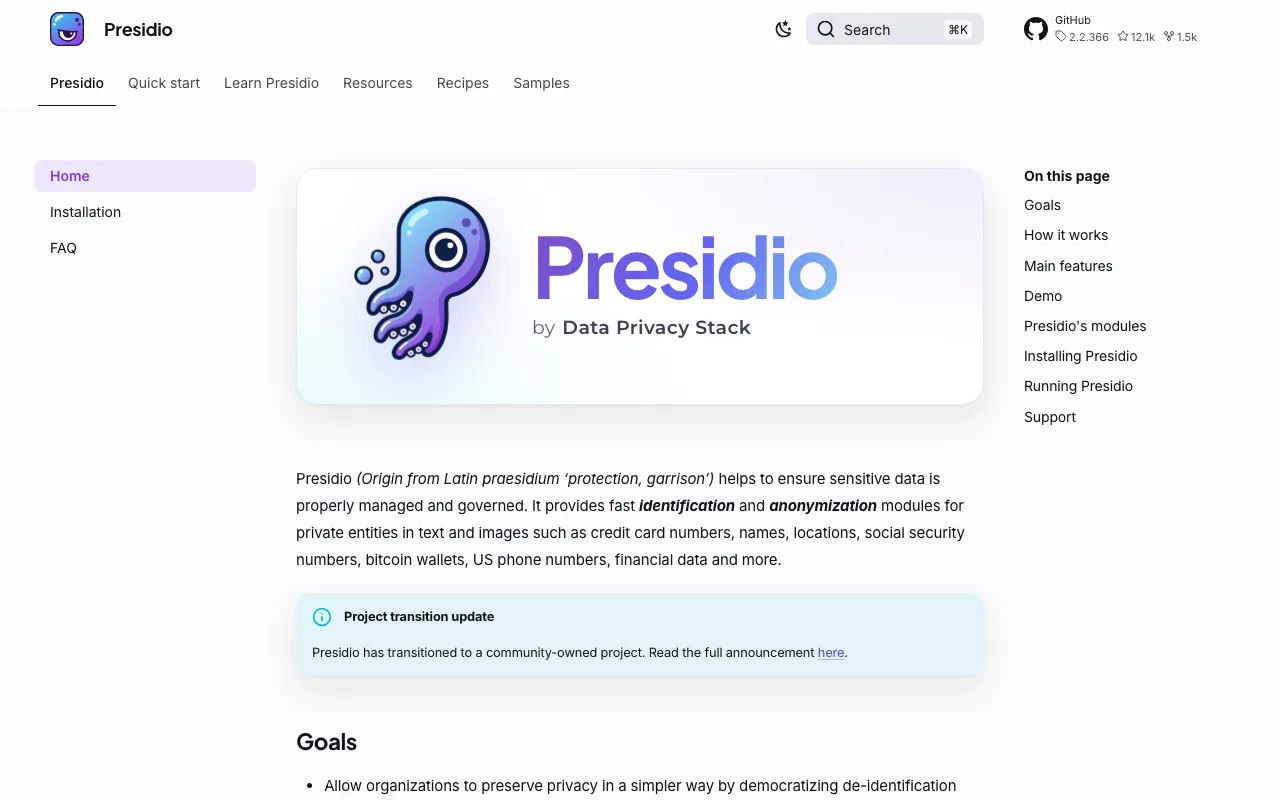
Presidio finds and de-identifies personally identifiable information in text, images, and structured data. Teams plug in recognizers, connect external models, and run flows in Python, Spark, Docker, or Kubernetes.
Overview
Presidio is a data protection SDK from the Data Privacy Stack community. It helps organizations spot private entities such as names, locations, payment and government identifiers, phone numbers, and financial strings, then mask, redact, or otherwise anonymize them.
Recognition combines named entity recognition, regular expressions, checksums, and rule-based logic with language context. Operators can use predefined recognizers or custom ones, and can wire in external PII detection models. Separate modules analyze text, anonymize findings, redact text in images (including DICOM), and handle structured or semi-structured data.
You can embed Presidio in application code or batch jobs, run it under Docker or on Kubernetes, or expose it as an HTTP service for remote calls. Documentation covers automated and semi-automated de-identification pipelines. The project warns that automated detection cannot guarantee every sensitive item is found, so additional controls may be needed.
Presidio moved to community ownership under the Data Privacy Stack. Automated detection is one layer in a broader privacy program rather than a standalone compliance guarantee.
Key features
- Text PII detection and anonymization
- Image and DICOM redaction
- Structured data PII module
- Custom and built-in recognizers
- External model integration
- Python and PySpark workloads
- Docker and Kubernetes deployment options
- Multi-language NER and pattern matching
Use cases
- Redacting logs and documents before sharing
- De-identifying medical images and records
- Privacy pipelines in data engineering jobs
- Semi-automated compliance review flows
- Masking sensitive fields in unstructured text