
MarkItDown
Python utility converting office and media files to Markdown
MarkItDown converts many file types into Markdown for LLM and text analysis pipelines. It aims to preserve headings, lists, tables, and links rather than perfect human layout.

Unified metadata context layer for data and AI workflows
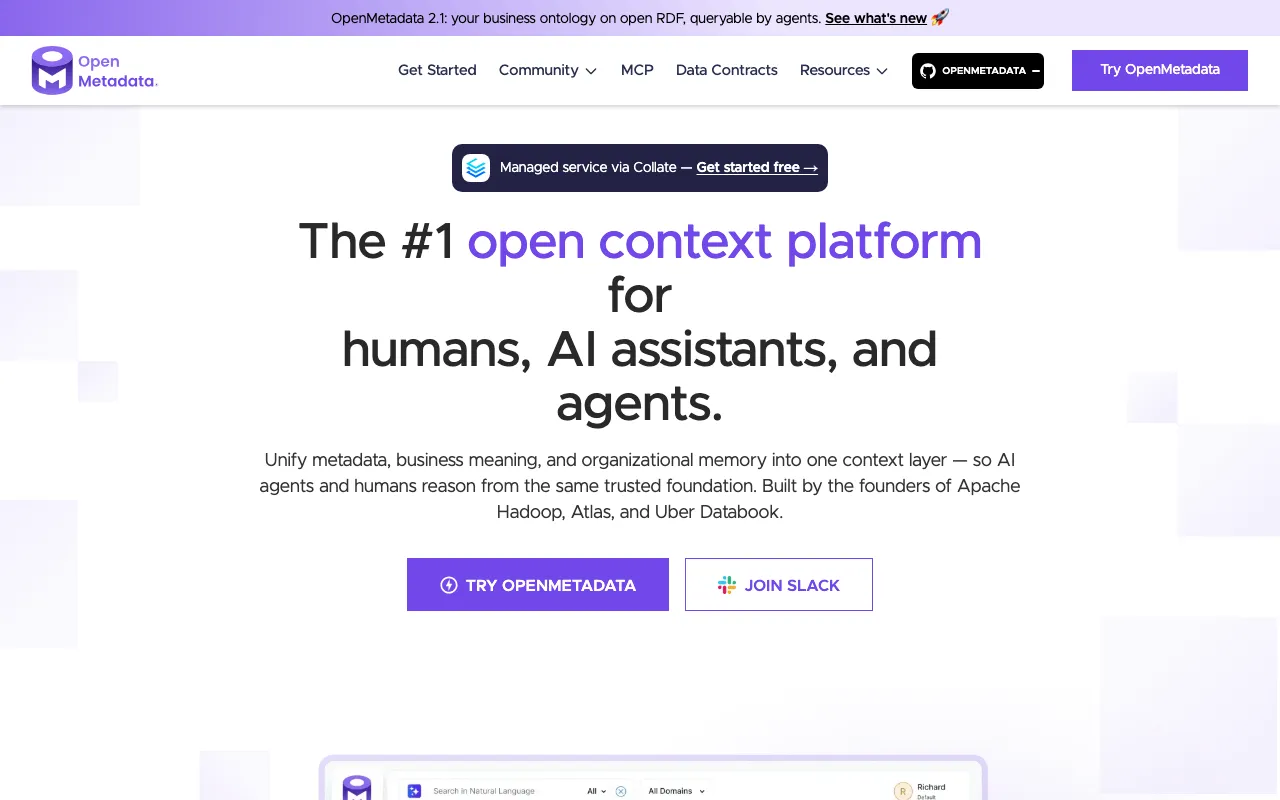
OpenMetadata is a platform that unifies technical metadata, quality signals, lineage, semantics, and organizational memory into one graph for people and AI agents.
OpenMetadata is built as an open context layer for enterprise data. It pulls together technical metadata, data quality checks, lineage (including column-level lineage), ownership, usage, policies, glossaries, classifications, metrics, domains, data contracts, and data products into a single metadata knowledge graph.
Ingestion is designed around many connectors to warehouses, lakes, BI tools, pipelines, ML platforms, messaging, storage, APIs, and related systems. Normalized schemas and open standards help represent assets, relationships, policies, lineage events, and stored conversational or operational memory consistently.
The product emphasizes semantics for business meaning—glossaries, KPIs, ontologies, and data products—and governance through owners, stewards, roles, certifications, and review workflows. Activation paths include semantic search, REST APIs, SDKs, events, webhooks, an MCP server, and AI-oriented SDK packages.
Memory features attach conversations, decisions, runbooks, and remediation notes to assets so tribal knowledge stays searchable and governed. Teams can deploy OpenMetadata in their own environment or use hosted offerings described on the project site.
Python utility converting office and media files to Markdown
MarkItDown converts many file types into Markdown for LLM and text analysis pipelines. It aims to preserve headings, lists, tables, and links rather than perfect human layout.

Open-source data integration platform for analysts, quants and AI agents
Open Data Platform (ODP) by OpenBB connects proprietary, licensed and public data sources once, then exposes them to Python, OpenBB Workspace, Excel, MCP servers for AI agents, and REST APIs.

Document parsing toolkit for generative AI pipelines
Docling ingests PDFs, office files, media, email, and many other formats into a unified document model. It targets downstream RAG and agent workflows with local execution options.

Python data structures for labeled analysis
pandas is a Python package for working with labeled, tabular, and time-series data. It provides Series and DataFrame objects with alignment, grouping, and rich import and export options.
Open RSS feed network with community-maintained routes
RSSHub aggregates content from many online sources into RSS feeds and is maintained as an open source project with a large network of deployed instances.
Portable command-line JSON processor
jq slices, filters, maps, and transforms JSON from the shell. It is a standalone C binary with no runtime dependencies, plus an online playground and optional Docker image.