
XiaoZhi ESP32
ESP32 voice chatbot firmware using MCP
XiaoZhi AI is voice-interaction firmware for ESP32 boards. It uses large models such as Qwen or DeepSeek and controls devices through the MCP protocol.

On-device wake word and keyword spotting engine
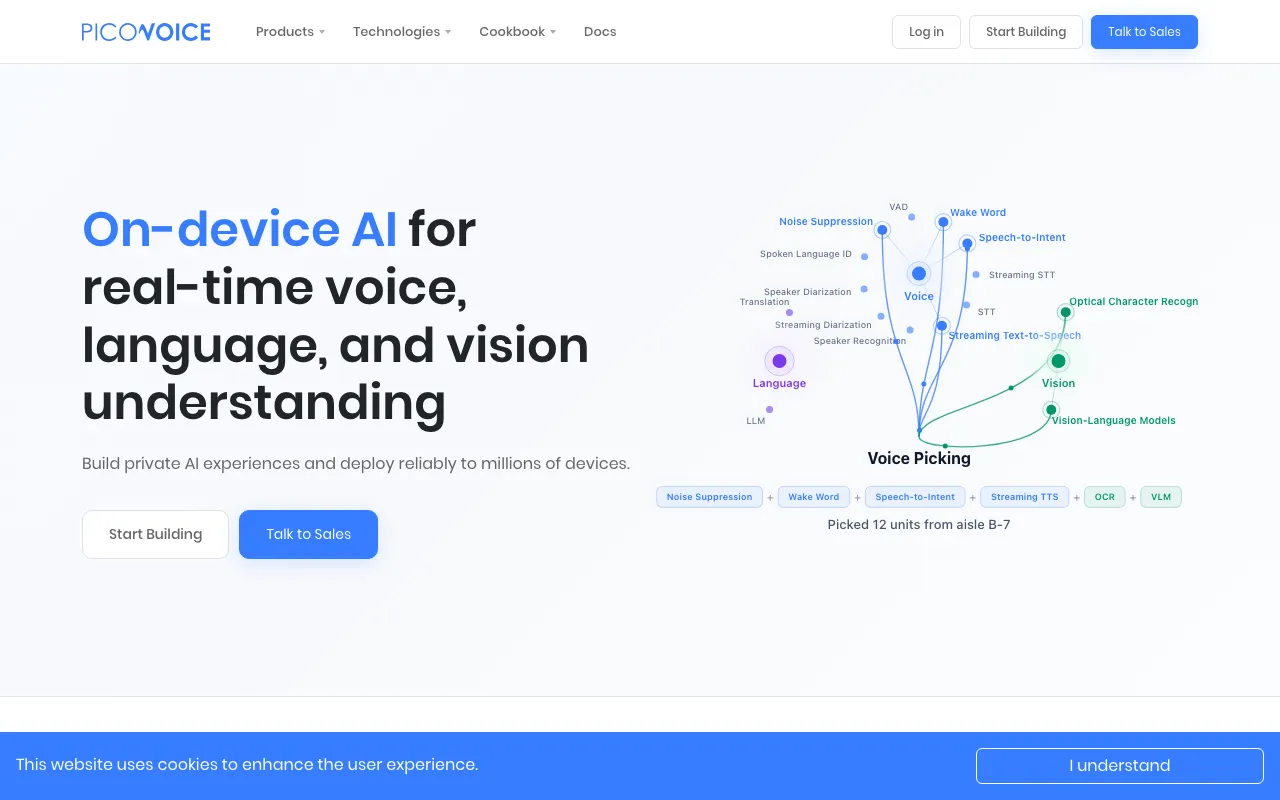
Porcupine is Picovoice’s wake word engine for always-listening voice apps. It spots fixed spoken commands on the device using compact neural models, without sending audio to the cloud.
Porcupine listens continuously for one or more predefined wake words or short voice commands. Picovoice trains the models for real-world noise and runs inference on-device so latency stays low and audio stays local.
Developers integrate it through SDKs for Python, .NET, Java, Flutter, React Native, Android, iOS, web, Node.js, C, and microcontrollers. Built-in keywords ship with the libraries; custom wake words can be trained in Picovoice Console and loaded from generated keyword files.
The engine targets phones, desktops, browsers, Raspberry Pi boards, and embedded targets such as Arm Cortex-M and STM32. Multiple wake words can run in parallel with little extra runtime cost. English, Chinese, French, German, Italian, Japanese, Korean, Portuguese, and Spanish are supported out of the box.
Picovoice positions Porcupine for static always-listening triggers. Broader voice-assistant stacks or natural-language intent parsing are handled by other Picovoice products such as the wider platform or Rhino Speech-to-Intent.
ESP32 voice chatbot firmware using MCP
XiaoZhi AI is voice-interaction firmware for ESP32 boards. It uses large models such as Qwen or DeepSeek and controls devices through the MCP protocol.

Realtime voice AI stack for ESP32 toys and devices
ElatoAI connects ESP32 hardware to many STT, LLM, and TTS providers over secure WebSockets for speech-to-speech agents and custom characters.
Desk robot showing AI coding agent activity
Tiny Engineer is a small open-source desk robot that moves, changes its face, and rings to mirror your AI coding agent. It connects over Wi-Fi or USB to tools like Claude Code and Cursor

Open-source personal AI assistant running on your devices and chat apps
Open-source AI assistant that runs on your own computer and answers in chat apps such as WhatsApp, Telegram, Slack and Discord. State, memory and credentials stay on your hardware.

Open-source plugin-based agent harness from DeepSeek
DeepSeek Harness is an open-source agent harness built on an everything-is-a-plugin architecture powered by Cordis. It offers a web UI, desktop app, and extensible plugins for daily work, coding, and automation.

Self-improving open-source AI agent with memory, skills and messaging gateway
Open-source AI agent from Nous Research that keeps persistent memory, creates skills from experience, and runs from a terminal, desktop app or messaging platforms with any model provider.
 ChatGPT
 Anthropic Claude