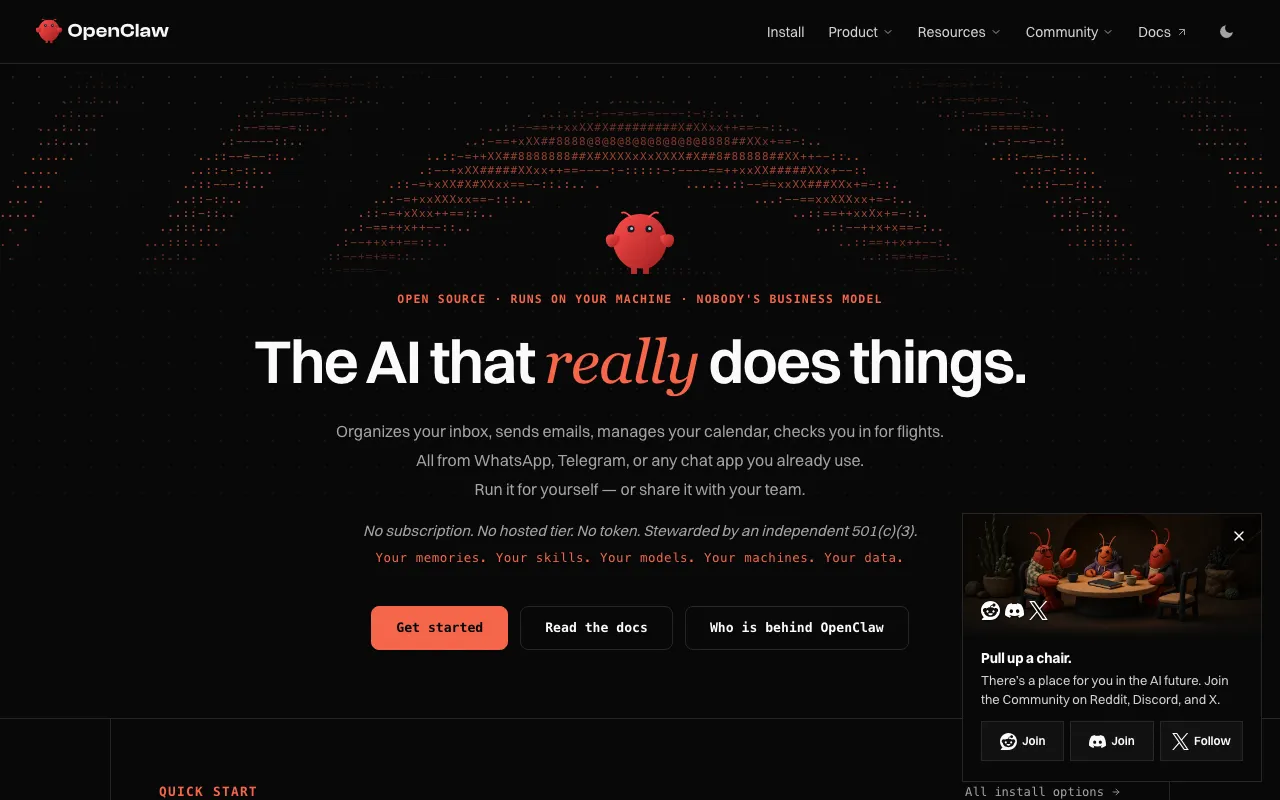
Open-source AI assistant that runs on your own computer and answers in chat apps such as WhatsApp, Telegram, Slack and Discord. State, memory and credentials stay on your hardware.
Overview
OpenClaw is an open-source AI assistant that runs on your own computer. You talk to it through the messaging channels you already use, including Discord, iMessage, Slack, Teams, Telegram, WhatsApp and more than 20 others. Native apps exist for macOS, iOS, Android, Windows and Linux. One Gateway can serve as a personal assistant on a laptop or as a shared assistant for several people. Only the configuration differs.
The Gateway is the local control plane for sessions, tools, events and channel connections. The Control UI, CLI and TUI connect to it. Companion apps and nodes add voice, Canvas, camera, screen and device-local actions on supported platforms. Tools, skills and plugins extend what the assistant can do. New capabilities usually go into plugins shared through ClawHub.
State, memory and credentials are stored on your hardware. Models and agent harnesses, such as Claude, Codex and local models, are plugins you can swap without changing the rest of the setup. Prompts go to the model providers and chat platforms you configure. By default OpenClaw itself only makes a daily version check, and anonymous feature statistics are opt-in.
You can install it with a one-line installer script, an npm package, desktop apps, Docker or Nix. An onboarding wizard verifies model access, creates the workspace and configures the Gateway. For security, DM-capable channels pair unknown senders by default. Tools run on the host for the main session unless you configure sandboxing.
The project is stewarded by the OpenClaw Foundation, an independent 501(c)(3). It has no paid tier, hosted service or token.
Key features
- Works in 20+ chat channels such as WhatsApp, Telegram, Slack and Discord
- Native apps for macOS, iOS, Android, Windows and Linux
- Gateway control plane with Control UI, CLI and TUI
- Swappable model providers and agent harnesses, including local models
- Plugins, tools and skills shared through ClawHub
- Voice, Canvas, camera and screen actions through companion nodes
- Pairing approval for unknown senders in DMs
- Optional sandboxing for tool execution
Use cases
- Personal assistant reachable from your chat apps
- Shared assistant for a team on one Gateway
- Running an AI agent with local models and private data
- Automating inbox, email and calendar tasks from chat
Does the same job as
OpenClaw doesn't name these products itself, but its own description shows it does the same job.
 ChatGPT
 Claude Cowork