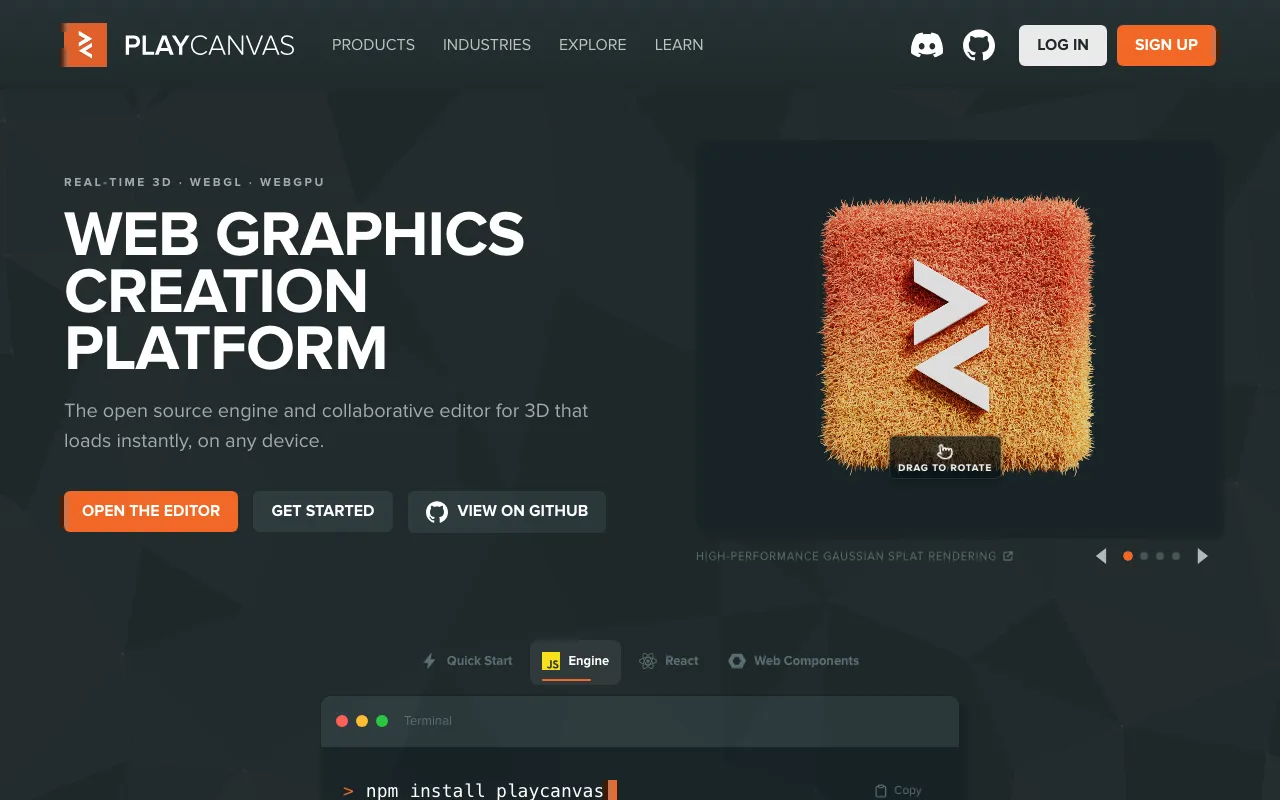
A browser graphics engine for interactive 2D and 3D apps, games, and visualizations on WebGPU and WebGL2. It ships as an npm package with TypeScript types and optional scaffolding via create-playcanvas.
Overview
PlayCanvas Engine targets experiences that run in the browser on phones, tablets, and desktops without a native install. Teams use it for games, data visualizations, XR scenes, and UI-heavy 3D interfaces that need broad device reach.
Rendering covers physically based materials, clustered lighting, soft shadows, HDR post-processing, GPU particles, text and image UI, skeletal and property animations, and WebXR for AR and VR. It includes first-class loading and rendering paths for 3D Gaussian splats and WebGPU compute where supported, while retaining WebGL2 fallback.
Input APIs cover mouse, keyboard, touch, and gamepads, with 3D positional audio on the Web Audio API. Behaviors can be written in JavaScript or TypeScript. Documentation, API references, examples, and agent-oriented guides support integration via npm bundlers or CDN import maps.
The engine is one piece of a broader PlayCanvas ecosystem that also offers an online editor and hosting; this package focuses on programmatic use in custom projects.
Key features
- WebGPU and WebGL2 rendering
- Physically based materials and lighting
- 3D Gaussian splat support
- HDR post-processing pipeline
- WebXR AR and VR
- GPU particles and animation
- TypeScript and script components
- 2D and 3D UI elements
Use cases
- Browser-based 3D games
- Product and vehicle configurators
- Architectural walkthroughs
- Playable web advertisements
- Immersive XR training scenes




 Ionic Enterprise


