qmetrics.net

Pint

Python physical quantities and unit conversion

Frameworks & PlatformsDesktop/CLI app
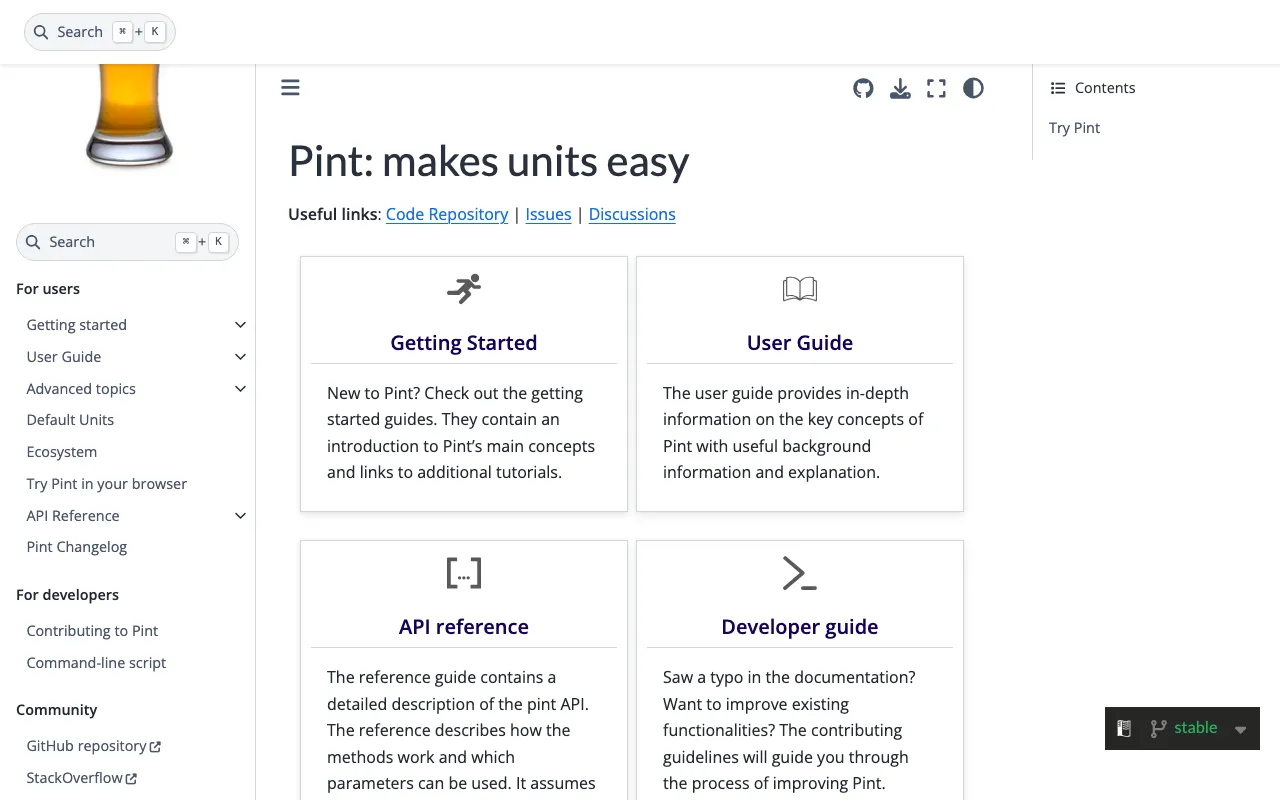
Pint screenshot

Pint defines and manipulates physical quantities in Python, combining numbers with units for arithmetic and conversion. It ships with a broad built-in unit registry and optional NumPy, pandas, and uncertainties integration.

Overview

Pint lets Python code treat measurements as values paired with units: you add, subtract, multiply, and convert quantities without manual factor tracking. A UnitRegistry loads definitions from an editable text file, recognizing prefixed and pluralized unit names when base units are defined.

The package includes physical units, prefixes, and constants out of the box, and you can extend or replace definitions without changing library code. Conversions cover ordinary dimensions and non-multiplicative units such as absolute temperature offsets. Quantities can wrap floats, decimals, fractions, or NumPy arrays; NumPy ufuncs respect dimensions when arrays are used.

Formatting supports PEP 3101-style quantity strings with optional symbolic, LaTeX, or pretty output when Babel is present. A pint-convert command-line script converts between units or prints conversion factors. The pint-pandas extension adds unit-aware pandas columns and DataFrame operations.

Pint runs on modern Python with minimal core dependencies and interacts with NumPy, uncertainties, and pandas only when those packages are installed. It is maintained as a community scientific utility for engineering and research scripts.

Key features

  • UnitRegistry quantity arithmetic
  • Editable unit definition files
  • Prefix and plural unit parsing
  • NumPy-aware operations
  • Temperature offset conversions
  • pint-convert CLI converter
  • pandas extension types
  • uncertainties package support

Use cases

  • Scientific calculation with units
  • Safe unit conversion in scripts
  • NumPy arrays with dimensions
  • pandas columns with physical units

Tags

Similar software

ECC

Open-source agent engineering toolkit for coding harnesses

ECC adds planning, verification, review, memory, skills, and security scanning to coding agents such as Claude Code, Codex, and Cursor. It installs as plugins, packages, and managed adapters across multiple harnesses.

★ 311.7k⟳ 8 days agoMIT
Frameworks & PlatformsDesktop/CLI app

React

JavaScript library for web and native user interfaces

React helps developers build interfaces from reusable components that manage their own state. Views update declaratively when underlying data changes.

★ 253k⟳ 2 days agoMIT
Frameworks & PlatformsDesktop/CLI app

Flutter

Open-source UI framework for multi-platform apps from one codebase

Flutter is an SDK for building user experiences for mobile, web, and desktop from a single codebase. It uses the Dart language and compiles to native machine code or web targets.

★ 181.5k⟳ todayBSD-3-Clause
Open Source Alternative to:Ionic Enterprise

Bootstrap

Responsive HTML, CSS, and JavaScript front-end toolkit

Bootstrap supplies CSS, JavaScript, and Sass-based styles for building responsive, mobile-first sites. It ships prebuilt grid layouts, UI components, and optional JavaScript plugins.

★ 175.1k⟳ 2 days agoMIT

Langflow

Visual low-code builder for AI agents and workflows

Langflow is a visual builder for AI agents and workflows. Flows can be customized in Python and deployed as an API or as an MCP server, with support for major LLMs and vector databases.

★ 157k⟳ todayMIT
Open Source Alternative to:Relevance AIVoiceflow

LangChain

Framework for agents and LLM-powered applications

LangChain helps developers chain interoperable components and integrations to build agents and LLM-powered applications. It offers a standard interface for models, embeddings, vector stores, and related pieces.

★ 150.1k⟳ 2 days agoMIT





