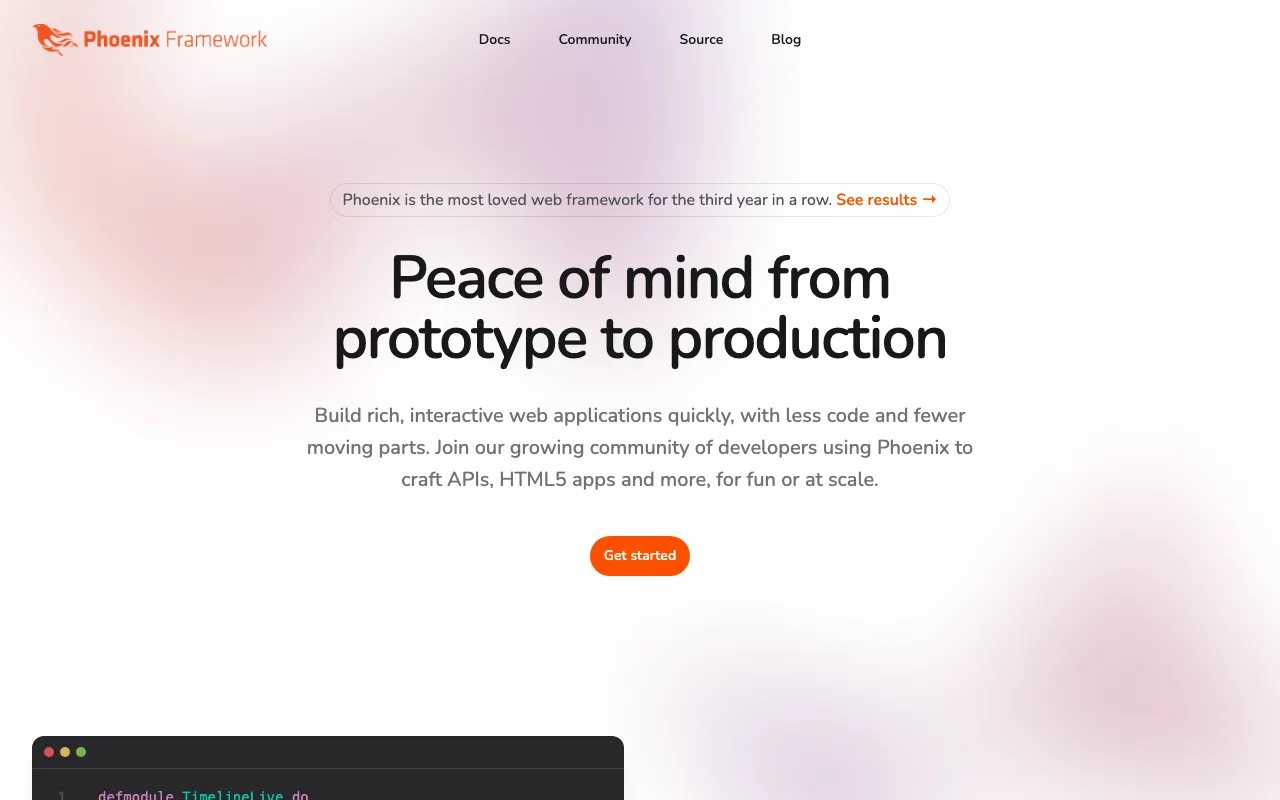
Phoenix is an Elixir web framework for building APIs, HTML5 applications, and interactive interfaces. It emphasizes real-time features, structured authentication, and integrated observability.
Overview
Phoenix gives Elixir teams a full-stack foundation for web products that need low-latency interaction and predictable operations. Projects start from a generator that scaffolds applications, and developers extend them with controllers, contexts, and templates written in HEEx, which mixes HTML with embedded Elixir and reusable components.
LiveView is a central piece for building dynamic pages without a separate single-page application stack. Server processes handle events, stream updates to browsers, and coordinate presence information across clustered nodes using built-in PubSub and Channels.
For persistence, Phoenix pairs with Ecto as the database layer, with support described for Postgres, MySQL, SQLite, and SQL Server. Authentication can be generated via a built-in generator task, and JSON or GraphQL APIs are supported through native JSON tooling or the Absinthe integration mentioned on the site.
Operational tooling includes optional Docker packaging for deployments, instrumentation with a live metrics dashboard, and WebSocket scaling on the Erlang VM. Documentation and API references are published on the official Phoenix sites for the core framework and Phoenix.js client library.
Key features
- HEEx templating with components
- Phoenix LiveView real-time UI
- PubSub and Channels messaging
- Built-in Presence tracking
- mix phx.gen.auth scaffolding
- Ecto database integration
- Live observability dashboard
- Optional Dockerfile generation
Use cases
- Real-time collaborative web apps
- JSON and GraphQL API backends
- Interactive dashboards with LiveView
- Clustered WebSocket services
- Full-stack Elixir product development




 Ionic Enterprise


